 Guide On Map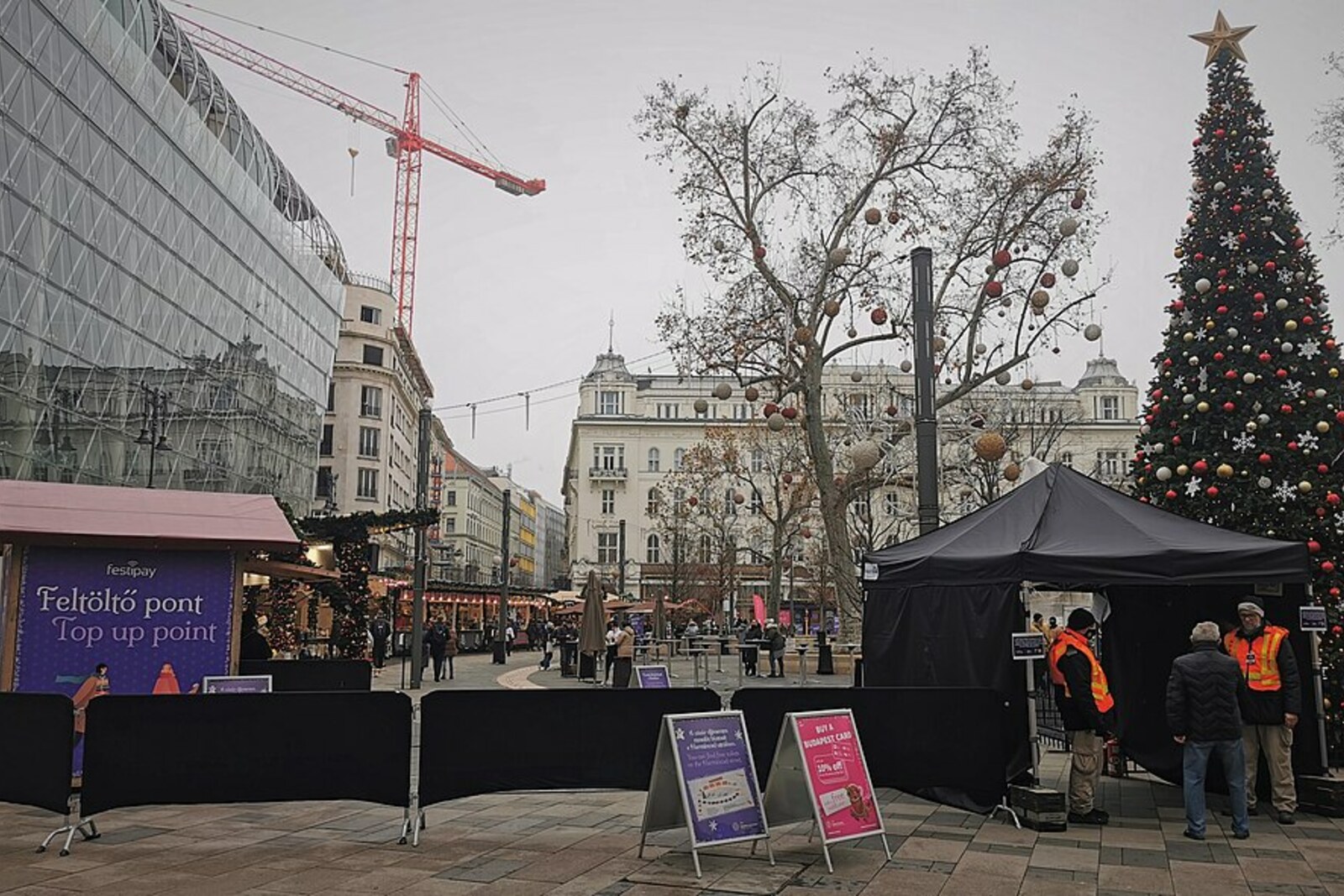
Look around first
What to notice
- White marble group
- Seated figure of the poet
- Carved line
- Dark coin in pale stone
The story of the place
The square was once named after Gisela, daughter of Emperor Franz Joseph I. Its present name came from the poet Mihály Vörösmarty, seated amid a marble crowd: a worker with a hammer, a peasant, a schoolboy, a mother with an infant, a student, and a man in festive Hungarian dress. The sculptors chose white Carrara marble for this group, and in the middle of the open square the poet found himself among people of different occupations and ages.
Beneath the square's granite paving lie connection points for fair pavilions. They were installed during the redesign in two thousand nineteen: seasonal trade here is built into the very layout of the space. At the center of the fair stalls stands a white marble group—the very group that explains the square's name.
Seated above the other figures is Mihály Vörösmarty, the Hungarian poet who wrote Appeal. In the mid-eighteen thirties, the Viennese court dissolved the Transylvanian Diet, put one of the leaders of the Hungarian opposition on trial, and ordered the opposition suppressed in the counties. Vörösmarty answered with a poem about remaining faithful to one's homeland even in the face of the country's possible destruction. After publication, it was learned by heart, and in eighteen forty-three the text was set to music. During the revolution of eighteen forty-eight, Hungarian soldiers sang the song.
Defeat changed the poet's attitude toward his own lines. When people told him that the destruction he had predicted had already come to pass, Vörösmarty objected angrily. In one surviving copy, he crossed out the two bleakest stanzas in his own hand. Yet the opening words of Appeal continued to be sung as a second Hungarian anthem—it was for those words that the poet received a monument and then gave the square its name.
In nineteen hundred, the journalist Jenő Rákosi, chairman of Budapest's club of writers and journalists, undertook to secure a monument to Vörösmarty in the capital. He wanted Appeal to be performed one day before an image of its author. The city offered the committee Gizella Square—this was what the place was then called, in honor of Gisela, daughter of Emperor Franz Joseph I. Raising the money, holding two competitions, and making the monument took eight years.
Among the donations came a letter from Ungvár—the name then used for what is now Uzhhorod. It was written by János Liskai, a former bank director and merchant who had lost his fortune after the Vienna stock-market crash and was living on charitable assistance from a church. From his former life, he still had a silver twenty-kreuzer coin, given to him by his mother. Liskai gave it to the committee and asked for it to be melted into the future monument: then, he wrote, no one would ever steal his last treasure.
The sculptors Ede Kallós and Ede Telcs, who won the competition, chose Carrara marble rather than bronze for the monument. Fulfilling Liskai's request literally became impossible. Rákosi and Mayor István Bárczy then ordered the coin to be set into the base in a conspicuous but inaccessible place.
Kallós and Telcs surrounded the seated Vörösmarty with people singing or listening to Appeal. A worker set down his hammer and embraced his wife and son; beside them stand a peasant, a schoolboy, a mother with an infant, a student, and a man in formal Hungarian dress. On May twenty-fourth, nineteen hundred eight, the square filled with spectators, a university choir accompanied by four French horns performed the song, and Rákosi handed the monument over to the city. Eighteen years later, the former Gizella Square was named Vörösmarty Square.
Below the carved line, “Be steadfastly faithful to your homeland, Hungarian,” a small dark spot is visible in the pale stone. It is János Liskai's blackened silver coin—placed precisely where it cannot be taken away.
Useful on site
Open city square; check the schedules of cafés, fairs, and events separately.
Checked: June 25, 2026. Check the official source before visiting.The square remains a lively public space; during events, view the monument from the accessible side, and treat a café visit as a separate stop.