 Guide On Map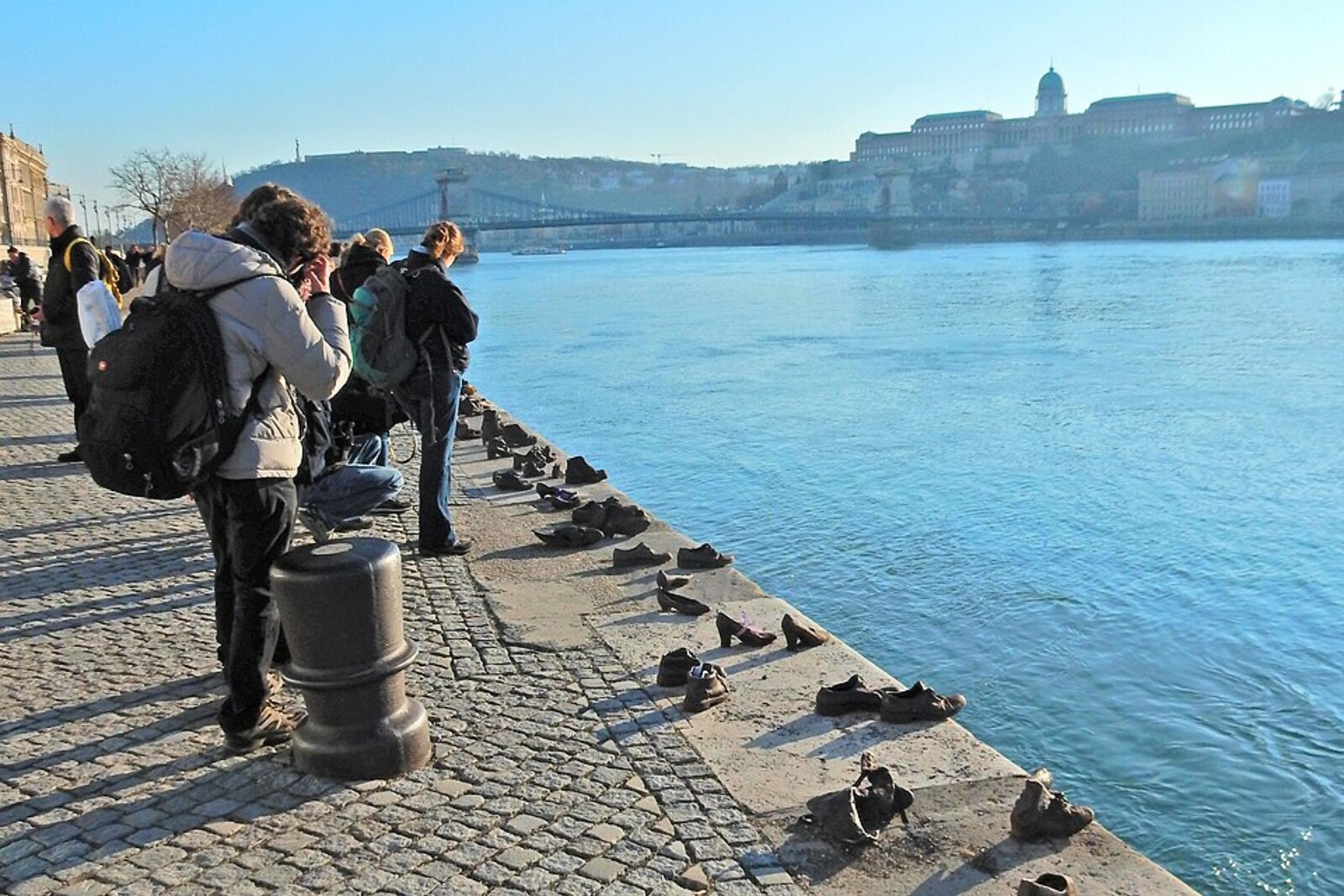
Look around first
What to notice
- Cast-iron men's boots
- Women's shoes
- Children's shoes
- Stones, flowers, and candles
The story of the place
Right by the water lie cast-iron shoes of different sizes: men's, women's, and children's; iron rods hold each pair in the stone. In two thousand five, the memorial was assembled from shoe models from the nineteen forties, which sculptor Gyula Pauer found specifically for this work. The sixty pairs are not tied to identified victims and do not indicate individual shooting locations: the killings took place along different stretches of both banks, and this edge of the embankment was chosen because the current carried away the bodies. Stones, flowers, and candles are now left in the empty shoes and boots.
First, people were forced to take off their shoes. In wartime Budapest, good shoes were valuable property: they could be worn or sold. Armed members of the Arrow Cross Party ordered victims to leave their boots and shoes on the stone, sometimes ordering them to place confiscated watches and jewelry inside them. The killers took it all after the shooting.
The Arrow Cross Party was a Hungarian fascist movement. On October fifteenth, nineteen forty-four, it took control of the country with Germany's support. Its units searched Budapest for Jews, burst into homes and hospitals, and took people out of the ghetto and out of houses under the protection of neutral embassies. Men, women, elderly people, and children were driven to the Danube in groups of about fifty.
At the edge of the embankment, people were made to face the water and shot so that their bodies fell into the river. Sometimes two or three people were tied together and only one was shot: the dead body pulled the others under. If anyone surfaced, they were shot again from the bank. The current carried away the bodies, so many of those killed were left without an established grave.
The sixty pairs before us do not belong to one discovered group and do not mark the place where each particular person stood. Shootings took place along different stretches of the Pest and Buda banks. This section of the embankment was chosen symbolically: the killing was carried out at the water precisely because the river immediately carried away the bodies. A spatial connection to the crime has survived here, but there are no physical traces of the shootings themselves.
In two thousand five, director Can Togay and sculptor Gyula Pauer returned to the bank what had remained after the victims—empty shoes. Pauer found authentic shoe models from the nineteen forties and used them to make men's boots, women's shoes, and children's shoes. He linked the number of pairs to the usual size of the groups driven to the river. The composition was unveiled on April sixteenth, and the cast-iron shoes were fixed with iron rods into the stone edge of the embankment.
The victims' actual shoes were taken by the killers. Memorial stones, flowers, and candles are now placed in the cast-iron pairs that appeared here sixty years later.
Useful on site
Open waterfront space; behave as you would at a memorial, not as at a photo spot.
Checked: June 25, 2026. Check the official source before visiting.Do not stand inside the composition or move the items that have been left there; give other visitors time to be silent at the memorial.