 Guide On Map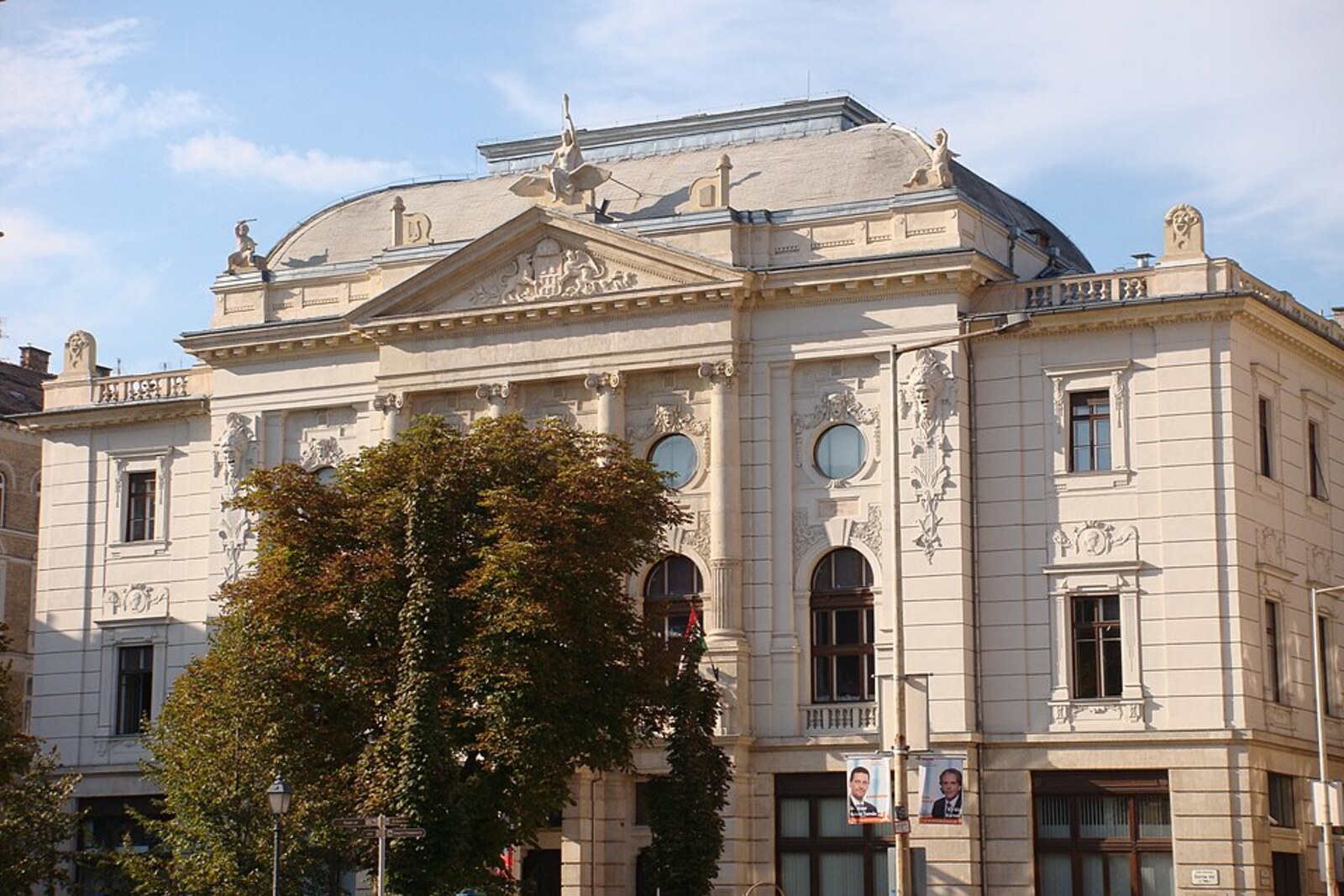
Look around first
What to notice
- Pesti Vigadó façade
- Main entrance
- Buda Castle on the opposite bank
The story of the place
The Hungarian word “vigadó” means a place for festivities and entertainment. Concerts, exhibitions, and ceremonial gatherings still take place in the present concert hall, and part of its premises is occupied by the Hungarian Academy of Arts. The building opened in eighteen sixty-five on the site of the Redoute, the city’s house for balls and concerts. The façade with the main entrance faces Buda Castle across the Danube.
On July eleventh, eighteen forty-eight, Lajos Kossuth was almost led into the large ballroom that stood on this site. He was pale, ill, and barely able to stand. Kossuth was the finance minister in the new Hungarian government and was about to ask the deputies for two things the government barely had: soldiers and money.
Hungary still remained part of the Habsburg Monarchy. Laws passed in the spring made ministers responsible to an elected parliament, but the treasury was almost empty, and the imperial regiments could not be relied upon with confidence. Fighting was already under way in the south. Kossuth sought permission to raise two hundred thousand men and obtain forty-two million forints to arm them.
The session was held in a concert hall for the simple lack of space. Buda and Pest were still separate cities, and no purpose-built parliament building existed in Pest. The lower house was given the main hall of the Redoute—the name of the city’s house for balls and concerts, opened in eighteen thirty-three and the predecessor of today’s Pesti Vigadó.
The deputies suggested that the weakened Kossuth speak while seated, but he remained at the lectern. When the minister finished, the representatives rose and shouted, “We give!” The proposal was adopted. Yet two hundred thousand soldiers did not appear at a single shout. Implementing the decision required the monarch’s approval, and that approval was delayed. Before mass recruitment began in September, the government managed to form only two of the four planned additional battalions. Kossuth became head of the National Defence Committee and continued raising an army during the war.
In the spring of the following year, Hungarian troops were commanded by Artúr Görgei, who sought to retake Buda Castle. Before the siege, he warned its commander, Heinrich Hentzi, in writing that the fortress would not be shelled from the Pest side and that it must therefore not answer with fire against the civilian city and the Chain Bridge. Hentzi was determined to hold the garrison and demanded that the shelling of the fortress walls cease. He then ordered his artillerymen to fire across the Danube.
The fortress was indeed not fired upon from the Pest bank. Nevertheless, the shelling continued almost daily and was especially heavy on May ninth and thirteenth. The artillerymen directed incendiary shells, among others, at the row of houses along the Danube. About seventy residents were killed, and dozens of buildings were destroyed. The Redoute, where the deputies had approved the creation of an army ten months earlier, burned down. By then the hall was already seen as the site of the first elected parliament, so its inclusion among the targets was not considered accidental.
The shelling did not save the garrison. On May twenty-first, Görgei’s men took the fortress; Hentzi was mortally wounded and died soon afterward. A few months later, Hungarian resistance was suppressed, and Kossuth left the country.
The old Redoute was not restored. In eighteen fifty-nine, the architect Frigyes Feszl received the commission for a new building, and the present hall opened here in eighteen sixty-five. It was given a Hungarian name: “vigadó” means a place for festivities and entertainment. Concerts, exhibitions, and ceremonial gatherings are again held inside today; the Hungarian Academy of Arts is also housed here.
The façade of today’s Pesti Vigadó faces Buda Castle. The very hall where Kossuth asked for soldiers and the deputies rose from their seats is not behind this façade: it remained in drawings, then disappeared under shelling from the opposite bank.
Useful on site
The official website on the day of checking showed 10:00-19:00; check the program, floors, and access to events separately.
Checked: June 25, 2026. Check the official source before visiting.This account is intended to be followed from the street. Arrange a concert, exhibition, or visit to the halls according to Pesti Vigadó’s current program.