 Guide On Map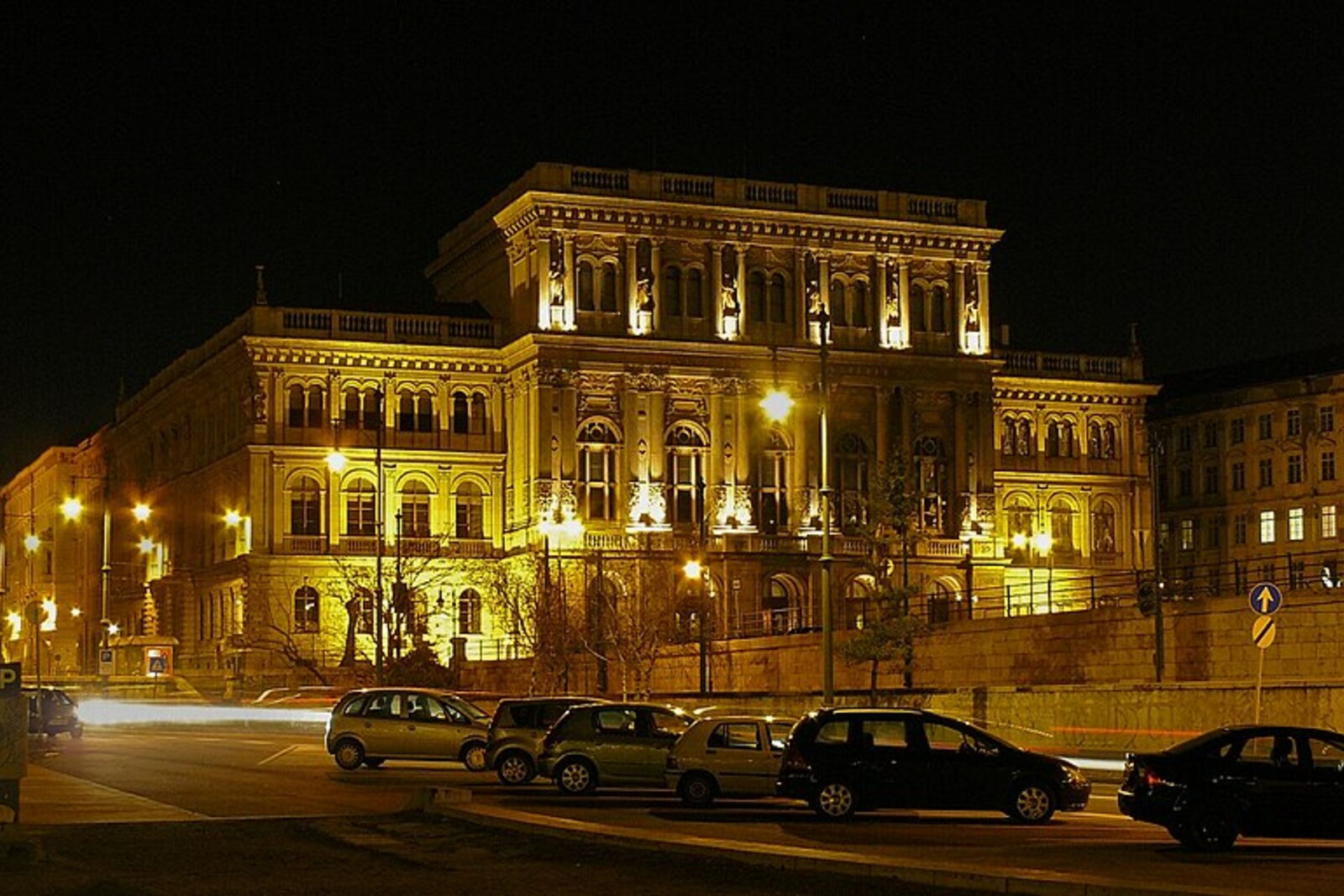
Look around first
What to notice
- Arched windows
- The inscription “Founded by patriots”
- The inscription “Raised by the nation”
The story of the place
Above the arched windows of the facade, the words “Founded by patriots” and “Raised by the nation” can be read. The scholarly society grew out of donations for the development of the Hungarian language and scholarship, and its permanent home was built with money collected across the country. General meetings of the Hungarian Academy of Sciences are still held in the ceremonial hall. Behind this facade are offices, archives, and rooms for scholarly work.
Behind the windows of the northern part of the wing facing the Danube is a narrow room where, in September nineteen thirty-four, Béla Bartók spread out the books, phonograph recordings, and thousands of note cards he had brought from home. The famous composer came here as a researcher: he wanted to turn songs recorded in Hungarian villages into a scholarly collection in which related melodies could be recognized even when the words and manner of performance differed.
This plan was already more than twenty years old. In nineteen thirteen, Bartók and his colleague Zoltán Kodály, a composer and expert on old song manuscripts, proposed that the Kisfaludy Society prepare a critical edition of about three thousand four hundred folk melodies. The project did not move forward. Meanwhile, collectors continued traveling through the villages, and the number of recordings grew.
In nineteen thirty-three, the board of the Hungarian Academy of Sciences finally decided to prepare a complete edition. By ministerial order, Bartók was released from teaching at the Academy of Music and transferred here to a separate post. Systematization became his job and source of income. He was given a room with a horseshoe-shaped desk; the staff called it the horseshoe room.
Bartók usually worked here three times a week, from two in the afternoon until seven, sometimes until eight. He listened again to the phonograph recordings, corrected his own transcriptions, and sorted the cards by rhythm, number of lines, endings of musical phrases, and the relationship of variants. New songs kept arriving, and it was impossible to complete a closed system while collectors continued adding to it. Bartók expected to finish in two years. The work took six. In nineteen thirty-eight, he set the boundaries of the collection by stopping the addition of new materials, and he classified about thirteen thousand recordings. Thanks to this system, researchers were able to distinguish several regions of the Hungarian song tradition and compare it with the music of neighboring peoples.
On October tenth, nineteen forty, Bartók gathered Kodály and three colleagues in the horseshoe room. Two days later, he was leaving for the United States. Bartók handed Kodály the entire collection: the classification of melodies was ready, but he had not managed to write the introduction to the edition or part of the editorial rules. The new system came as a surprise to Kodály. It took him weeks to understand it; in a letter sent after his departing friend, he reproached Bartók for explaining his decisions too late.
The war stopped the publication. Kodály first found a safe place for the cards and recordings, then assembled a new research group. Bartók died in New York in nineteen forty-five and did not see the printed continuation of his work. The first volume of Corpus of Hungarian Folk Music, devoted to children’s games, was published under Kodály’s supervision in nineteen fifty-one.
The scholarly society itself arose in eighteen twenty-five, when Count István Széchenyi donated the annual income from his estates to the development of the Hungarian language and scholarship. A permanent home for it was built with public donations and opened in eighteen sixty-five. Above the arched windows of the facade, this is written literally: “Founded by patriots” and “Raised by the nation.”
Today, general meetings of the Hungarian Academy of Sciences are held in the ceremonial hall, while the former horseshoe room serves as the office of its vice president. It cannot be seen from the street. Inside, a memorial plaque to Bartók hangs on the wall, and a bust of Kodály stands beside it—in the very room where one handed the collection—the first volume of which would not appear for another eleven years—to the other.
Useful on site
Exterior viewing is open as part of the square; interior access depends on Hungarian Academy of Sciences events and program.
Checked: June 25, 2026. Check the official source before visiting.Exterior viewing is sufficient for the route. Do not expect to enter the working and ceremonial rooms freely without a separate program.