 Guide On Map
Budapest Jewish Quarter: Courtyards and Memory
From Dohány Street Synagogue through Kazinczy Street and Gozsdu Courtyard to Rumbach Sebestyén Street
Guide On Map on your phone
Open the walk like a regular app
It takes about 10 seconds to install. No app store needed.
The whole path
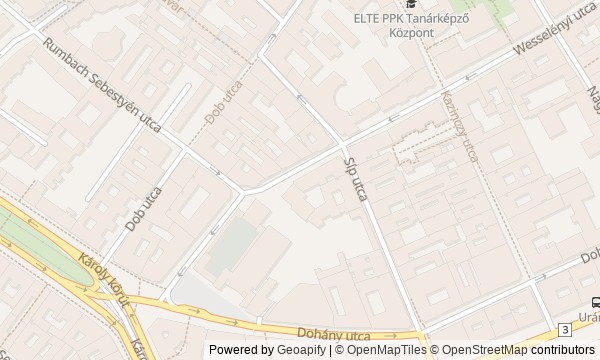
Route map
About the walk
You will begin at Dohány Street Synagogue and make your way through the courtyards and short streets of Erzsébetváros toward Kazinczy Street, Klauzál Square, Gozsdu Courtyard, and Rumbach Sebestyén Street. Along the way come active synagogues, a memorial garden, former apartments and a factory courtyard, a shopping arcade, and a parking lot beneath an enormous football scene.
The questions will emerge from small things. Why would tombstones remain in the courtyard of a house of prayer? Why would families need metal leaves? Why would no one take the first rabbi's chair? And why would the wall with a great match leave out the goal itself?
The story will be calm and documentary in tone. It will distinguish testimony, memory, and the memorial that came later, then sharply change scale: from a cardboard tag and an empty chair to an entire neighborhood.
After the walk, you will be able to point out where in Budapest a courtyard served as a refuge, a collection point, a source of scholarships, and a bar—without blending those stories into one.
Why this order
The first 2 stops remain within one complex: first, a courtyard explains why burials appeared here; then the neighboring Raoul Wallenberg Memorial Park shows how an anonymous number was broken back down into family names. The walk out toward Kazinczy Street and Szimpla Kert moves the conversation to another old courtyard—one tenants adapted for a new kind of city life. The next square returns courtyards to their wartime geography and reveals the center and boundaries of the Budapest Ghetto. From there, the route comes back to Kazinczy Street, to an active Orthodox community and the preserved place of its first rabbi. Gozsdu Courtyard continues the theme of communal institutions through rentals, shops, and scholarships. On Rumbach Sebestyén Street, the same kind of inner courtyard becomes a place of confinement. The final mural opposite shifts the scale from a courtyard to a blank wall and ends the route with another way of preserving a city episode: through one frozen frame.
Those who want to understand the Budapest Jewish Quarter through specific courtyards and buildings Those who value documentary human stories without ceremonial rhetoric Those who notice how old spaces take on new functions
Those looking only for an easy bar crawl Those for whom stories of persecution and mass murder feel too difficult right now Those who prefer an overview of major façades without going into courtyards
Before you go
Check access to the Dohány Street Synagogue, Rumbach Street Synagogue, and Kazinczy Street Synagogue complexes in advance: services, Sabbath, holidays, and private events can change access regardless of the usual city schedule. Choose modest clothing for the synagogues, follow local photography rules, and keep your voice low. The route still makes sense without entering every building, but Raoul Wallenberg Memorial Park is inside the Dohány Street Synagogue complex. Gozsdu Courtyard and Szimpla Kert change noticeably over the course of the day: earlier, it is easier to take in the architecture; later, the spaces fill with visitors to the venues.
When to go
2-3 hours
Backup plan
If the religious sites are closed, keep Dohány Street Synagogue, Rumbach Street Synagogue, and Kazinczy Street Synagogue as exterior architectural stops and shift your attention to the façades and courtyard buildings. Then complete the street section: the passageways of Gozsdu Courtyard, the bronze markers of the Budapest Ghetto boundary at Klauzál Square, the façade of Szimpla Kert, and the Match of the Century mural can all be read without a museum visit. If Szimpla Kert is too crowded or entry is limited by an event, do not wait: the story of the building's reuse is clear from outside, and the route can end at the mural.
Route conditions
Surface. Paved — 1.6 km (data covers 94% of the route)
Facilities. Toilets — 3; drinking water — 3
Elevation. Ascent — 20 m; descent — 20 m
OpenStreetMap extract of June 25, 2026: database data, not a check on the ground. Data © OpenStreetMap contributors, ODbL licence
Walk plan
Open in maps ↗- 1
Dohány Street Synagogue and Jewish Museum
Here the route takes on its original dimension: a place of prayer stood beside forced burials and an archive of names. - 2
Raoul Wallenberg Memorial Park and Emanuel Tree
This stop shows how families restored individual names from the anonymous number of those killed. - 3
Ruin Bar Szimpla Kert
Here it becomes clear how tenants and defenders of the old buildings created a new kind of urban place. - 4
Klauzál Square and the Budapest Ghetto Memorial
The square makes it possible to relate people’s fates to the cramped space into which they were driven in the winter of 1944–1945. - 5
Kazinczy Street Synagogue
An empty chair shows how the memory of the community's first leader became attached to a single object. - 6
Gozsdu Courtyard
A walk through the complex will explain how renting urban premises turned into money for education. - 7
Rumbach Street Synagogue
This stop brings the route back from the community’s institutions to the fate of one urban family. - 8
Match of the Century Mural
The finale will show how the artists assembled the city’s memory from a surviving frame.
Route features
Everything you need stays in the browser
Progress, saves and your trip plan are stored on this device.
Add Guide On Map to your home screen so the walk opens outside the browser.
How we handle sources, maps and corrections: our editorial standards