 Guide On Map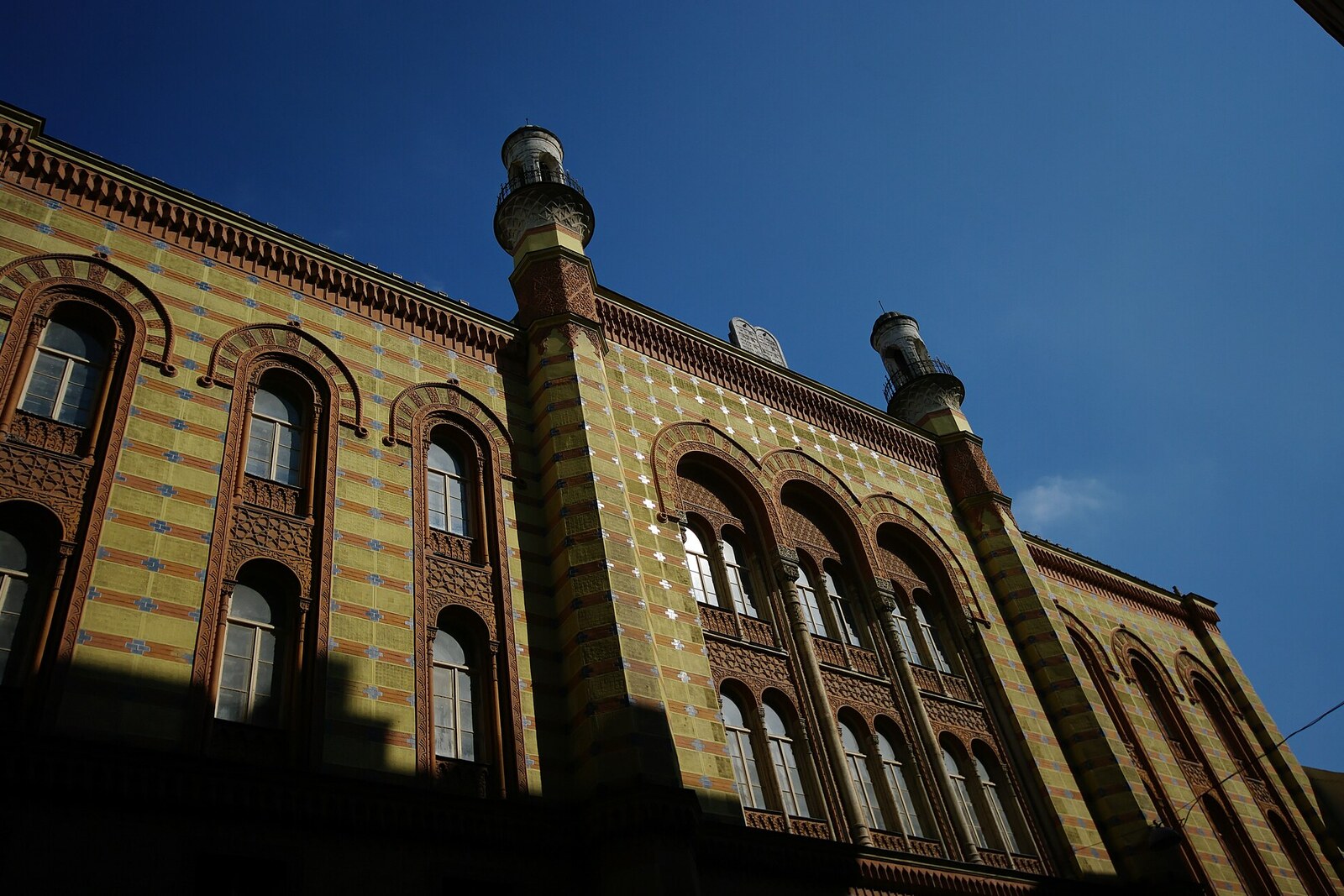
Look around first
What to notice
- Synagogue facade
- Prayer hall
- Inner courtyard
- Memorial plaque to the right of the entrance
The story of the place
The local name predates the synagogue: the street was named in memory of a Pest physician who treated those in need free of charge. The Pest Jewish Community opened this building in eighteen seventy-three. Behind the facade is a hall for more than one thousand two hundred worshippers, with an inner courtyard beyond it. Prayers, exhibitions, and concerts are held here again today, and a memorial plaque fixed to the right of the entrance links the hall and courtyard to a difficult chapter of the past.
Klári Bárt was sixteen years old. She was born in Budapest, lived on nearby Dob Street, and grew up in Hungarian culture. In nineteen forty-one, officials told the girl that she was “not Hungarian.” According to the testimony of her childhood friend, Klári was brought here, to Rumbach Street Synagogue, together with her parents and her maternal uncle. The building that had once gathered people for prayer was turned by officials into a camp for Jews with “unsettled citizenship.”
Different life stories lay behind that wording. After the dissolution of Austria-Hungary, a person could stay where they were yet become a citizen of one of the states that emerged in place of the empire. A Polish decree of nineteen thirty-six stripped many Jews living abroad of their citizenship. They were joined by refugees from Poland and Slovakia, and by residents of Hungary who could not quickly prove the origins of their documents. After Hungary entered the war against the Soviet Union, the office responsible for monitoring foreigners decided to expel them. Klári’s birthplace changed nothing in her case.
The synagogue was suitable as a large holding point. The Pest Jewish Community opened it in eighteen seventy-three; the prayer hall held more than one thousand two hundred people, with an inner courtyard behind it. Officials set up similar camps at Jewish institutions, and two Jewish charitable organizations had to feed the prisoners here.
The name came from the street. It was named after Sebestyén Rumbach, a Pest physician who treated the poor free of charge. He had no connection to the synagogue: together with the address, the community received an already existing city name.
Deportees were allowed to take food for three days and up to fifty kilograms of belongings, but some were taken so suddenly that they did not have time to gather even that. From Budapest, transports went to the border town of Kőrösmező. There, Hungarian officials handed people over to the Germans; they were then taken toward Kolomyia and marched on foot to Kamianets-Podilskyi, on the occupied territory of Soviet Ukraine.
From August twenty-sixth to twenty-eighth, SS and police units under the command of General Friedrich Jeckeln shot twenty-three thousand six hundred people there. This number included deportees from Hungary and local Jews. Klári Bárt, her parents, and her uncle were among those killed.
The synagogue and courtyard were used to confine people later as well. Jenő Barkány, an architect and artist who fled from Slovakia, left drawings of the camp titled “Lunch,” “Evening,” and “Suicide.” Thanks to them, it is known that prisoners were also held in the courtyard between Rumbach Sebestyén Street and Madách Imre Road.
After restoration, prayers, exhibitions, and concerts are again held here. To the right of the entrance, a memorial plaque installed in nineteen ninety-one remains. It calls this building one of the camps for deportees; Barkány’s drawings clarify the boundary: beyond the present-day prayer hall, the inner courtyard also served as a camp.
Useful on site
Accessible outside at all times; interior access is seasonal and depends on hours, events, Saturdays, and holidays.
Checked: June 28, 2026. Check the official source before visiting.The main structure is barely visible from the sidewalk, so the interior requires a separate visit. The building combines religious and cultural functions; before entering, check whether the hall is open to ordinary visitors.