 Guide On Map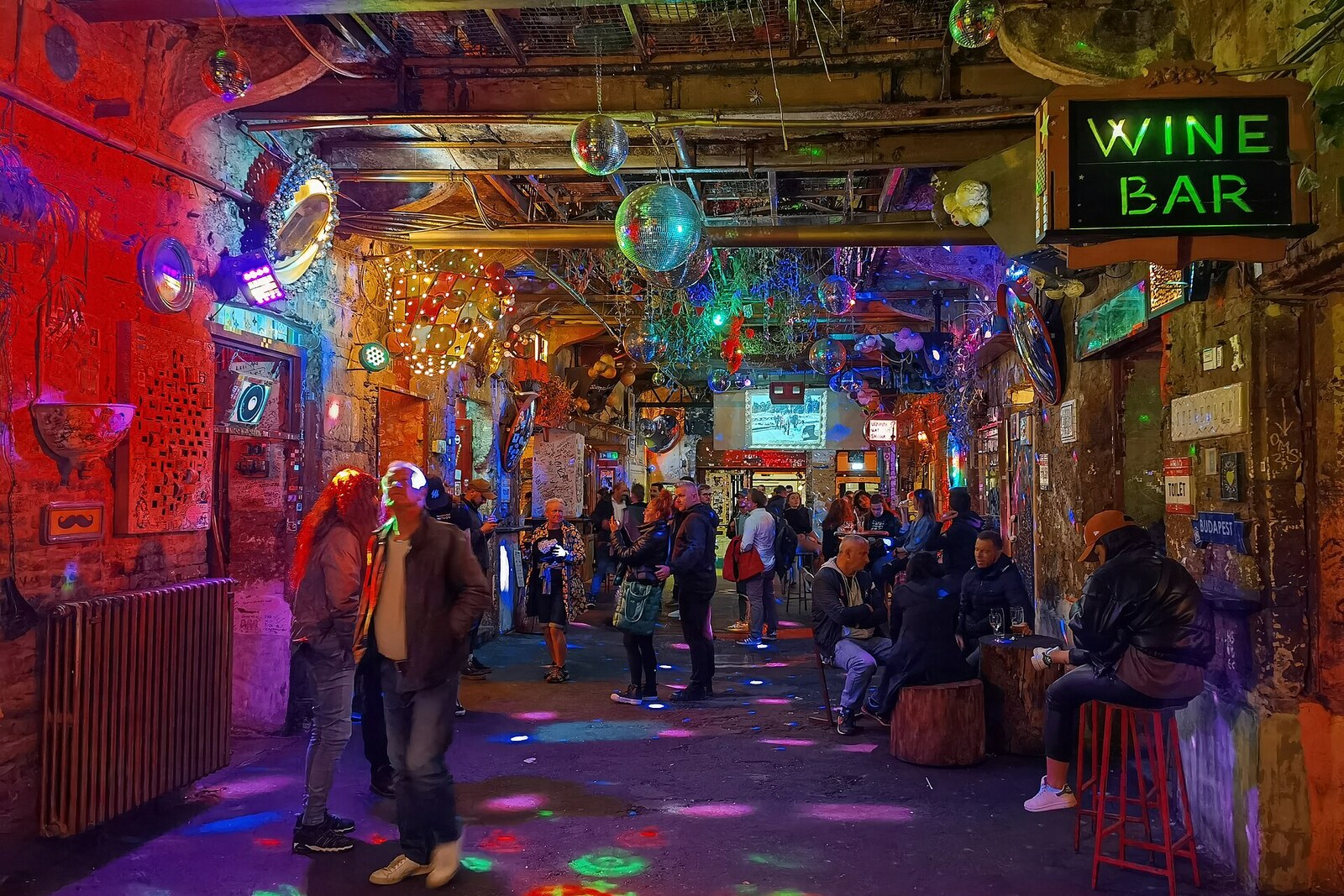
Look around first
What to notice
- The body of a Trabant
- Stone staircases
- Cast-iron railings with winged figures
- Removable bar partitions
The story of the place
Inside, the rooms of the former apartments, the factory space, stone staircases, and cast-iron railings with winged figures have been preserved. After the factory closed, the premises stood empty for a long time, and now musicians, artists, workshops, and markets occupy them; drink counters provide the money for their work. The furniture came here from cheap sales and from city residents, which is why, among the armchairs and lamps, there is a Trabant body. The bar partitions were made without major alterations so that they could be removed and the house returned to its former appearance.
In Hungarian, Szimpla Kert means “a plain garden.” The name appeared before this bar and at first referred to a genuinely simple courtyard with tables. The present maze of rooms, staircases, and bar counters came about because of two evictions and one house that was to be demolished.
In two thousand one, Attila Kisz and three friends—Gábor Bértenyi, Márk Gauder, and Ábel Zsendovics—opened a small bar on Kertész Street. They were not restaurateurs: they studied art and social sciences, and wanted to create a place for meetings, exhibitions, and film screenings. Drink sales were meant to pay for it.
They expected to take in thirty to forty thousand forints a day and recover their investment within a year. Kisz recalled that by the second day, the tally was already in the hundreds of thousands. They threw out the survival plans they had prepared, and a year later the friends rented the courtyard of number twenty-five Király Street and opened a summer Szimpla Kert there. When the site was sold, the new owner demanded that they vacate the courtyard.
The four founders then found number fourteen Kazinczy Street. It had once contained apartments and a stove factory, and after the factory closed, the rooms stood empty for a long time. By the end of the nineteen nineties, the building had deteriorated to such an extent that it was designated for demolition. The ÓVÁS! Association, which brought together defenders of the district’s old buildings, secured a postponement. The private owner had time to turn the courtyard into a parking lot, but the founders’ proposal proved more profitable than parking. In two thousand four, the new Szimpla opened here.
The tenants had no money for a conventional renovation, so they made that part of their method. They collected old furniture at cheap sales and accepted it from city residents; they installed bar partitions and decorations so that they could be removed without a trace. They did not apply a single branded design to discarded objects: an armchair, a computer, a lamp, or the body of a Trabant retained its former appearance. Other entrepreneurs followed this decision, and the name “ruin bar” became established for an entire type of Budapest venue. The founders even held free classes for people wishing to open a similar place.
For a long time, they themselves objected to the word “bar.” In two thousand five, the managers called Szimpla a private cultural center with a buffet: independent films were screened here, concerts and exhibitions were held, and rooms were provided to civic organizations. Now, on different days, musicians, artists, workshops, and markets still occupy the former apartments and factory courtyard; the drink counters bring in the revenue.
This arrangement nearly came to an end a year after the move. Neighbors complained about nighttime programs, and the venue was threatened with closure. About two thousand seven hundred signatures were collected in its support. Márk Gauder, one of the founders and Szimpla’s manager, reached an agreement with the residents: until soundproofing was installed, there would be no musical events after midnight, and the neighbors would support lifting the general ban on late operation. They agreed, and the bar remained.
In two thousand five, the building was placed on the list of protected monuments. Inside, the rooms of the former apartments, the factory space, stone staircases, and cast-iron railings with winged figures are still recognizable. The counters and decorations added by the founders remain removable.
Useful on site
A commercial venue with late hours, events, and a market; check Szimpla’s current schedule before visiting.
Checked: June 28, 2026. Check the official source before visiting.Earlier in the evening, it is easier to look at the building itself; later, the bar becomes the main focus. The market and special events require separate checking; residential and service areas are not part of the freely accessible visit.