 Guide On Map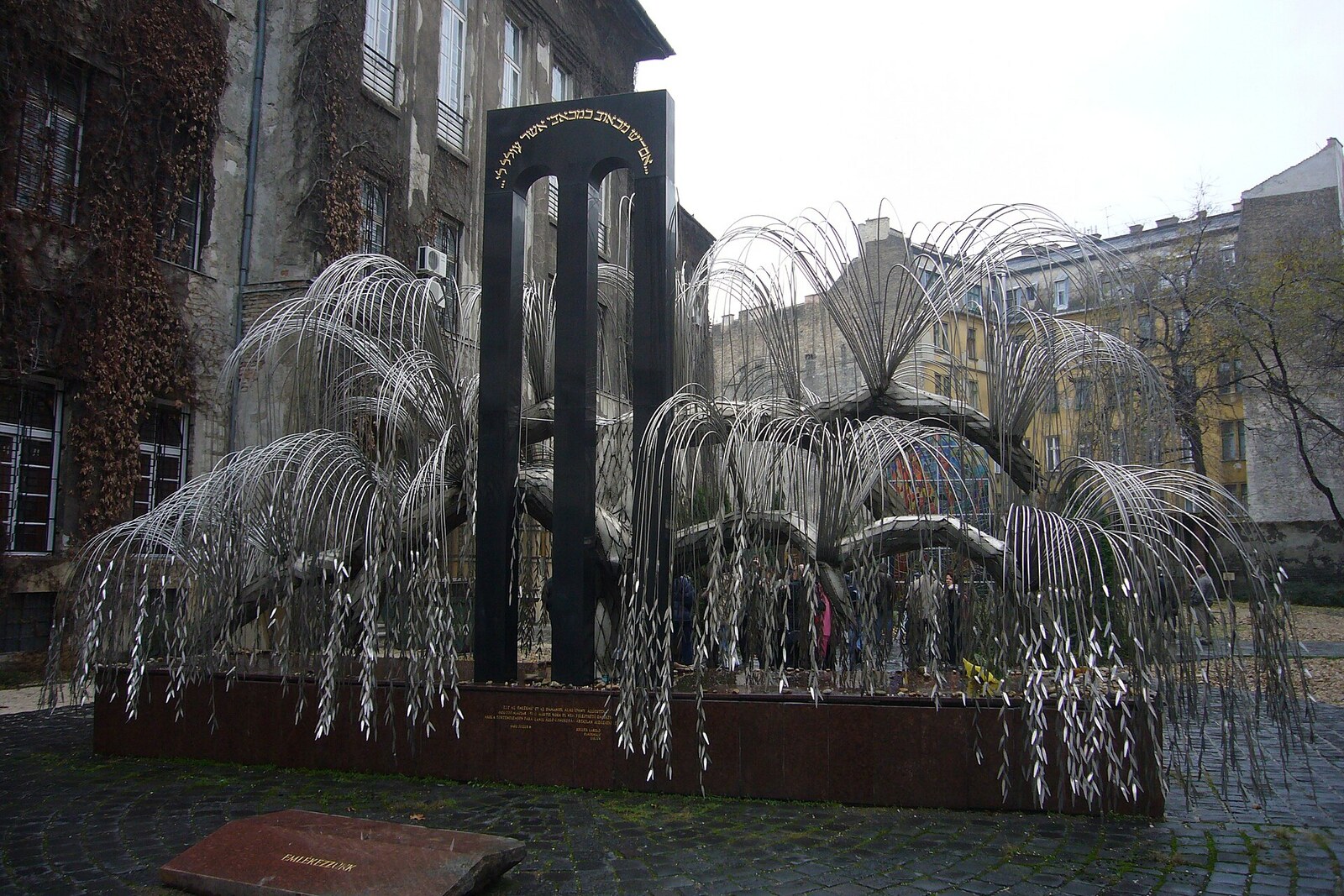
Look around first
What to notice
- Steel willow
- Metal leaves with names
- Stone slab bearing Raoul Wallenberg's name
The story of the place
Behind the Dohány Street Synagogue, on the grounds of the former Budapest Ghetto, a willow of chromed steel stands among the graves. Its metal leaves are engraved with the names of relatives who were killed, which their families managed to recover and submit to the foundation. This list remains incomplete: many people could never be identified by name. Beside it lies a stone slab bearing the name of the Swedish diplomat Raoul Wallenberg.
The metal willow in this courtyard began as a small drawing. It was made by the Hungarian sculptor Imre Varga when he was trying to understand what had happened to two of his childhood friends.
During World War II, Varga served as a pilot in the Hungarian army, was taken prisoner, and after his release returned to Budapest, earning a living first at a factory and then by repairing damaged statues. In nineteen forty-five, the sister of Varga's friends told him that both had been killed at Auschwitz. In the nineteen sixties, Varga traveled there at his own expense, met the former prisoner Kazimierz Smoleń, who was then director of the museum, and spent two days listening to his account of the camp. After that trip, he drew a monument in the form of a tree.
The drawing remained in his studio for about twenty years. In nineteen eighty-seven, representatives of the World Jewish Congress saw it and proposed that Varga turn the sketch into a monument to Hungarian Jews killed during the Holocaust. The rear courtyard of the Dohány Street Synagogue was selected for it—within the former Budapest Ghetto, beside the graves already mentioned.
The money was raised by the American Emanuel Foundation. It was founded by the film actor Tony Curtis, who was born to a family of Hungarian Jewish immigrants, and named after his father, the New York tailor Emanuel Schwartz. Hence the sculpture's second name: the Emanuel Tree.
Around the turn into the nineteen nineties, Varga installed a willow of chromed steel here. Families commissioned the engraving of the names of relatives who had been killed on its metal leaves; the funds raised remained with the Dohány Street Synagogue and covered part of the memorial's costs. The list was incomplete from the outset: many names could not be established, and the names that appeared on the tree were those that relatives managed to recover and submit to the foundation. New leaves were also added after the opening.
Raoul Wallenberg's name is carved on the stone slab beside the willow. The Swedish diplomat arrived in Budapest in the summer of nineteen forty-four with a mission to save Jews from deportation. He issued Swedish certificates of protection, placed their holders in houses under the protection of a neutral country, and personally pulled people from columns being driven toward the Austrian border.
In January nineteen forty-five, the danger reached the large Budapest Ghetto, which included this courtyard. According to postwar testimony by Pál Szalai, a Hungarian police employee associated with the Arrow Cross Party who secretly helped Wallenberg, a mass killing of the remaining residents was being prepared here. Through Szalai, Wallenberg sent a warning to the German commander Gerhard Schmidhuber: if the attack took place, Schmidhuber would be held accountable for it as a war criminal after the war. Schmidhuber ordered the operation canceled, and the people in the Budapest Ghetto lived to see the arrival of Soviet units.
Wallenberg himself was soon detained by Soviet military personnel. He disappeared in custody; the exact circumstances of his death have never been established. His name remains on the stone beside the metal willow, and above Raoul Wallenberg's name hang the names that families managed to recover from the nameless number of those killed.
Useful on site
Access depends on the hours of the Dohány Street Synagogue complex; on Saturdays, holidays, and certain dates the complex is closed or changes its schedule.
Checked: June 28, 2026. Check the official source before visiting.The park belongs to the Dohány Street Synagogue complex and is not always accessible as a separate outdoor stop. Do not touch the leaves, and let other visitors approach the names in peace.