 Guide On Map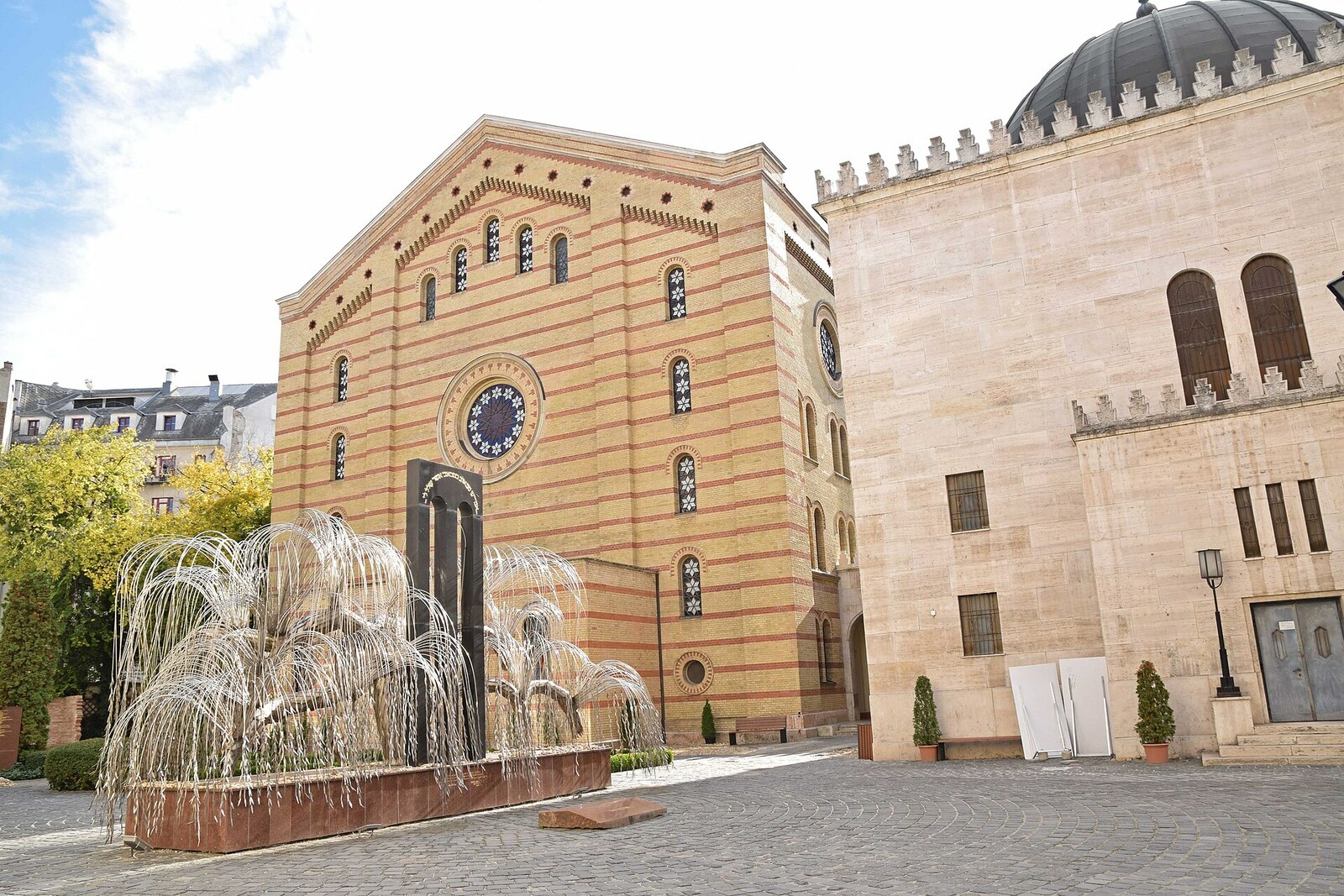
Look around first
What to notice
- The façade of the Dohány Street Synagogue
- The Jewish Museum building
- Grave markers in the courtyard
- The arcade on the Wesselényi Street side
The story of the place
Behind the synagogue façade is the main hall, designed for almost three thousand worshippers. It opened in eighteen fifty-nine, and services are still held here today. Nearby, within the same fence, Hungary's Jewish museum operates with the community archive.
On January fourth, nineteen forty-five, Márkus Trebitsch was directing burials in the sealed Budapest Ghetto. He was the general secretary of Chevra Kadisha, the Jewish community's burial society. His staff would normally prepare bodies for burial, keep records, and arrange funerals. Now Trebitsch needed at least to preserve the deceased person's name and find land for burial.
Five weeks earlier, the Arrow Cross regime had forced about seventy thousand Jews into a fenced-off part of the old quarter. One of the gates stood here, by the arcade on the Wesselényi Street side. The Dohány Street Synagogue found itself inside the Budapest Ghetto and sheltered hundreds of people. When the siege cut off access to the city cemeteries, the dead could no longer be taken away.
Trebitsch's burial department sent instructions to building wardens. Every death had to be entered on a list. If a name was unknown, distinguishing features were recorded and a cardboard tag was attached to the leg. Deaths were reported daily. Shovels were to be taken from supplies intended for clearing up after bombings. A coffin was issued only after the grave was ready. Trebitsch continued to direct the burials while armed detachments guarded the ghetto and fighting went on in its streets.
When Soviet troops liberated the ghetto on January eighteenth, thousands of unburied bodies remained in houses, courtyards, and streets. The regular cemetery was still inaccessible. Trebitsch's staff began burying the dead in the garden between the Dohány Street Synagogue and the small Heroes' Temple.
The work took almost a month. About one hundred people worked here each day, including twenty employees of burial organizations. Two investigators established identities, while two others kept the registers. Every entry was made in three copies; one was returned with a doctor's signature and served as permission for burial. There were not enough vehicles, the ground was frozen, and many people had died several weeks earlier, so it was far from possible to identify everyone.
By February seventeenth, two thousand two hundred eighty-one people had been buried in twenty-four mass graves. The temporary burials in Klauzál Square were later opened, and the remains were transferred to a cemetery. The graves beside the Dohány Street Synagogue were left in place.
For Jewish tradition, the proximity of graves and a house of prayer is unusual: cemeteries are separated from places of prayer and study. Here the distance disappeared for one practical reason—the living could not carry the dead beyond the ghetto fence. The people Trebitsch buried do indeed lie beneath the grave markers in the courtyard.
The main hall, opened as early as eighteen fifty-nine for almost three thousand worshippers, once again serves as an active synagogue today. The neighboring building houses the Hungarian Jewish Museum and Archives. The archives hold the lists of those buried that were compiled then, along with daily cemetery records. Within one fence remain the prayer hall, documents bearing names, and the twenty-four graves that Trebitsch had to arrange in the courtyard.
Useful on site
Accessible from outside at all times; the museum and synagogue complex operates on a seasonal schedule and is closed on Saturdays and on certain holidays.
Checked: June 28, 2026. Check the official source before visiting.The interiors and courtyard are accessible only under the complex's rules. Allow time for entry screening, keep quiet near the burials, and do not expect to see this place in a quick pass-through.