 Guide On Map
Marolles and Sablon: Markets, Memory, and Justice
From the Church of Our Lady of the Chapel through Marolles to Place du Grand Sablon
Guide On Map on your phone
Open the walk like a regular app
It takes about 10 seconds to install. No app store needed.
The whole path
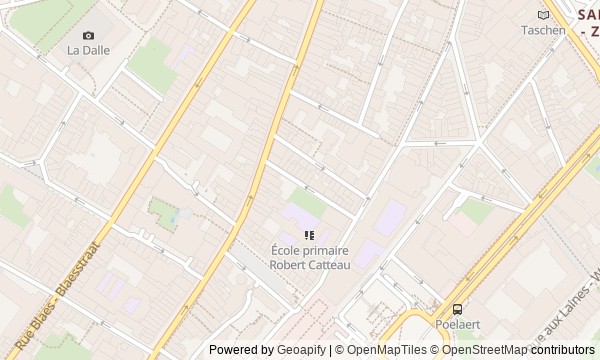
Route map
About the walk
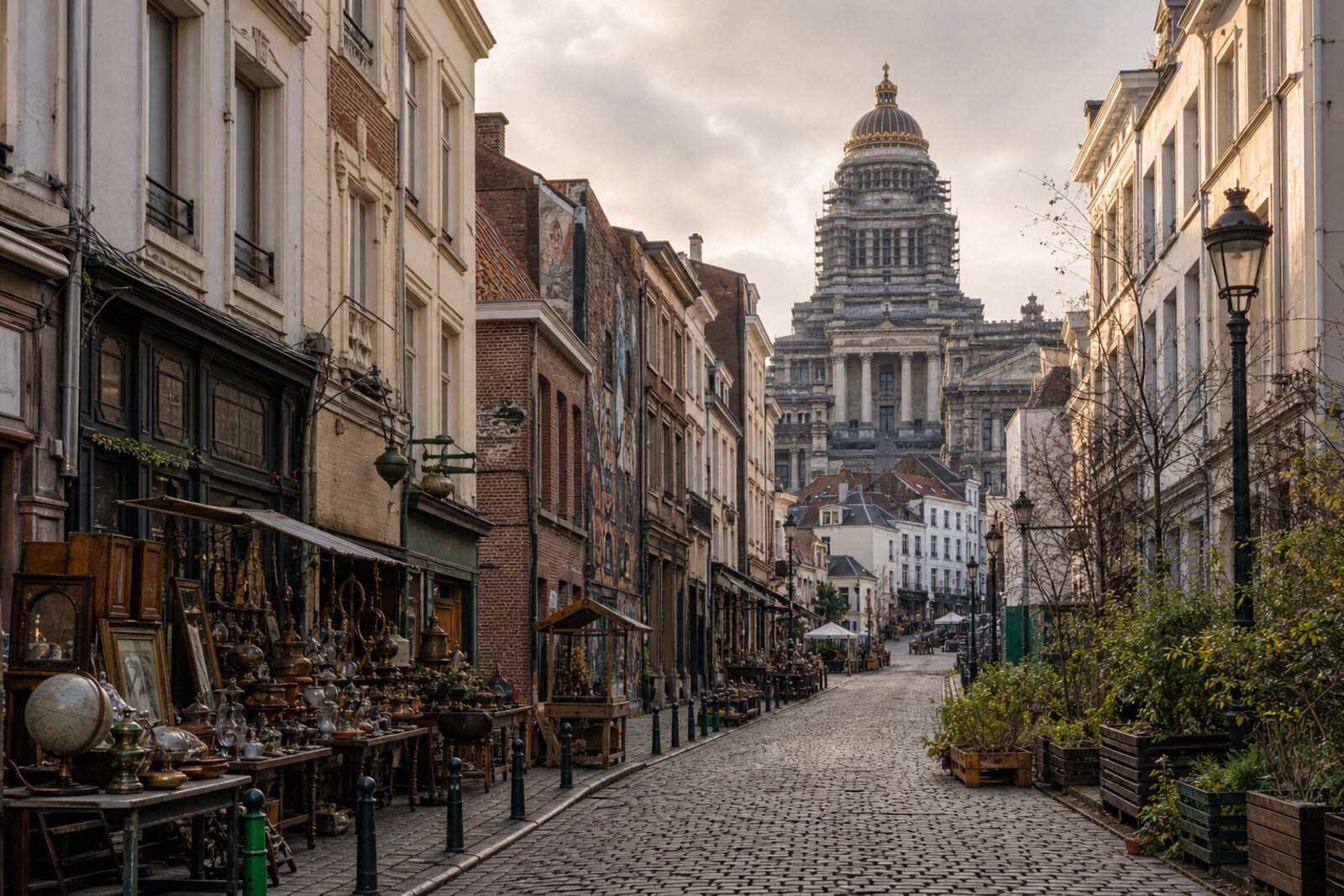
You will walk from the Church of Our Lady of the Chapel along Rue Haute into Marolles, to a daily market for things that have already been used. Then the route will abruptly change elevation: a glass elevator will carry you from narrow streets to the square before the Palace of Justice. From there, Sablon begins—a square with bronze craftspeople, a Gothic church, and a weekend antiques market.
This is a walk about how Brussels moved people, markets, monuments, and even confidence in its own past. Why does an old house bear a plaque to an artist when the archive leads to another address? What links a church to a statue said to have been stolen? And why did the city need two names for the same elevators?
The story will stay with documents and qualifications: a legend will remain a legend, a conjecture a conjecture. By the end, you will be able to tell Brussels’ two Sablons and two markets apart by who brings what to their squares, and when.
Why this order
The Church of Our Lady of the Chapel gives the route a solid archival point: the record of Pieter Bruegel the Elder’s wedding. That is why the next stop is the house on neighboring Rue Haute, where certainty gives way to a dispute over the address. The street then leads to Place du Jeu de Balle: after the story of one conjecture that took hold, you will see how the city moved an entire trade and the people involved in it. From the market, the route heads to the elevator, because the difference in height between Marolles and Place Poelaert emerged beside neighborhoods cleared to make way for the Palace of Justice. The upper station places you directly before the palace itself. From there, a straight route leads to Square du Petit Sablon, where a garden of urban memory answers the scale of the state. The church opposite continues the theme of craft guilds, and Place du Grand Sablon beyond its walls ends the walk with a second market—this one antique and held on weekends.
Those who want to see Brussels beyond Grand-Place Lovers of city markets and old residential neighborhoods Those who care about the line between document, conjecture, and legend
Those looking for a walk only through the formal center Those uninterested in archival disputes and urban memory Those who do not enjoy markets for used things
Before you go
Start early enough if you want to catch Place du Jeu de Balle while it is lively, rather than when the goods are already being cleared away. Both churches on the route are active: keep quiet inside, be mindful of services, and be prepared to view monuments only from the accessible part of the nave. Wear shoes suited to cobblestones and climbs. The Poelaert Elevators may be unavailable, and the space around the Palace of Justice changes because of long-running works, so do not count on unobstructed entry or a single route through. Antique trading at Place du Grand Sablon depends on the day, but the Minerva Fountain and the square itself still make a full ending without the stalls.
When to go
It is best to give the route the morning and part of the day: that way, the market in Marolles will be an active stop rather than a story about an empty square. Do not pass through Place du Jeu de Balle too quickly—the rhythm of the walk depends on paying attention to individual things. After the market, the pace naturally quickens at the elevator, then slows again in Sablon among the sculptures, church facade, and shop windows.
Backup plan
If the Church of Our Lady of the Chapel or the Church of Our Lady of the Sablon is closed or a service is underway inside, keep the stop at the facade and continue without trying to enter at any cost. An empty Place du Jeu de Balle still lets you see the scale of the former factory site and imagine the daily display of goods. If the elevator is out of service, walk up to Place Poelaert, allowing extra time and energy. View the Palace of Justice from outside if entrances or viewpoints are blocked by works. If there is no antiques market at Place du Grand Sablon, the Minerva Fountain, old facades, and the contrast with the unselected old things of Marolles make up for it.
Route conditions
Surface. Paved — 2.6 km; unpaved — 138 m (data covers 93% of the route)
Stairs. Flights: 2, 90 m in total
Access. Wheelchair — no; stroller — limited (stairs)
Facilities. Toilets — 2; drinking water — 5
Elevation. Ascent — 43 m; descent — 19 m
OpenStreetMap extract of June 18, 2026: database data, not a check on the ground. Data © OpenStreetMap contributors, ODbL licence
Walk plan
Open in maps ↗- 1
Church of Our Lady of the Chapel
Here you will first test what the archive confirms in Bruegel’s biography and what it leaves as a family story. - 2
Rue Haute and Bruegel House
This stop shows how a professional archival conjecture acquired a façade, an address, and protected status. - 3
Place du Jeu de Balle and the flea market
The relocation of the trade will explain how scrap dealers preserved their livelihood after being driven from the new central boulevards. - 4
Poelaert Elevator and Viewing Platform
Here you will see why the lower neighborhood needed a direct route to Place Poelaert. - 5
Palace of Justice
The story of the arson will let you see in the present dome the result of postwar reconstruction, rather than the original structure. - 6
Square du Petit Sablon
Here you will see how city councilors assigned places in shared memory to the counts, their contemporaries, and craftspeople. - 7
Church of Our Lady of the Sablon
A legend of a stolen statue will link a craftswoman, crossbowmen, a Gothic church, and the city's Ommegang. - 8
Place du Grand Sablon
The finale will make it possible to compare the everyday trade in second-hand goods in the Marolles with the weekend antiques market in the Sablon.
Route features
Everything you need stays in the browser
Progress, saves and your trip plan are stored on this device.
Add Guide On Map to your home screen so the walk opens outside the browser.
How we handle sources, maps and corrections: our editorial standards