 Guide On Map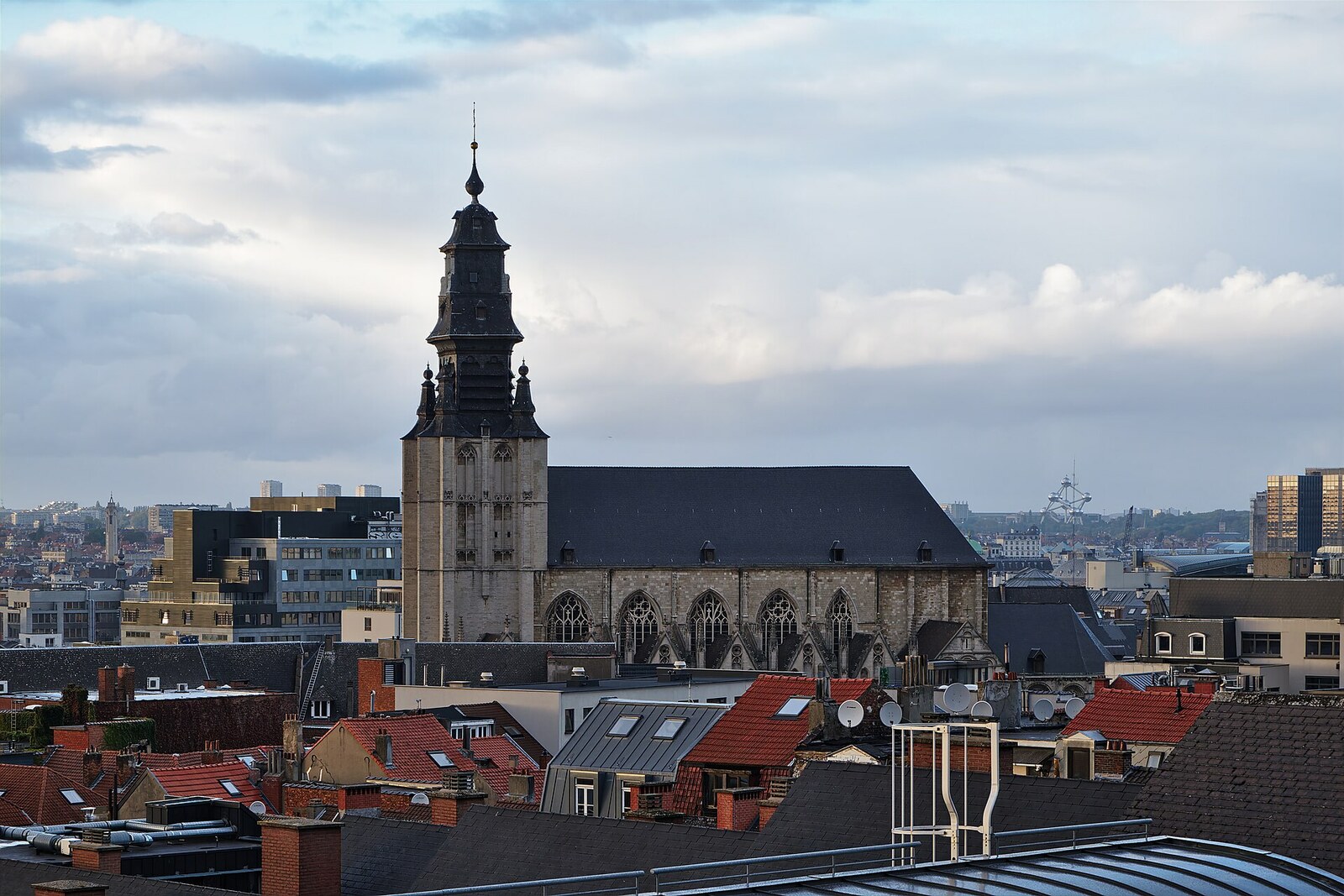
Look around first
What to notice
- Pieter Bruegel’s memorial
- Black-and-white marble frame
- Copy of a painting by Rubens
The story of the place
In the fourth side chapel to the right of the entrance hangs a copy of a painting in a black-and-white marble frame: its original left the church long ago. Jan Brueghel the Elder commissioned the work for the grave of his father, whom he barely had time to know. The artist Rubens painted Christ handing the keys to the Apostle Peter—the saint was chosen because of the name of the man buried here. So one of the chapels became a family memorial assembled decades after his death.
“Chapelle” means “chapel” in French. In eleven thirty-four, Duke Godfrey the First ordered it established beyond the city wall and entrusted it to the monks of the Abbey of the Holy Sepulchre in Cambrai. Apparently, the residents of the growing suburb had asked for it—weavers, fullers, and tanners. They needed a church of their own. In twelve ten, representatives of the abbey and the Chapter of Saint Gudula agreed to establish a separate parish here, although the chapter did not want to lose the income from its parishioners. Nothing survives of the first chapel; its name passed to the Church of Our Lady of the Chapel, which grew up on this site.
In fifteen sixty-three, Pieter Bruegel the Elder and Mayken Coecke van Aelst were married here. Bruegel earned his living in Antwerp by making drawings for printed engravings, and he belonged to the city’s guild of artists. Mayken was the daughter of his late teacher, the painter Pieter Coecke van Aelst. To marry, Bruegel had to leave Antwerp and move to Brussels.
Why the bride’s family required the move is not known for certain. The artist’s first biographer, Karel van Mander, wrote that Mayken’s mother, the miniaturist Mayken Verhulst, agreed to the marriage only on condition that her future son-in-law break off his previous relationship in Antwerp. Archivists did indeed find a record of an engagement in Antwerp and a record of the wedding in the Brussels parish of the Church of Our Lady of the Chapel. This sequence makes the biographer’s account plausible, but does not prove it.
After the wedding, Bruegel remained in Brussels and switched almost entirely from drawings for engravings to painting. The last six years of his life passed here. In fifteen sixty-nine, the artist died; he was a little over forty. He was buried in the same church where he had married. His younger son Jan was then about one year old, and his elder son Pieter about five. They did not have time to learn from their father. After their mother’s death, the boys were introduced to the craft by their grandmother Mayken Verhulst—the very woman who had once set a condition before the wedding.
Jan Brueghel the Elder became a well-known painter and, more than forty years later, commissioned his friend Peter Paul Rubens to paint a work for his father’s memorial. Rubens depicted Christ handing the keys to the Apostle Peter: the saint was chosen as the heavenly patron of Pieter Bruegel. So the son, who barely knew his father, marked his grave with the work of another great master.
This memorial survives in the fourth side chapel to the right of the entrance. The original by Rubens is no longer here: in seventeen sixty-five, it was sold to Amsterdam, and later ended up in Berlin. A copy, put in place of the sold painting, hangs in a black-and-white marble frame.
Useful on site
Usually open Tuesday through Saturday from about 10:00 to 16:00; admission is free, access is partly restricted, and services take priority over the sightseeing schedule.
Checked: July 1, 2026. Check the official source before visiting.This is an active church: speak quietly, do not disturb services, and visit only the parts open to visitors. If entry is unavailable, linger by the facade.