 Guide On Map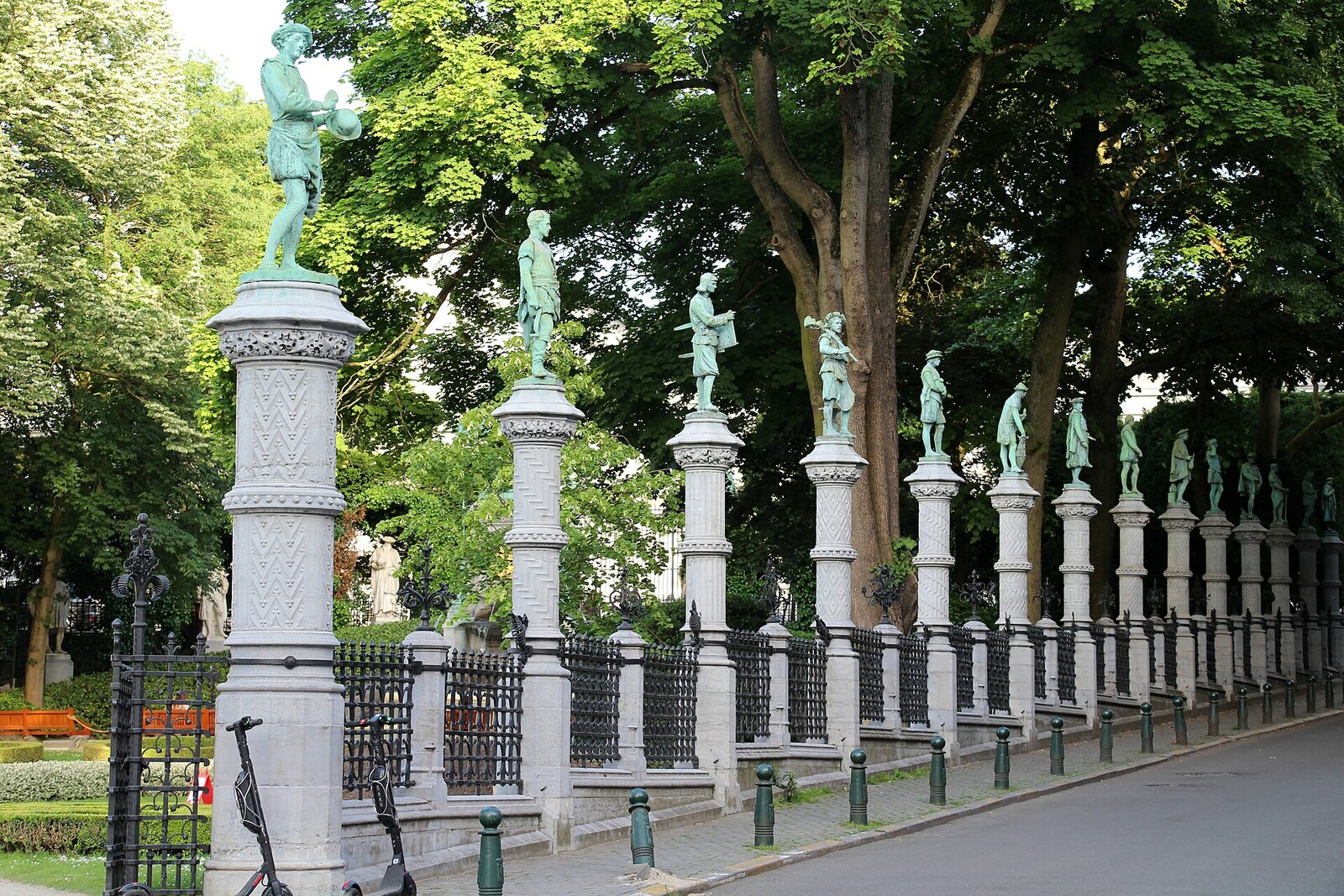
Look around first
What to notice
- Bronze figures of Egmont and Horn
- Fountain
- Ten marble figures
- Forty-eight bronze craftspeople
The story of the place
At Square du Petit Sablon, the garden is arranged around two bronze figures: a fountain stands before them, and a semicircle of ten statues behind them. The fence is divided by forty-eight different columns and bears bronze representatives of former city trades, including a brewer, a weaver, a jeweler, and a shoemaker. The sculptural group was moved here from the main square during the rebuilding of the King's House, and the entire garden was laid out beside the former residence of the family of one of the men depicted.
Brussels city councilors argued over whether the two men at the center of the garden deserved a monument. Lamoral, Count of Egmont, was a royal commander and governor of Flanders; Philip de Montmorency, Count of Horn, commanded the fleet and governed provinces. Both were Catholics, served the Spanish king Philip II of Spain, and received income from lands and offices with which he endowed them.
When the king intensified the persecution of Protestants in the Netherlands, the counts demanded that the reprisals be eased and local rights preserved. They were not preparing a break with the monarchy. Egmont condemned the Calvinists and helped suppress their uprisings. His earlier service seemed to him a safeguard: as a victorious general and a knight of the Order of the Golden Fleece, he expected not to be treated as a rebel.
The Duke of Alba, sent by the king, sought the complete submission of the provinces. He ordered both counts arrested. The defense invoked the privileges of the Order of the Golden Fleece, but the extraordinary court created by Alba found them traitors. On June fifth, fifteen sixty-eight, Egmont and Horn were beheaded at the Grand-Place, Brussels's main city square. Their estates were confiscated. Behind the garden stood the Brussels residence that Egmont had built for his family; after the verdict, it too was taken away. Only eight years later was the palace returned to his son. The execution of two prominent Catholic nobles provoked outrage and strengthened the revolt in the Netherlands.
The bronze group was first installed at the Grand-Place itself, by the place of execution. As early as eighteen fifty-nine, city councilors decided to present the counts as heroes, although they acknowledged that this image smoothed over inconvenient details of their conduct. The sculptor depicted them embracing each other before death, and the inscription on the pedestal directly called the Duke of Alba's verdict unjust.
Even the language of the inscription had to be defended. At first, the French and Dutch texts were considered temporary. The councilors then wanted to replace them with Latin, but opponents of that decision secured the preservation of the two living languages; the French error was corrected, and both versions remained on the stone.
In eighteen seventy-seven, the monument was removed because the King's House, in front of which it stood, was being rebuilt at the Grand-Place. Two years later, the bronze counts were moved here, beside Egmont's former residence. The architect Henri Beyaert organized the entire new garden around them. Behind the fountain, he placed ten marble figures of their contemporaries in a semicircle, and divided the fence with forty-eight different columns bearing bronze representatives of old Brussels trades—a brewer, a weaver, a jeweler, a shoemaker, and others.
Some councilors disliked the fact that William of Orange, the future leader of the revolt, had been placed among the retinue of Egmont and Horn. Their objections had no effect. In eighteen ninety, the garden opened with this arrangement.
The bronze counts no longer stand where they were beheaded. A fountain now lies before them, ten contemporaries stand in a row behind them, forty-eight craftspeople are placed along the fence, and beyond the garden stands the later-remodeled palace that was confiscated from Egmont's family after his execution.
Useful on site
Fenced city garden; access may depend on the season, maintenance, and city work.
Checked: July 1, 2026. Check the official source before visiting.Walk around the perimeter of the garden: the craft figures differ in their tools and clothing, and these details are lost from a single central point.