 Guide On Map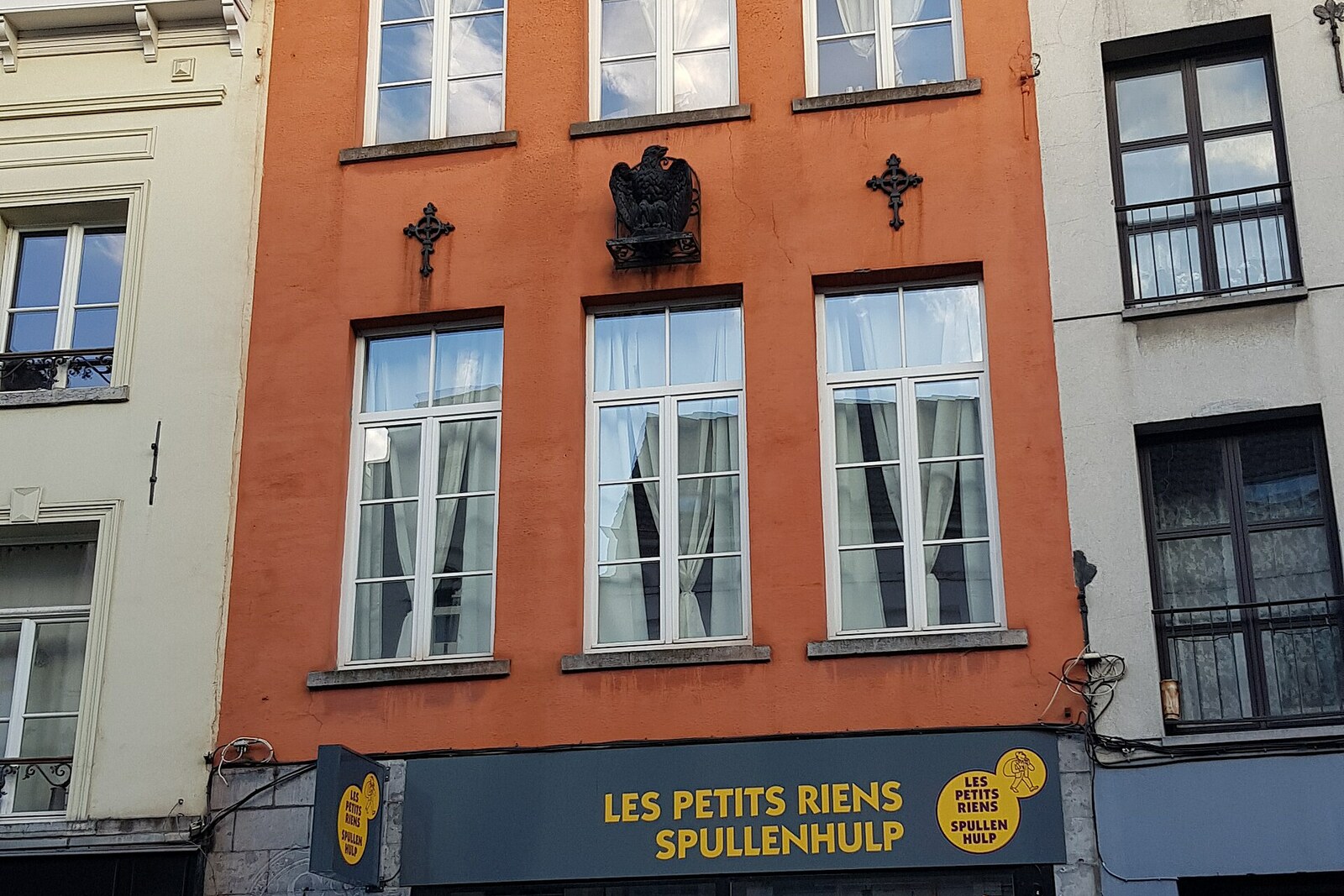
Look around first
What to notice
- Brick house No. 132
- Stepped gable
- Memorial plaque from 1924
The story of the place
At number one hundred thirty-two, a brick house survives: its gable rises above the façade in steps, and a memorial plaque is fixed to the same wall. The roof is supported by beams felled around fifteen forty-one. The façade and roof were entered on the list of protected monuments in nineteen sixty. Later, the building, together with its collection of antique objects, passed to the Royal Museums of Fine Arts of Belgium.
The French name Rue Haute means “High Street.” It was recorded that way as early as the late thirteenth century: the road ran through what is now the Marolles toward the city gates. At one of its old bends stands a brick house with a stepped gable and a memorial plaque to Pieter Bruegel the Elder.
After the wedding already mentioned, Bruegel settled in Brussels, lived here for six years, and died in fifteen sixty-nine. He painted for wealthy patrons and supported his wife and two young sons; losing dangerous drawings or an unfinished work meant losing part of the family’s inheritance. But no known document links him to the doorstep of house number one hundred thirty-two.
The address appeared three centuries after the artist’s death. In eighteen ninety-seven, the city archivist Alphonse Wauters was trying to establish where Bruegel’s Brussels studio had been. He came across a record about the painter David Teniers the Third, Bruegel’s great-grandson: he had died in a house “near the Red Gate.” The Red Gate was the name given to the entrance to an alley near this spot. Wauters decided that Teniers’s famous ancestor had also worked here, although he pointed to the neighboring house, which had already been demolished.
In nineteen eighteen, another city archivist, Guillaume Des Marez, transferred the conjecture from the vanished building to the surviving number one hundred thirty-two. Both authors worked professionally with Brussels documents, so readers took the conclusion for a discovered address. In nineteen twenty-four, a plaque dedicated “by the people to their great painter” was fixed to the façade. The house received Bruegel’s name, and the adjoining part of the Marolles came to be called the Bruegel Quarter.
The conjecture had very tangible consequences. The façade and roof were entered on the list of protected monuments in nineteen sixty. Three years later, the physician and collector Frans Huylens bought the house and commissioned a major restoration. A study of the wood showed that the roof beams date from around fifteen forty-one: this really is a Brussels house from Bruegel’s time. After the collector’s widow died in two thousand seven, the building and the antique objects collected by the couple passed to the Royal Museums of Fine Arts of Belgium.
Then the archivist Jean Bastiaenssens returned to the question Wauters had begun with. He found a family manuscript compiled in fifteen eighty-three, only fourteen years after Bruegel’s death. Relatives of the artist’s wife reported that the family lived near Manneken Pis, directly opposite Bogards Monastery—on present-day Rue des Bogards, a few minutes from here. Bastiaenssens checked the people mentioned in the manuscript against archival records and found confirmation. Bruegel House on Rue des Bogards has not survived to the present day.
Even the record about the great-grandson does not save the old version: the phrase “near the Red Gate” fits both the present house and its demolished neighbor. The nineteen twenty-four plaque remains on house number one hundred thirty-two. It marks not Bruegel’s proven home, but the precise place where an archival conjecture acquired a brick façade, an official address, and a monument of its own.
Useful on site
Open city street; the house and neighboring shops have private or separate hours, and interior access is not expected.
Checked: July 1, 2026. Check the official source before visiting.View the house from public space, and do not take the memorial address as an established fact: Bruegel’s connection with this particular building is disputed.