 Guide On Map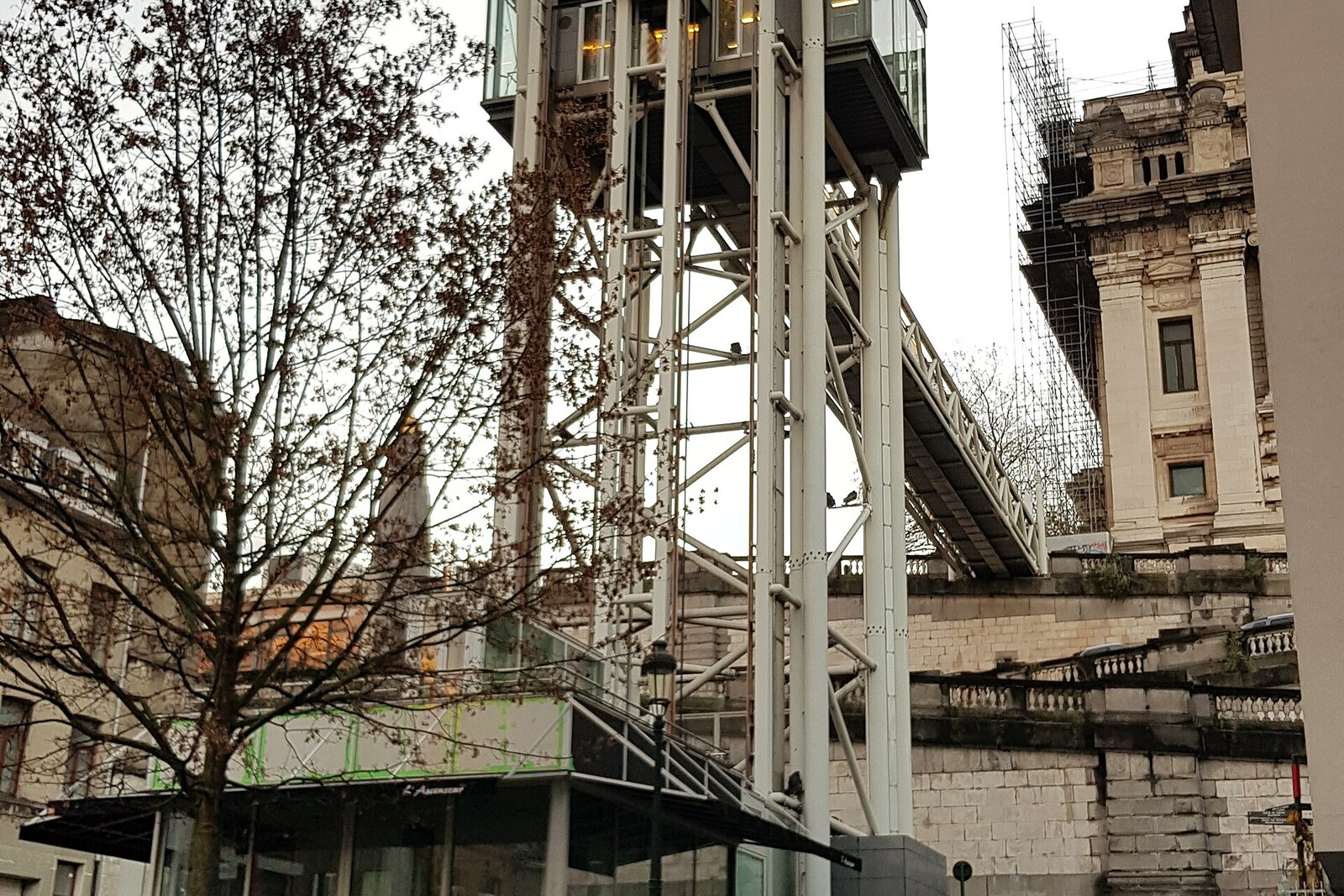
Look around first
What to notice
- Two glass cabins
- Metal bridge
- Roofs of Marolles
- Place Poelaert above
The story of the place
These elevators have two names. City services call them the “Poelaert Elevators”—the upper bridge leads out onto Place Poelaert. Brussels residents more often refer to them by the name of Marolles—the neighborhood of that name begins below. Both names are explained by the history of this rise.
Joseph Poelaert was Brussels’s city architect and sought the commission for the new Palace of Justice. His own house, workshop, and drafting rooms stood nearby, on Rue des Minimes in Marolles. In eighteen sixty-one, the minister of justice entrusted him with the project after an unsuccessful competition in which not a single proposal had been accepted.
The plans required the clearance of six blocks on the slope. In eighteen sixty-three, expropriation affected seventy-five owners; around one hundred less well-off residents had to leave Marolles. They were resettled in Quartier du Chat, in the then still rural municipality of Uccle, where Poelaert designed a group of small houses for them. Compensation provided a new roof, but it could not restore their former streets, neighbors, and everyday life around their home.
Local tradition links the insult “schieven architect”—“crooked architect”—to these evictions. That is what the people of Marolles called Poelaert, even though he himself lived here and earned his living through architecture. He did not live to see his main building completed: Poelaert died in eighteen seventy-nine, and the court opened four years later. The square above the slope took his surname.
The difference in elevation between Place Poelaert and Marolles remained almost twenty-eight meters. In the late nineteen nineties, the architects Patrice Neirinck and Michel Jaspers proposed creating a free vertical route here. They wanted to give the lower neighborhood direct access to the upper city and bring people back to Bruegel the Elder Square at the foot of the slope. Neirinck’s firm carried out the project, and in June two thousand two, two glass cabins began carrying passengers up to a metal bridge thirty-five and a half meters long.
The elevators operate as part of a city route: buses on Rue Haute remain below, and trams at Place Poelaert are above. The viewing platform is here because the bridge leads directly to the open edge of the upper city, above the roofs of Marolles. On transport maps, Brussels officials call these cabins the Poelaert Elevators; residents of the lower neighborhood continue to refer to them by the name of Marolles.
Useful on site
Public elevator and city crossing; the exact schedule depends on maintenance, so check its status on site before the route or keep the walking ascent as a backup option.
Checked: July 1, 2026. Check the official source before visiting.First make sure the cabins are operating. If the mechanism is stopped, use the walking ascent; on the open platform, take account of wind and wet surfaces.