 Guide On Map
Black Boston on Beacon Hill
From Boston Common across the northern slope to the African Meeting House
Guide On Map on your phone
Open the walk like a regular app
It takes about 10 seconds to install. No app store needed.
The whole path
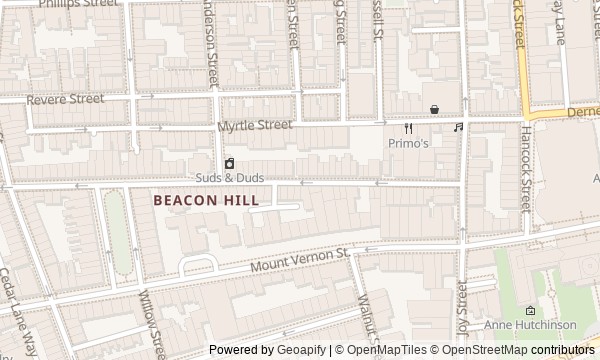
Route map
About the walk
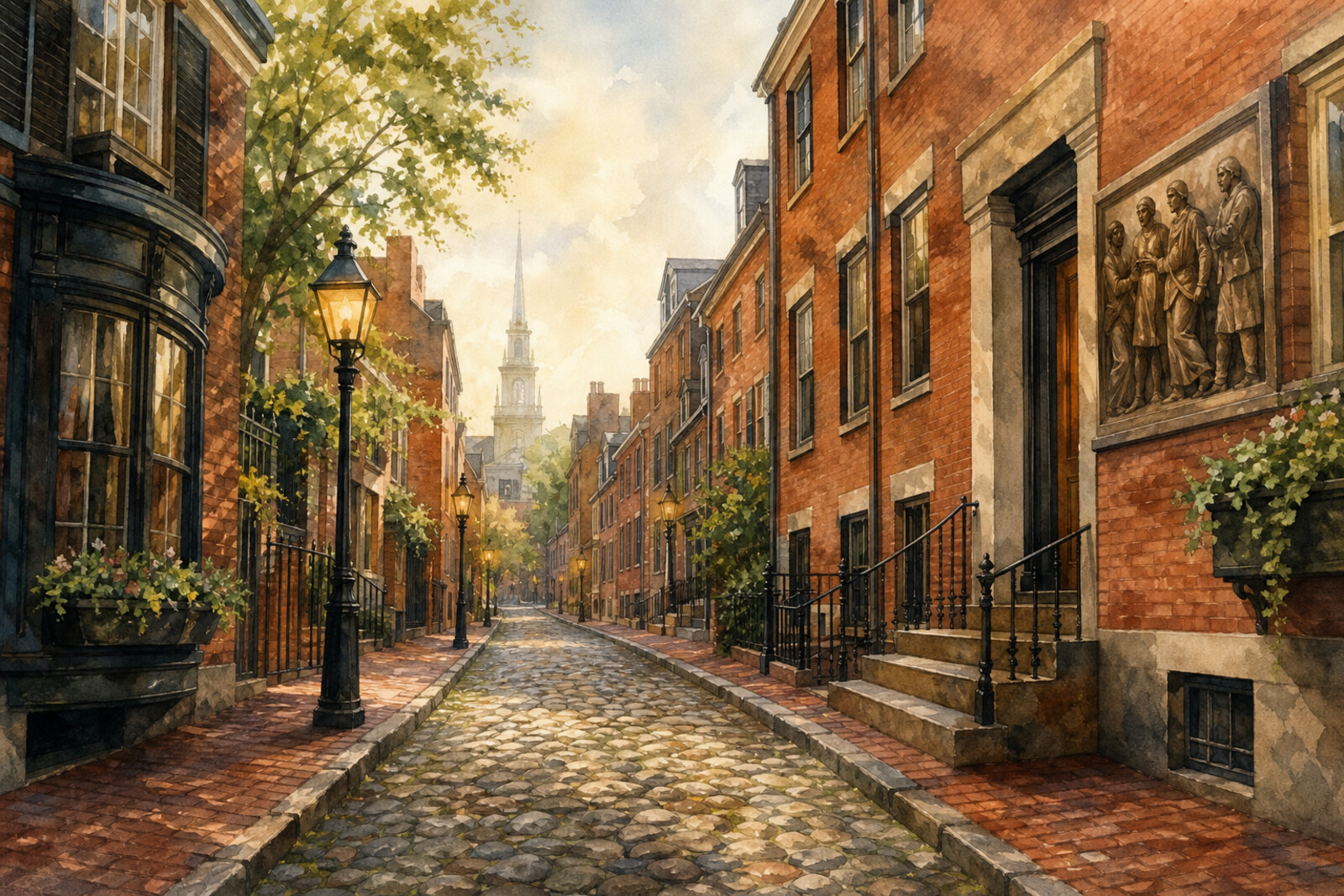
You will begin at Boston Common, between bronze ranks and the golden dome of the Massachusetts State House. Then the route leaves grand Beacon Street for the residential slope of Beacon Hill, heading toward a former school, private brick houses, and 2 meeting houses. Behind ordinary doors and at familiar city corners, you will look for the history of Black Boston.
These stories turn on people's decisions. In one, an old flag will pass before its own image in bronze. In another, a fuse waits beneath a house floor. Elsewhere, a congregation refuses to let its church be demolished. The story separates what is proven from what remains disputed, showing how a family, a class, or a community fought for change without knowing the ending in advance.
At the end, you will reach neighboring school and church buildings. After the walk, the red brick of Beacon Hill will remind you of specific places where Black Bostonians protected fugitives, changed the law, and built institutions of their own.
Why this order
The Robert Gould Shaw and the 54th Regiment Memorial stands opposite the Massachusetts State House. First, you will see how Black soldiers entered public memory; across the street, you will see where pressure from residents became law. From the State House, the route heads into residential streets toward Phillips School, testing equality at the threshold of an ordinary classroom. A few steps along Pinckney Street lead to the John J. Smith House: after access to education comes the next question—access to public service. The route then crosses the slope to the Lewis and Harriet Hayden House, where official appointments and legislative decisions are set against one family's protection of people. From Phillips Street, the route returns to Charles Street: private refuge gives way to a church the community preserved as shared property. The final climb along Mount Vernon Street and Joy Street connects that church to a former segregated school, while the neighboring African Meeting House shows where the community created its own church, classrooms, and a place for shared decisions.
Those interested in civil rights history through the lives of specific people Those who want to see residential Beacon Hill beyond its grand facades Those who enjoy dense historical storytelling without museum grandeur
Those expecting a walk made up only of open interiors Those looking for a light overview of Boston's most familiar sights Those who prefer history without the subjects of slavery and discrimination
Before you go
Wear comfortable shoes: Beacon Hill streets run along a slope, and some surfaces may be uneven. Check visiting conditions at the Museum of African American History in advance if you want to enter the Abiel Smith School and African Meeting House, as indoor access may require separate planning. The Massachusetts State House also has its own visiting rules and is not an essential part of the walk. Most other stops are active or private buildings; view them from the public sidewalk, do not step onto a porch without an invitation, and do not photograph interiors through windows. City noise can be loud outdoors, so headphones will be useful for the audio.
When to go
Allow about 2 hours for the outdoor version with the full audio stories. Leave extra time if you plan a museum visit, pauses on the slope, or a separate visit to the Massachusetts State House.
Backup plan
If you cannot enter the museum buildings, follow the entire route from outside: its drama rests on addresses visible from the public street. At the final stops, linger by the facades and entrances, and listen to the audio where you do not disturb residents or block the way. In poor weather, you can shorten pauses at private houses, but do not skip the pairing of the Abiel Smith School and the African Meeting House—it completes the story of the difference between a designated place and a space the community controls for itself.
Route conditions
Surface. Paved — 1.8 km (data covers 78% of the route)
Stairs. Flights: 2, 69 m in total
Access. Wheelchair — no; stroller — limited (stairs)
Elevation. Ascent — 29 m; descent — 44 m
OpenStreetMap extract of June 18, 2026: database data, not a check on the ground. Data © OpenStreetMap contributors, ODbL licence
Walk plan
Open in maps ↗- 1
Robert Gould Shaw and the 54th Regiment Memorial
Here, the military episode will continue decades later, when veterans meet their bronze ranks. - 2
Massachusetts State House
The state capitol links the freeing of one person to limits on the authority of government across the state. - 3
Phillips School
This stop will show what a legislative victory looked like on the first integrated school day. - 4
John J. Smith House
The house marks the moment when the struggle for equal rights reached municipal service. - 5
Lewis and Harriet Hayden House
Here, defense organized inside a private home would be set against federal law. - 6
Charles Street Meeting House
The history of preserving the building will show that the community had to choose between convenience and its own heritage. - 7
Abiel Smith School
The former classrooms will become the scene of a dispute over whether a separate school can be improved without abolishing segregation itself. - 8
African Meeting House
The final stop brings the route back to the place where Black Bostonians themselves created a church, a school, and a hall for shared affairs.
Route features
Everything you need stays in the browser
Progress, saves and your trip plan are stored on this device.
Add Guide On Map to your home screen so the walk opens outside the browser.
How we handle sources, maps and corrections: our editorial standards