 Guide On Map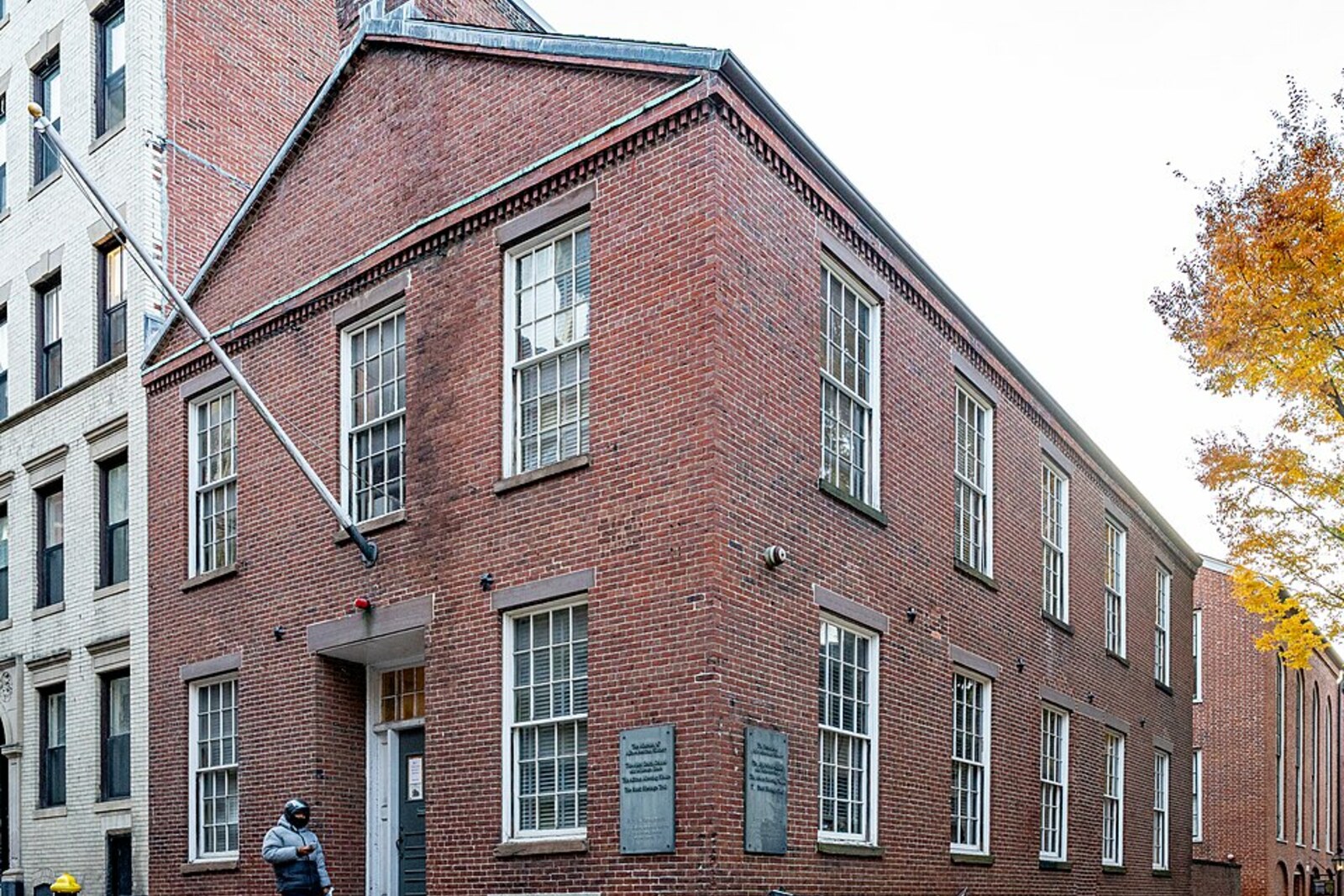
Look around first
What to notice
- Abiel Smith's name on the facade
- Brick facade
- Central entrance
- Staircase
The story of the place
Abiel Smith's name is on the facade. He was a white Boston merchant, not an educator or the founder of the school. Black parents organized a school for their own children as early as seventeen ninety-eight, when getting a place in regular city classrooms was almost impossible. Smith contributed money, and after his death in eighteen fifteen he left Boston four thousand dollars in three-percent securities for the education of Black children. The interest paid for textbooks, teachers' salaries, and firewood. The city later invested part of the principal in this building.
On March third, eighteen thirty-five, pupils were moved here from cramped quarters nearby. The new classrooms solved one problem and entrenched another: Black children from all over Boston were assigned to a separate school. Before long, parents again complained about overcrowding and the condition of the premises. Now they demanded not a better building for a separate school, but the right to choose the city's common schools.
Beginning in eighteen forty-four, families started taking their children out of this school. Some transferred them to private classes or moved to neighboring towns; others kept them at home. The boycott was led by William Cooper Nell, a Black printer and employee of an abolitionist newspaper, who had attended the same separate school as a child when it was still housed nearby. He sought to close the Abiel Smith School specifically as an institution to which pupils were assigned by skin color.
Not all Black Bostonians agreed with him. Some parents wanted to keep their school but place it under a good Black teacher. In eighteen forty-nine, school officials appointed Thomas Paul, a Black graduate of Dartmouth College, to lead the upper grades. They hoped to improve the quality of instruction and bring pupils back. For supporters of the boycott, a strong teacher made the separate school more viable and therefore hindered its closure.
On Paul's first morning, a group of the school's opponents surrounded the entrance and tried to keep children from going inside. Accounts differ: one author wrote of persuasion without physical violence, while a school official wrote of pupils being intimidated. It is known that a police officer dispersed those gathered, a patrol was kept near the building for several more days, and only twenty-three children enrolled. Whether Nell approved of this attempt to block the entrance is unknown.
In the following days, Nell demanded that his supporters keep order and began collecting donations for a temporary school, so that the children of boycott supporters would not be left without lessons. By the spring of eighteen fifty, average attendance at the Abiel Smith School had fallen to twenty-five pupils; before the boycott, more than one hundred attended. Even after losing a court case, families continued to withdraw their children, and Nell took the fight to the state legislature.
In April eighteen fifty-five, legislators prohibited public schools from distinguishing among children at admission on the basis of skin color and religious affiliation. The city closed the Abiel Smith School as a separate school for Black children, and later briefly opened common elementary classes here.
Today, the interior houses exhibition galleries, educational programs, the Museum of African American History ticket desk, and its shop. The name of the merchant who paid for the school's opening remains on the facade; the building no longer contains classrooms that the city reserved only for Black children.
Useful on site
A museum site of the Museum of African American History; as of the verification date, hours were listed as 10:00 to 16:00 Tuesday through Sunday, with admission slots at 10:00, 12:00, and 14:00.
Checked: July 1, 2026. Check the official source before visiting.The facade can be viewed from the street. Entry inside is part of a museum visit, which must be planned separately.