 Guide On Map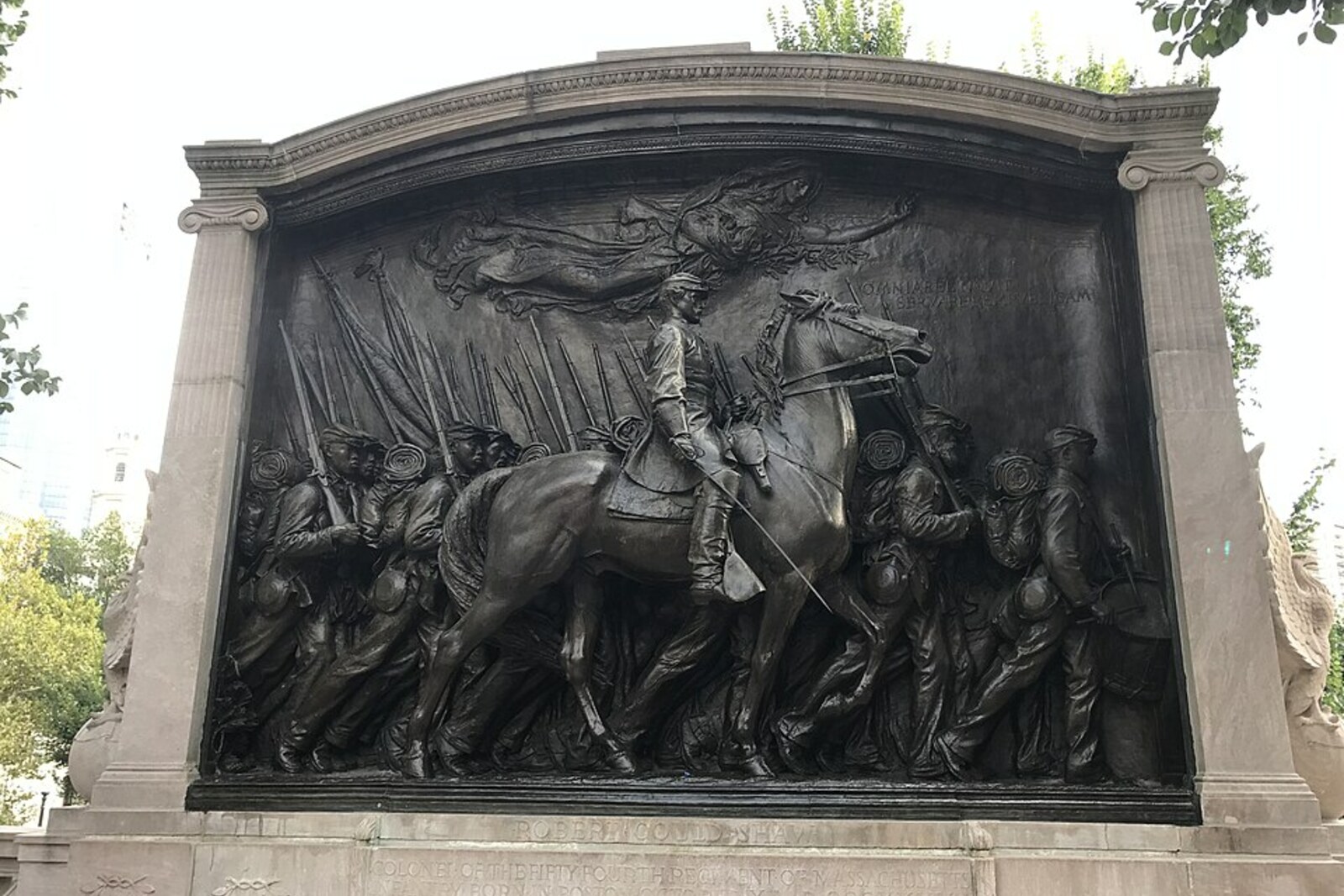
Look around first
What to notice
- Bronze relief
- Equestrian figure of an officer
- Ranks of infantrymen
- Figure of a drummer
The story of the place
On May thirty-first, eighteen ninety-seven, sixty-five veterans of the 54th Massachusetts Regiment marched along Beacon Street. Many were gray-haired; some walked with disabilities. Sergeant William Harvey Carney carried the old regimental flag. Before the newly made bronze relief, the soldiers turned toward their own young faces and saluted.
Thirty-four years earlier, Carney had passed this way in the opposite direction. He was born into slavery in Virginia, made it to free Massachusetts, and scraped by on odd jobs at shops in New Bedford. Carney intended to become a preacher. When recruitment of Black soldiers began, he decided that his enslaved compatriots needed him more in the army, and he enlisted for three years.
The 54th Massachusetts Regiment became one of the first Black regiments formed in the North during the American Civil War. The soldiers came from different states and even from Canada; among them were free-born men and former slaves. They were not allowed to serve as officers. Command went to the twenty-five-year-old white colonel Robert Gould Shaw, who had already seen combat and initially refused the appointment. He was to train men from whom many expected no soldierly steadfastness in advance.
On May twenty-eighth, eighteen sixty-three, the regiment held a farewell march through Boston to a ship bound south. This was the march that the sculptor Augustus Saint-Gaudens chose for the relief. Shaw rides with his saber drawn; the infantrymen carry rifles, knapsacks, and rolled blankets, while a drummer marches at the front. These are people who do not yet know which of them are destined to return.
Seven weeks later, they reached Fort Wagner, an earthen Confederate fortification guarding the entrance to Charleston Harbor. The regiment was ordered to attack first across a narrow stretch swept by fire before the rampart. Shaw led about six hundred men forward. The defenders had survived the artillery bombardment and met the attackers with canister shot and rifle fire.
When the flag bearer fell, Carney threw down his rifle, raised the flag, and carried it to the head of the column. He made it almost to the top of the rampart, but there was no one left to go farther. During the retreat, a bullet shattered his leg and a fragment struck his head. An officer offered to take the flagstaff, but Carney agreed to hand it over only to a soldier from his own regiment. He crawled back to his men and gave the flag to a lieutenant of the 54th, saying, “The old flag never touched the ground.”
Shaw was killed on the rampart. Nearly half the soldiers who took part in the attack were killed, wounded, or captured; that evening, the fort remained in Confederate hands. Yet reports of how the regiment fought undermined one of the main arguments against recruiting Black troops. By the end of the war, about one hundred eighty thousand African Americans had served in the Union army.
Shaw was buried in a common grave with twenty of his soldiers. The Confederates intended this burial to humiliate the white officer. Shaw’s parents refused to have their son’s body moved: they considered a grave among his men a fitting place. Later, the family also rejected the original design for a solitary equestrian statue. Shaw was a young colonel, not a great commander; he should be depicted in the regiment’s ranks.
The initiator of the Boston memorial was Joshua Bowen Smith, a Black caterer who helped fugitive slaves and had once been a servant to the Shaw family. He pressed for the memory of the dead to be preserved in Massachusetts, where the regiment had been formed. The project stretched over decades. Saint-Gaudens worked on the relief for fourteen years and made dozens of studies from Black models of different ages. That is why the soldiers’ faces differ, although they are not portraits of actual men from the 54th.
At the unveiling of the memorial, the actual veterans marched past the bronze ranks in the direction opposite to the earlier march. The sculptor saw in them soldiers finally returning from war. In bronze, the regiment is still marching off to the front, and that day Carney carried that same tattered flag toward it.
Useful on site
An open-air memorial on Boston Common; the National Park Service states that access is available around the clock.
Checked: July 1, 2026. Check the official source before visiting.View the relief from the pedestrian side without blocking the passage. For small details, move closer after first taking in the composition as a whole.