 Guide On Map
Stone Bordeaux Between the Garonne and the Cathedral
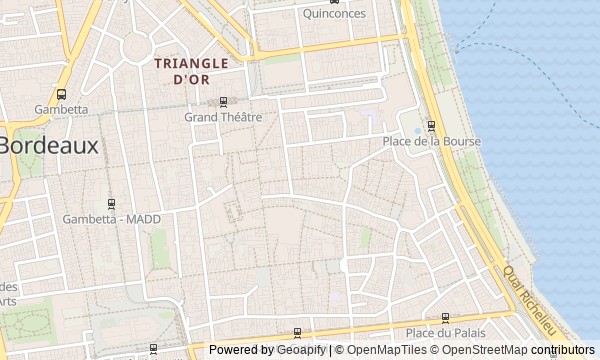
From Place des Quinconces along the riverfront and through the old town to Tour Pey-Berland
Guide On Map on your phone
Open the walk like a regular app
It takes about 10 seconds to install. No app store needed.
The whole path
Route map
About the walk
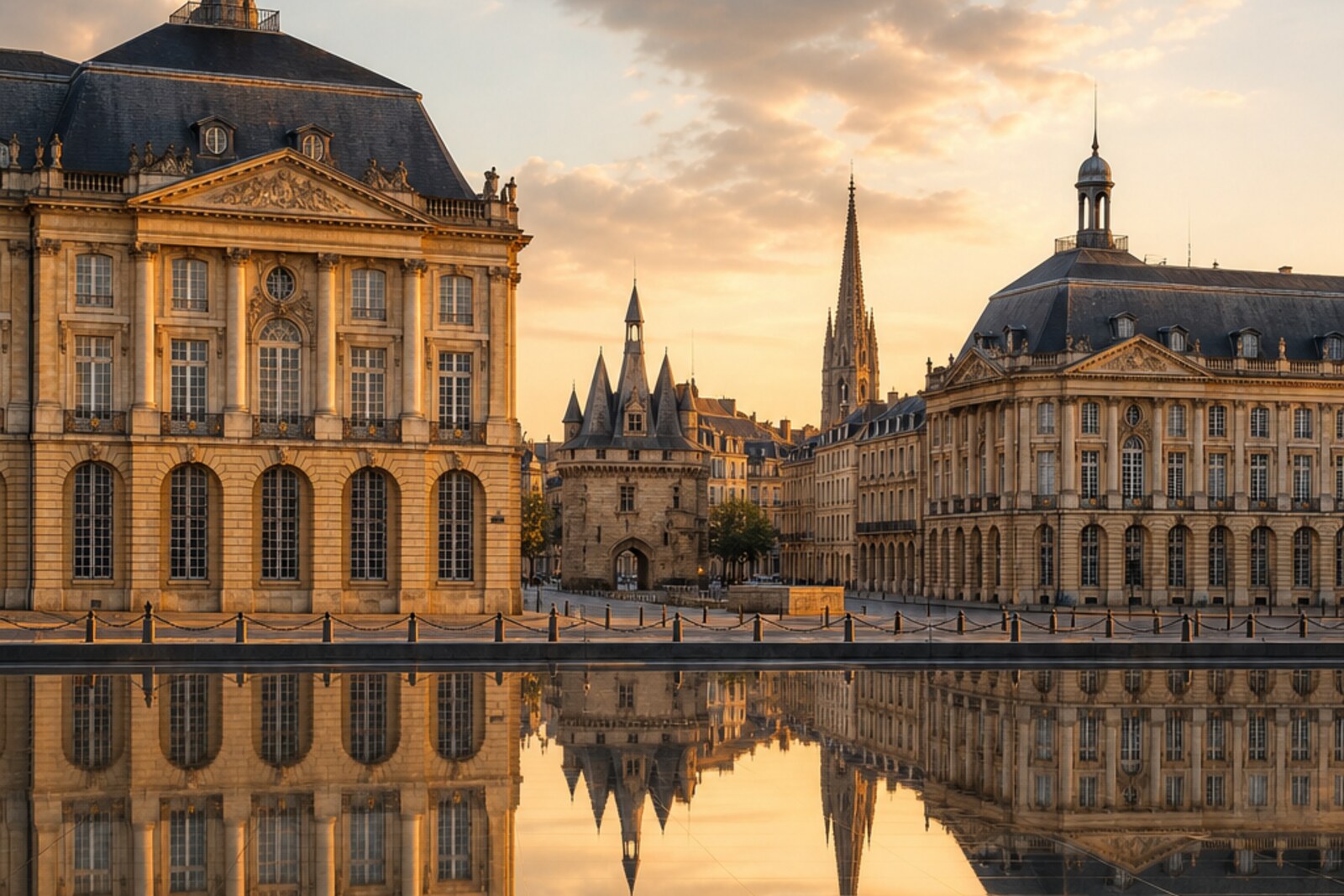
You will walk from a vast square by the Garonne along the grand riverfront, then turn into the narrow streets of old Bordeaux. The route begins where the city once lived under the sights of a fortress. At the Grand Théâtre colonnade, you will find out why the parterre was once covered with decking. At Place de la Bourse, royal administration, port trade, and a fountain standing where a vanished figure once stood come together. By the water, one question remains: how did an accidental puddle become a new city square? Then come gates with a door leading nowhere, a church above a filled-in harbor, and a bell Bordeaux was once deprived of. The story rests on documents, human decisions, and visible traces; legend remains legend. By the end, you will be able to read stone Bordeaux as the outcome of a long dispute between the port, the crown, the city, and the weak ground beneath the cathedral.
Why this order
Place des Quinconces gives the route its opening scale: the former citadel explains why the walk starts in an open field by the river. From here, the former boundary of military Bordeaux leads to the Grand Théâtre, where the city's grandeur once became scenery for a conflict of state. After the theater, the route reaches Place de la Bourse, where it becomes clear how power moved from the stage and the tribune into the facades of port administration. Miroir d'eau comes next because it lies directly before this ensemble and shows its modern reinterpretation. The route then follows the current toward Porte Cailhau, moving from the open riverfront to a surviving entrance to the old town. Beyond the gates, Place Saint-Pierre continues the port story above a vanished inner harbor. From there, the walk goes deeper toward Grosse Cloche, where control of the city's time becomes a continuation of the struggle for civic rights. The final passage to Saint-André Cathedral and Tour Pey-Berland brings the theme to another bell: not one taken away by power, but one moved out of the cathedral because of the ground beneath its walls.
A first introduction to the historic center of Bordeaux Those interested in urban conflicts and the fates of buildings Lovers of port history, architecture, and archaeological finds
A walk devoted to winemaking and tastings Those looking only for interiors and museum collections Anyone wishing to avoid a dense historical narrative
Before you go
The main story is designed for viewing from outside, so the route still works without entering the buildings. Treat the interiors of Grand Théâtre, Porte Cailhau, and Tour Pey-Berland as separate additions, and check access in advance rather than tying the whole walk to a single entrance. At Miroir d'eau, the effect depends on its operating cycle: reflection, drainage, and mist follow one another, and sometimes the installation may not be running at all. Do not hurry away after the first phase, and take care on the wet granite. At Place des Quinconces and by the river, there is little shelter from sun, rain, or wind. Keep quiet in active churches, and be ready to change the order of your visit if a service is underway.
When to go
Allow about 2.5–3 hours for the full outdoor route, with audio and unhurried looking. A visit to the theater, the gates, or a climb up Tour Pey-Berland can easily extend the walk to 4 hours: treat each addition as a separate pause, not a quick stop along the way.
Backup plan
If Miroir d'eau is not operating, use the space as a continuation of Place de la Bourse: step back toward the river and see how the facades form an open stone stage without the reflection. Closed interiors do not require a change of route either: the colonnade matters at the theater, Porte Cailhau still reveals its double role, and the separation of cathedral and tower is visible from outside. In rain, linger beneath sheltered stretches of facade and move long pauses from the open riverfront into the Saint-Pierre quarter. If time is short, end the walk at Grosse Cloche: the theme of the city's voice already reaches a clear conclusion there.
Route conditions
Surface. Paved — 2.9 km; unpaved — 141 m (data covers 95% of the route)
Access. Wheelchair — limited; stroller — limited
Facilities. Toilets — 6; drinking water — 8
Elevation. Ascent — 31 m; descent — 25 m
OpenStreetMap extract of June 18, 2026: database data, not a check on the ground. Data © OpenStreetMap contributors, ODbL licence
Walk plan
Open in maps ↗- 1
Place des Quinconces
Here you will understand why Bordeaux’s main esplanade repeats the dimensions of a vanished citadel. - 2
Grand Théâtre
The opera house will serve the route as the place where a parliamentary dispute ended a writer's career as a deputy. - 3
Place de la Bourse
The ensemble shows how a dispute between a provincial court and a royal official changed the entrance to a port city. - 4
Miroir d'eau
This modern square will explain how an engineering solution became a new way of using the waterfront. - 5
Porte Cailhau
The tower will show why freeing the monument from the neighboring houses nearly led to its destruction. - 6
Place Saint-Pierre
This stop will take you beneath the city pavement to a Roman statue and a long-filled-in inner harbor. - 7
Grosse Cloche
The city bell will link a revolt, the loss of privileges, and the townspeople’s attempt to learn how to tell time again. - 8
Saint-André Cathedral / Tour Pey-Berland
The final stop will explain the gap between the cathedral and its bell tower, which remained without bells for several centuries.
Route features
Everything you need stays in the browser
Progress, saves and your trip plan are stored on this device.
Add Guide On Map to your home screen so the walk opens outside the browser.
How we handle sources, maps and corrections: our editorial standards