 Guide On Map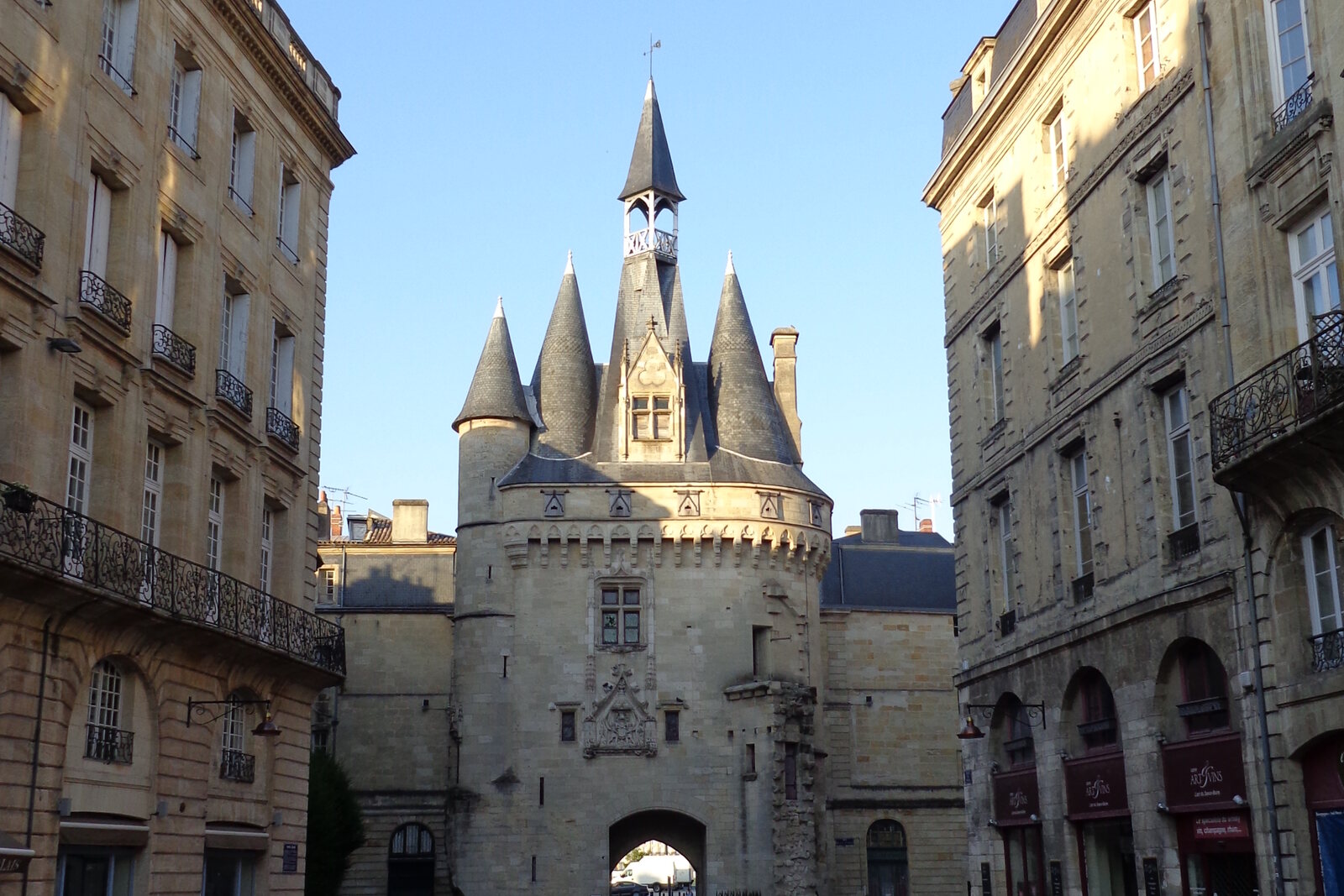
Look around first
What to notice
- Marble figures above the passage
- Pointed arches
- Short sections of wall
- A small door above ground level
The story of the place
Marble figures stand above the passage of Porte Cailhau, and pointed arches support the tall tower, which survived the disappearance of the wall that once surrounded it. People once entered the city from the river harbor through this passage and continued to the Palais de l’Ombrière, where the Parliament of Bordeaux sat. A portcullis closed the opening, an opening above it was left for defense, and the upper platforms made it possible to control the approach from the Garonne side. The small door high in the masonry remains from an exit onto the wall walk, although there is now neither a wall nor the adjoining buildings beyond it.
In December eighteen sixty-four, municipal officials entered Porte Cailhau and discovered an apartment building inside. Bordeaux rented the tower to a public letter writer—a person who, for a fee, wrote letters and petitions for those unable to write. He sublet the rooms to a shoemaker, a salt weigher, and other tenants. For them, the medieval monument was both a home and a place to earn a living.
The inspection gave the city authorities grounds to terminate the contracts. The attic floor was rotting beneath straw and rubbish, the wooden structures had blackened from smoke, and a hole from a hearth built directly on the floor structure gaped in the chimney. The officials demanded that the tenants be evicted and repairs begun. But the city had no prepared plan, the work was expensive, and neighboring houses had already taken over parts of the old wall. The letter writer, shoemaker, and salt weigher remained there for another eighteen years.
The tenants appeared in the tower because its former function had ended. At the end of the fifteenth century, it was Bordeaux’s main entrance from the river port. Beyond the gateway began the road to the Palais de l’Ombrière, where the Parliament of Bordeaux sat. A portcullis could block the passage; through an opening in the vault, defenders dropped objects onto those who had forced their way in; and from the upper platforms, they could fire on the approaches from the Garonne side.
The city magistrates built the present structure between fourteen ninety-three and fourteen ninety-six. It received the name Cailhau from an older gate. Its origin remains disputed. According to one version, it is a Gascon word meaning pebble: stones lay along the gently sloping bank and served as ballast for ships. According to another, the name preserved the memory of the wealthy Cailhau family, who lived near the Palais de l’Ombrière and gave Bordeaux several mayors.
While construction was nearing its end, King Charles VIII was returning from his campaign in Italy. After the capture of Naples, a coalition of Italian states blocked his way at Fornovo. The French fought their way north, their opponents captured part of the royal baggage train, and both sides declared themselves the victors. In Charles’s army, the Bordeaux contingent was commanded by André d'Épinay, Archbishop of Bordeaux, who had gone on campaign as a military commander. The city magistrates accepted the royal version of the outcome and dedicated the nearly finished gate to Charles. That is how his marble figure, holding an orb and scepter, appeared above the main entrance from the port, alongside d'Épinay and Saint John the Baptist. The exterior statues standing there now were made at the end of the nineteenth century: revolutionaries threw the former figure of the king from the façade and smashed it in October seventeen ninety-two.
By the time artisans settled inside, almost nothing remained of the wall on either side of the gate. In eighteen eighty, the city architect Charles Durand proposed evicting the tenants, buying the adjoining houses, and opening the tower on all sides. The last tenants of the gate left in eighteen eighty-two. The city began demolishing the additions and clearing the façades.
After the clearing, the tower began to subside. One hundred thirty years earlier, the architect Charles Dardan had widened the passage and removed three of the four pointed arches that transferred the weight of the upper floors onto the supports. The houses pressed against the gate had inadvertently served as buttresses. When they were dismantled, cracks spread through the masonry.
The state commission forbade Durand to restore the lost arches: officials considered such work an alteration of the monument. In August eighteen eighty-eight, Durand showed the mayor the sunken middle of the tower and demanded action before a reply came from Paris. The mayor inspected the cracks and authorized the work to continue immediately. The minister approved that decision only after repairs had begun, in February eighteen eighty-nine. Durand restored the load-bearing arches, reinforced the floor structures, and rebuilt short sections of wall on either side of the gate.
On the city side, a small door above ground level is visible in one of these sections. Durand left it where people once stepped out onto the wall walk. Now beyond its threshold there is neither wall, nor the letter writer’s room, nor a neighboring house—only open space.
Useful on site
April–October: daily 10:00-13:00 and 14:00-18:00. November–March: Wednesday–Friday 14:00-18:00; Saturday, Sunday, and holidays 11:00-13:00 and 14:00-18:00. Adult ticket 7 euros, reduced ticket 5 euros.
Checked: June 28, 2026. Check the official source before visiting.Compare the river side of the gate, with its passage, to the city side: its dual purpose is easier to see while moving. The old royal sculpture is kept inside, so seeing it depends on separate access.