 Guide On Map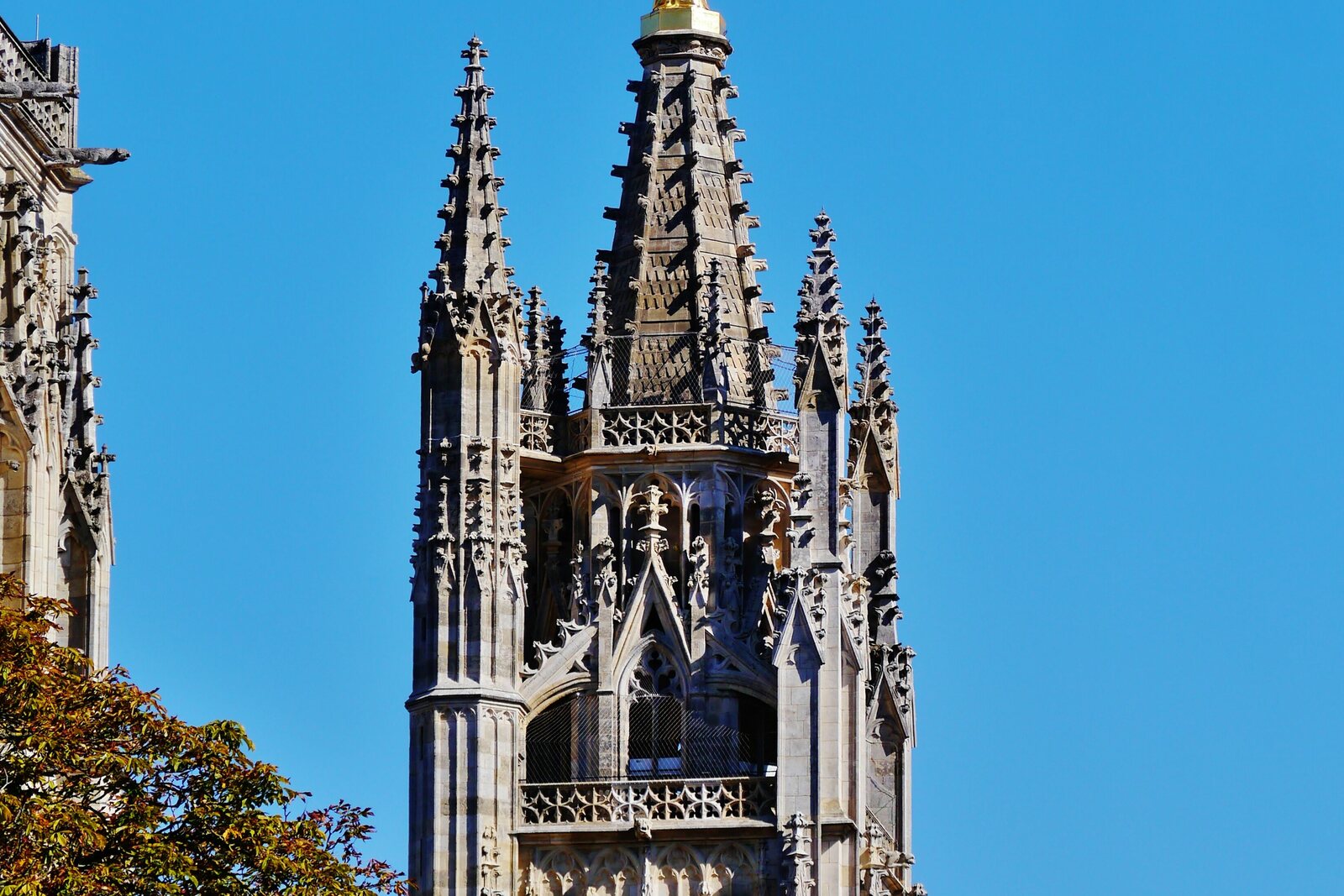
Look around first
What to notice
- Saint-André Cathedral
- Separate bell tower
- The gap between the tower and the cathedral
- Pointed opening in the north wall
The story of the place
Inside the cathedral stood the bishop's throne, which is why the church is called a cathedral: the entire diocese was governed from here. The tall bell tower beside it stands separately for a very practical reason. Beneath the church lay former marshy ground and watercourses, and the heavy swinging of bells could have damaged its masonry. The tower was given a site in the old cemetery, and a large pointed arch was later cut through the north wall to raise the bells.
On October thirteenth, fourteen forty, Archbishop Pey Berland laid the foundation for a separate bell tower beside the cathedral. Pey is the Gascon form of the name Pierre. The son of a prosperous farmer from Médoc, he began his church career as secretary and assistant treasurer to the cathedral chapter, and in fourteen thirty he became Archbishop of Bordeaux. He received his income, status, and the right to administer the diocese precisely through the See of Saint Andrew.
The cathedra is the bishop's throne, which is where the word “cathedral” comes from: Saint-André served as the principal church of the entire diocese. The cathedral is dedicated to Saint Andrew—the Galilean fisherman, brother of the Apostle Peter, and one of Christ's first disciples. Later sources report that he was executed in the Greek city of Patras. Why the church in Bordeaux received this particular dedication is not known for certain. Medieval canons told how Saint Martial saw Andrew's martyrdom in a dream and founded a church here that same day. This is a legend, not an established account of the building's history.
Pey Berland needed large bells, but the cathedral stood on weak ground, amid former marshes and watercourses. The weight and swinging of the bells could have damaged the masonry. The archbishop ordered the tower to be built at a distance, in the cathedral cemetery, above a chapel containing an ossuary. That is how the gap arose that still separates the bell tower from the altar end of Saint-André.
Construction began when Bordeaux and Aquitaine belonged to the English Plantagenets. Pey Berland supported that order and defended the city's privileges. In fourteen fifty-one, the troops of the French king Charles VII approached Bordeaux. The city agreed to surrender. On June thirtieth, the archbishop and the leading townspeople swore allegiance to Charles inside Saint-André. The cathedral was chosen because there the head of the local church could publicly ratify the agreement, while the French side in return confirmed Bordeaux's privileges.
A year later, the people of Bordeaux let English troops into the city again. After their defeat at Castillon-la-Bataille, the French occupied the city for a second time. This time, the former oath no longer saved the archbishop: he was regarded as a man of English Bordeaux. In fourteen fifty-six, Pey Berland was forced to leave the see and was replaced by an associate of the French king. Two years later, he died.
The tower retained his name, but during his lifetime it did not manage to fulfill its purpose. The change of crown and the end of the Hundred Years' War delayed the installation of bells for several centuries. Its empty levels were divided into living quarters. Around seventeen ninety, the tower was to be demolished to widen the streets; residents secured its preservation, after which the building was sold and converted into a hunting-shot factory.
In eighteen fifty-one, Cardinal Ferdinand Donnet bought back the tower and returned it to the cathedral. To raise bells inside, a large pointed arch was cut through the north wall. The first enormous bourdon bell proved to be cracked and sounded out of tune. It was recast, and in eighteen sixty-nine the present eight-ton Ferdinand-André appeared on the tower.
An inscription marking Pey Berland's laying of the first stone remains on the northern buttress. Beside it, you can see the opening that had to be made four hundred years later, when bells were finally carried into the empty tower. Between it and the cathedral still lies the distance calculated by the archbishop: the bells ring for Saint-André without making its walls sway.
Useful on site
Saint-André Cathedral publishes seasonal hours; as of the date checked, the schedule through 30 June 2026 was: Monday 14:00-19:00, Tuesday—Saturday 10:00-12:00 and 14:00-19:00, Sunday 09:30-12:15 and 14:00-18:00. Tour Pey-Berland: ticket €9, entry by electronic time slot; check hours and unplanned closures on the day you go up.
Checked: June 28, 2026. Check the official source before visiting.View the cathedral and Tour Pey-Berland as two separate structures. Entry to the church depends on its religious life, while climbing the tower requires a separate decision; to complete the route, it is enough to walk between them and compare their scale.