 Guide On Map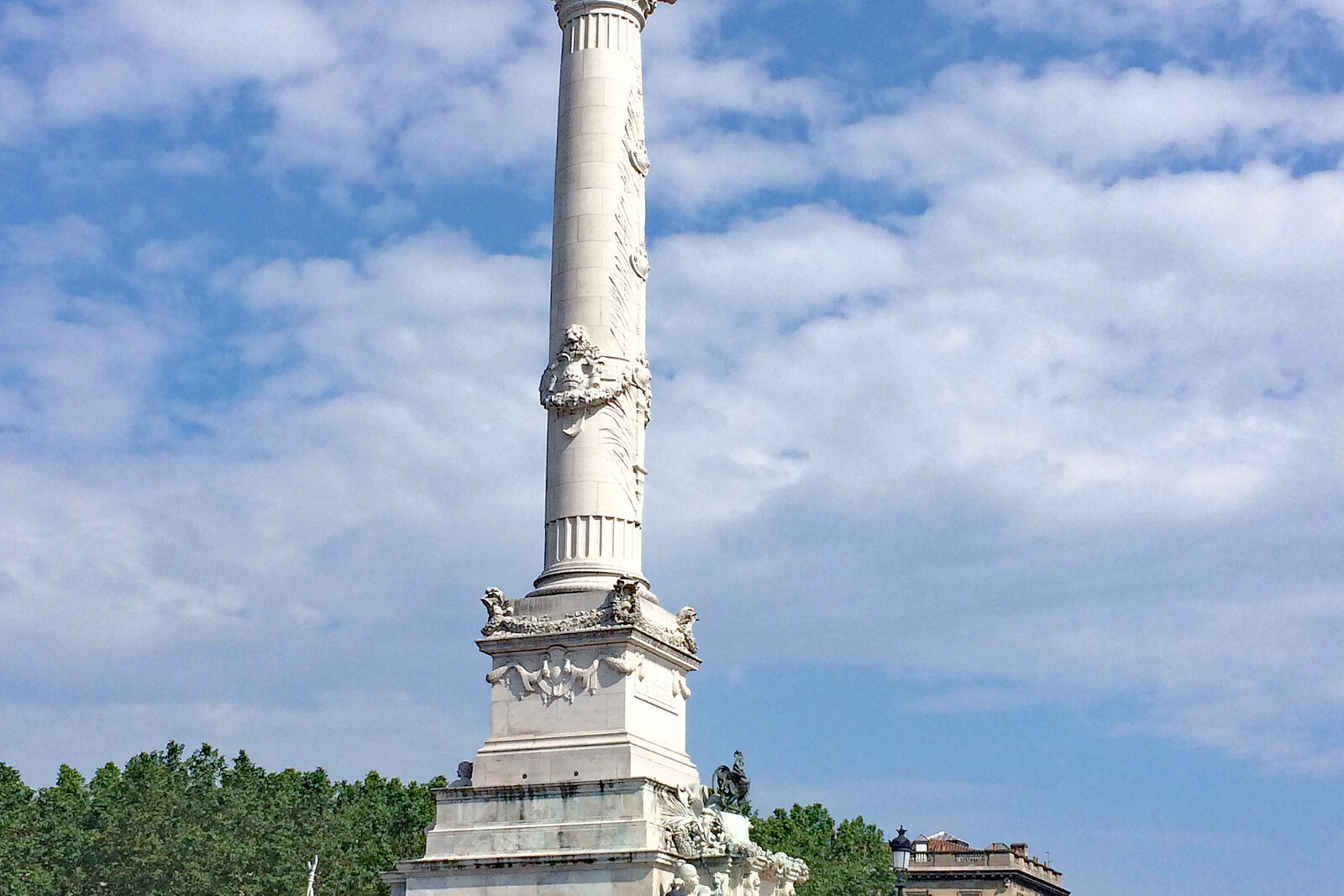
Look around first
What to notice
- Quincunx rows of trees
- Open esplanade
- Column of the Monument aux Girondins
- Fountain sculptural groups
The story of the place
Quincunx rows of trees surround the open esplanade that occupies former military land beside the Garonne. A bastioned citadel once stood here, and a broad strip without houses was kept before its ramparts so that nothing would obstruct the artillery. When the site was transferred to the city, part was sold for development while the middle was kept as a square and promenade garden; nothing of the walls remains above ground, though foundations were found underground during works. The trees were planted in the pattern of five dots on a die, which gave the square its name, and the former military field is now occupied by fairs, a circus, concerts, and a tram interchange.
In the summer of sixteen forty-nine, artillerymen from Château Trompette fired on Bordeaux and its port from the site of today’s square. The order came from the Duke of Épernon, the royal governor of Guyenne: the townspeople were resisting new levies and his rule, while the governor was trying to force them into obedience.
The fortress had been built here two centuries earlier for a similar reason. Bordeaux had belonged to the English Crown for almost three hundred years, and local merchants made their living above all by selling wine to England. When French troops first occupied the city, the people of Bordeaux soon let the English back in. After the final French victory of fourteen fifty-three, King Charles VII ordered Château Trompette built on the Garonne. Its guns protected the river while also keeping the recently conquered city under fire.
By the middle of the seventeenth century, the fortress was an obstacle in the most literal sense. The military had pushed port activity downstream, toward the Chartrons district; along the water, only a narrow road remained, linking it to old Bordeaux. For people who earned their living through river trade, the dispute with the royal governor was not only about taxes: the fortress stood between the city and its wharves.
After the bombardment, the people of Bordeaux besieged Château Trompette. The garrison held out for three months and surrendered on October eighteenth. The victors first razed the wall facing the city to the ground. They included a condition in the peace agreement: if the Crown rebuilt Château Trompette, it could do so only within its former boundaries.
That condition did not save them. After suppressing the rebellions, Louis XIV ordered a much larger bastioned citadel to be built here. At Bordeaux’s expense, about three hundred houses, two monasteries, and the remains of Roman structures were demolished for it; a broad undeveloped strip was left before the ramparts for artillery fire. The townspeople secured the destruction of the hated fortress and received in return a fortress that occupied even more urban land.
The War Ministry gave up Château Trompette only at the beginning of the nineteenth century. The state transferred the fortifications and the site to Bordeaux, the municipality sold part of the land for development, and kept the middle for a square and a promenade garden. The dimensions of Place des Quinconces repeat the area of the citadel together with its open field. Nothing of the walls remains above ground; fragments of the foundations have been found underground during urban works.
In eighteen eighteen, trees were planted around the edges of the new esplanade in a quincunx pattern: four at the corners of an imaginary square and one in the center, like five dots on a die. In French, such planting is called a “quincunx.” At first the square was named after Louis XVI, then after Louis-Philippe, and in eighteen forty-eight it received its current name—from the pattern of the trees. The former artillery field now accommodates fairs, a circus, concerts, and a major tram interchange.
The cleared site also allowed the city authorities to place the enormous Monument aux Girondins here. This was the name given to a group of republican deputies, many of whose leaders represented the Gironde department. They prepared a draft constitution and tried to shield the National Convention from armed pressure by the Paris sections. On June second, seventeen ninety-three, National Guardsmen and sans-culottes surrounded the deputies in session and forced them to order the arrest of the Girondin leaders. Twenty-one of them were convicted and sent to the guillotine on October thirty-first.
Bordeaux decided to commemorate them almost a century later. The monument was erected between eighteen ninety-three and nineteen oh two: a column rose above the fountains, and bronze Liberty, breaking chains, was placed at the top. The sculptural groups were meant to include eight figures of the deputies themselves, but they were never cast. At the monument’s base are the Republic, Concord, History, and Eloquence; the places intended for the Girondins remain empty.
Useful on site
Open urban space; free access at any time.
Checked: June 28, 2026. Check the official source before visiting.The square is best read from a distance: first take in its emptiness as a whole, then approach the base of the monument. Everything important is visible from outside, but the open space offers almost no protection from the weather.