 Guide On Map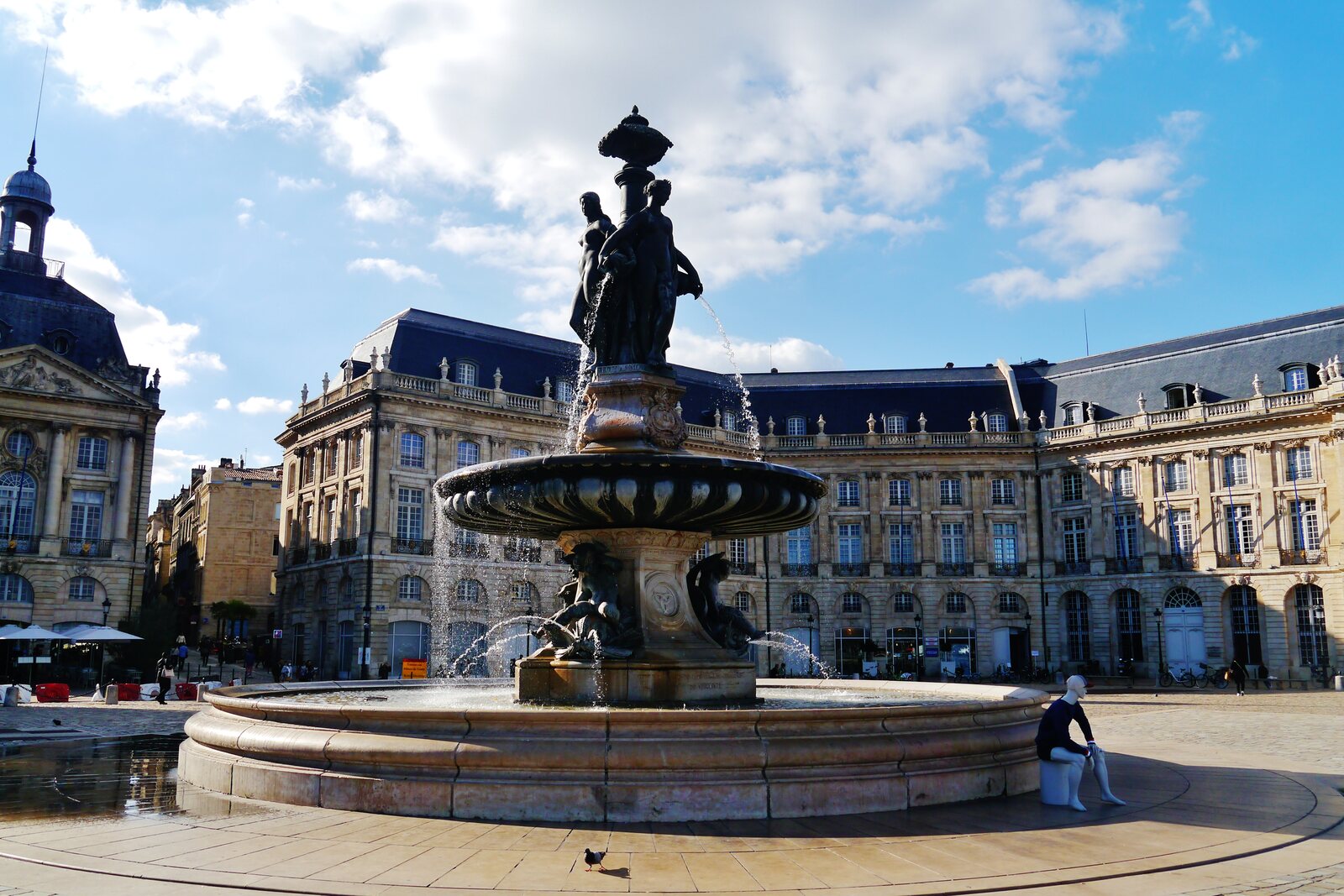
Look around first
What to notice
- Three Graces Fountain
- Northern and southern buildings
- Stone facade along the Garonne
- Open access to the promenade
The story of the place
From unloading a river vessel to a deal, there were only a few steps here: the square brought the entire port system together in one place. In the southern building, cargo was received, inspected, and charged duty, while in the northern one merchants set prices, concluded deals, and settled disputes in the commercial court. Two stone buildings stretch along the Garonne, leaving open access to the promenade. In the middle, the Three Graces Fountain murmurs in place of the vanished horseman, and the square's name still recalls the merchants' building in the northern wing.
In December seventeen twenty-eight, Bordeaux magistrate Jean-Jacques Bel prepared a lengthy protest in Paris against the construction of this square. The Parliament of Bordeaux had sent him—at the time, that name referred not to an elected assembly but to the province's highest court. Bel sought to have the king halt a project begun without the court's consent. His father had bought him the post of councillor; it defined his service and standing. If an official appointed by the king could bypass the Parliament in such a city matter, the weight of that post would diminish as well.
That official was Claude Boucher, the royal intendant—the head of the provincial administration. A medieval wall then stretched between the city and the Garonne. Boucher wanted to breach it, create a convenient place for unloading goods, and greet those arriving by river with an unbroken stone facade instead of fortifications. The city magistrates resisted for a long time. Boucher nevertheless secured their consent, but then the Parliament opposed him and sent Bel to press the case at court.
The king replied not with a letter, but by sending his First Architect, Jacques Gabriel, to Bordeaux. Gabriel surveyed the riverbank and prepared new plans. In February seventeen thirty, the Council of State authorized the start of the work. Bel lost this case and continued his judicial career; Boucher obtained the construction project but did not see its final result. In August seventeen forty-three, an equestrian statue of Louis XV was installed in the center, and less than three weeks later Boucher left Bordeaux. The buildings were completed by his successor and Jacques Gabriel's son.
On either side of the square, they placed the institutions through which port goods passed. Royal tax farmers worked in the southern building—a private company that collected taxes for the treasury. Cargo taken off ships was brought into its hall, inspected, and charged duty. The northern building housed a merchants' exchange, a chamber of commerce, and a commercial court. Here, an exchange meant above all a place where merchants set prices for goods and concluded deals, while judges heard their disputes. Its location directly on the Garonne shortened the route from unloading to inspection, price, and contract.
At first, the square was called Royal Square: the entire ensemble served as a setting for the bronze Louis XV. In August seventeen ninety-two, the revolutionary authorities voted to destroy the statue; it was removed and melted down. After further renamings, the square acquired its present name, Place de la Bourse, in eighteen forty-eight. The king was no longer in the center, but the merchants' institution in the northern building continued to operate.
The Bordeaux exchange ceased trading in nineteen ninety. Its building still houses the chamber of commerce and the commercial court; opposite, the customs service and the National Museum of Customs remain. The Three Graces Fountain, installed in eighteen sixty-nine, occupies the place of the vanished equestrian statue, and the square's name preserves the building that Bordeaux merchants entered after Boucher's victory.
Useful on site
Open urban space; free access at any time.
Checked: June 28, 2026. Check the official source before visiting.First stand closer to the river to see the square as a single ensemble, then walk over to the fountain. The National Museum of Customs inside the former administrative pavilion is a separate visit and not necessary for this account.