 Guide On Map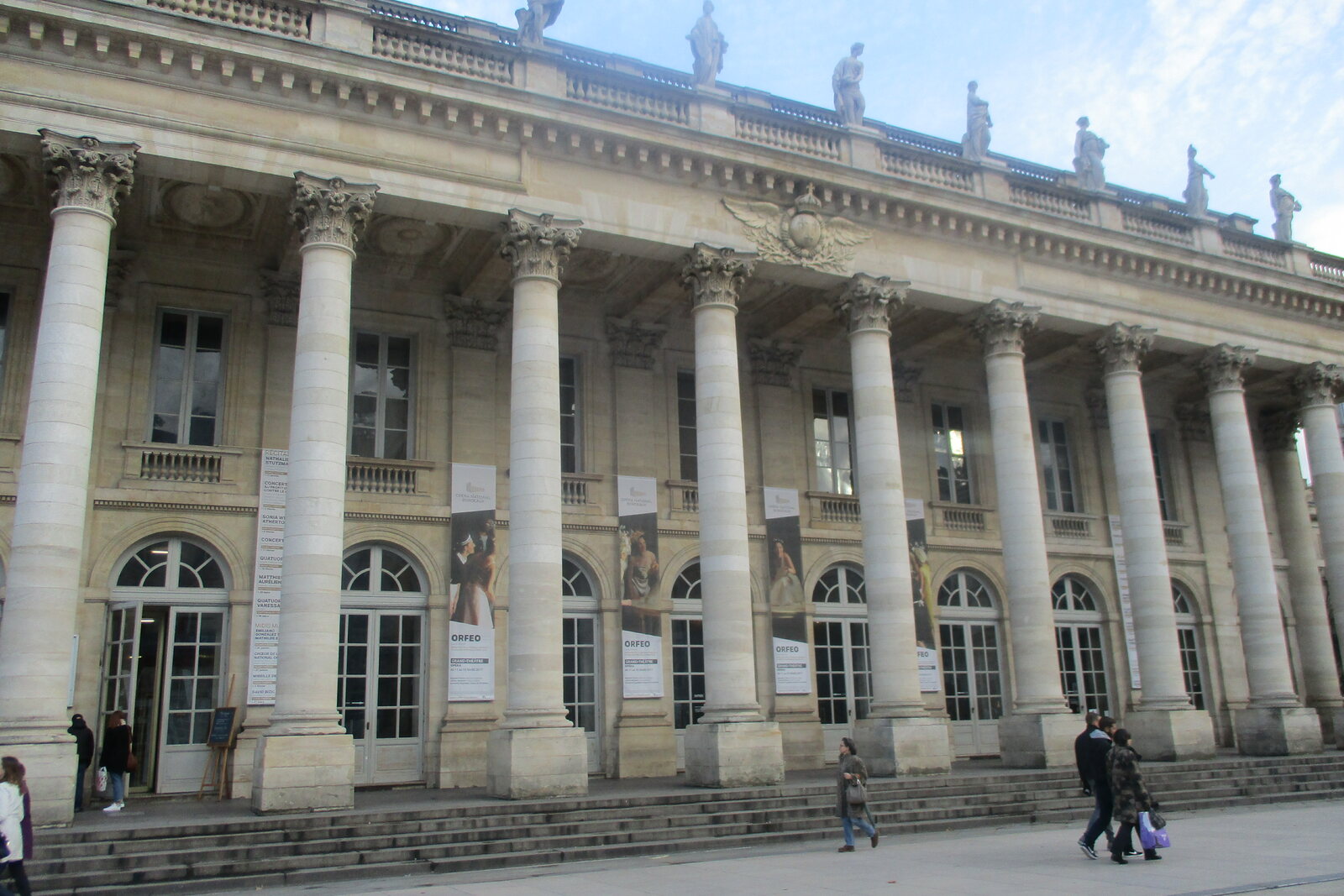
Look around first
What to notice
- Twelve Corinthian columns
- The facade behind the colonnade
- The audience boxes
The story of the place
A colonnade of twelve Corinthian columns faces the square, and behind it lies the large auditorium of the National Opera of Bordeaux. It was built after the previous stage burned down: the governor of Guyenne commissioned the design from Parisian architect Victor Louis, although the city magistrates favored another option. In seventeen eighty, the curtain rose in the new theater, and ever since then its boxes and orchestra seats have served opera and ballet.
In February eighteen seventy-one, the orchestra seats in the Grand Théâtre were covered with a continuous platform level with the stage. On the stage, they set up the chairman's desk, places for the secretaries, and a parliamentary rostrum. The boxes were given to the deputies, and rows of red velvet-covered benches were arranged before them. Architect Edmond de Joly was hurriedly turning the opera house into premises for the National Assembly.
They chose Bordeaux's largest public building for this. After France's defeat in the war with Prussia, Paris remained surrounded, and the government delegation retreated to Bordeaux. The newly elected deputies had to decide whether to accept the peace terms and form a new government.
By then, the theater had served the city for almost ninety years. After the old hall burned down, the governor of Guyenne, the Duke of Richelieu, entrusted the commission to Parisian architect Victor Louis, although the city magistrates supported another project. In seventeen eighty, a new stage opened here, with an auditorium enormous by the standards of the time. Today, operas and ballets of the National Opera of Bordeaux still take place behind its twelve Corinthian columns. It was precisely the size and layout of this hall that made it possible to accommodate hundreds of deputies here in eighteen seventy-one.
Among those elected was Giuseppe Garibaldi, an Italian republican and commander of a volunteer army who had come to fight for France. He had not even put himself forward as a candidate, but voters in four departments gave him mandates. Garibaldi wanted to support the republic with his vote and then resign: he remained a citizen of Italy and did not intend to make a career in the French parliament.
At the first session, the chairman read out Garibaldi's resignation statement. Garibaldi asked for the floor to explain his decision and thank the voters, but the chairman refused him. The general left the theater, and the townspeople and National Guardsmen gathered on the steps welcomed him.
Three weeks later, the deputies returned to his election. The candidate who had lost to Garibaldi in Algeria demanded that the Italian be declared ineligible and that the vacant seat be handed to him without a new vote. The reason was simple: Garibaldi was not a French citizen.
Then Victor Hugo took the rostrum erected on the stage—a writer, a deputy from the department of the Seine, and a convinced republican. For resisting the regime of Napoleon the Third, he had spent nineteen years in exile and returned to France only after the fall of the empire. This new mandate was his first elected office after his return.
Hugo reminded them that European states had not come to France's aid, while the Italian Garibaldi had come and fought. Deputies on the right-hand benches began shouting that the general had only pretended to take part in the war. One of them declared that Hugo's words insulted the country; another shouted that the Assembly did not wish to listen to such French.
Hugo tried several times to finish his speech. At last, he said that the deputies had first refused to hear Garibaldi and were now refusing to hear Hugo himself, and he announced his resignation. Descending from the rostrum, he took a pen from a stenographer and, standing at the edge of the stenographer's desk, wrote the statement. The chairman asked him to reconsider his action, but Hugo replied that he would not return to this hall.
Garibaldi never received a seat in the French Assembly. Hugo's term as a deputy ended here, beside the temporary rostrum on the theater stage. The platform over the orchestra seats, the red benches, and the stenographers' tables were later dismantled. Spectators once again sit in the boxes, and sets are installed where the parliamentary rostrum stood.
Useful on site
Outside—at any time. Official guided tour through the Office de Tourisme—from 10 euros, about 50 minutes, by reservation; on the first Sunday of the month the building is usually opened free of charge from 14:00 to 18:00.
Checked: June 28, 2026. Check the official source before visiting.The colonnade and figures clearly reveal the design without going inside. The blue, white, and gold interior can be seen only with separate access, so plan a tour or performance independently of the walk.