 Guide On Map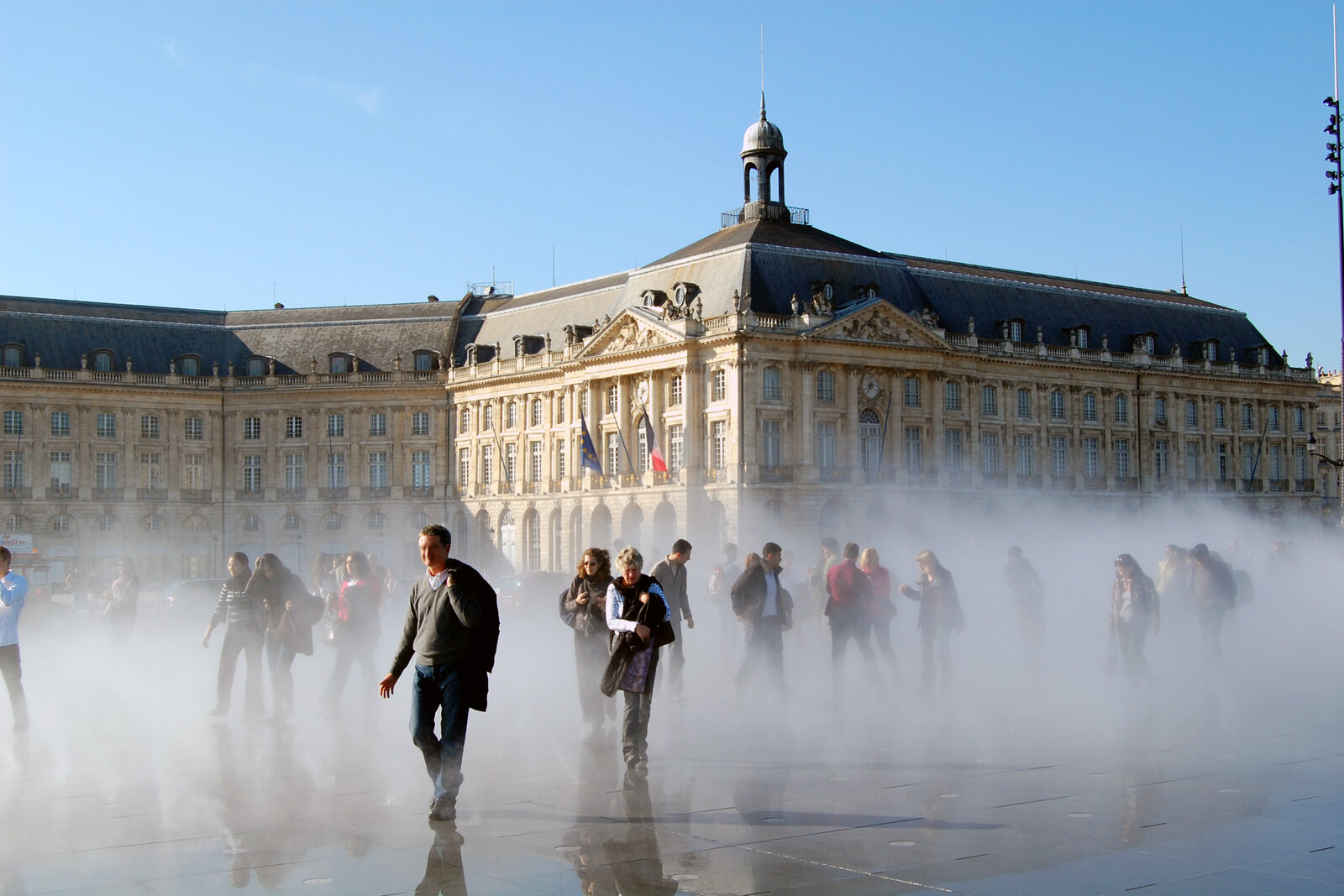
Look around first
What to notice
- Granite slabs
- Joints between the slabs
- Built-in nozzles
- A thin layer of water or mist
The story of the place
Beneath the flat granite expanse by Place de la Bourse, technical equipment is hidden that alternately turns the square into a mirror and a mist-covered space. Water emerges through the seams between the slabs, settles so thinly that the entire facade opposite fits within it, and then flows back. Once it has drained, mist rises from the same slabs, and the smooth surface without an edge remains a place where, on a hot day, people walk and run through the water.
Around the turn of the two thousands, landscape architect Michel Corajoud came here as one of five contenders for a major commission: redeveloping four and a half kilometers of Bordeaux's waterfronts. The outcome of the competition would determine whether his studio got the job. Before Corajoud lay an awkward site—the roof of an old port warehouse. It had once been sunk into the ground directly opposite Place de la Bourse so that the freight structure would not block its facades from the Garonne.
The competition organizers suggested finding a new use for the warehouse. Corajoud refused. After rain, he said, Place de la Bourse was reflected in a puddle on the warehouse roof. That single puddle suggested the design for the whole site: leave the underground room to the technicians and create a flat surface above, which water would alternately cover and uncover.
The project by Corajoud and architect Pierre Gangnet won. Turning the drawing into a working system was entrusted to fountain engineer Jean-Max Llorca. He made his living designing urban fountains, but here the water had to behave quite differently: spread evenly across an area of three thousand four hundred fifty square meters, remain only two centimeters deep, and then disappear without a trace.
Llorca placed an eight-hundred-cubic-meter reservoir, pumps, and solenoid valves in the former warehouse. Water rises through channels and emerges through the joints between the granite slabs. When the surface fills, the entire reflection of Place de la Bourse fits within it. Then the water is drained, and nine hundred nozzles built into the slabs release mist. That explains the name “Miroir d'eau”—“Water Mirror”: there is almost no water here; its task is to bring the facades of the square back to the ground for a short while.
In his competition drawings, Corajoud showed a calm architectural reflection. The team did not foresee how people would behave. After the opening in two thousand six, visitors began stepping into the water, children began running across the granite, and adults began using the mist in hot weather. During the first year, city services had to work out how to deal with this new use of the square; then they accepted it. The absence of an edge, intended to create an uninterrupted reflection, turned the fountain into a surface people could walk across.
For Llorca, the Bordeaux commission became an international recommendation: afterward, the firm began receiving commissions for versions of water mirrors from Paris to Shanghai and Qatar. After Corajoud's death, Bordeaux named after him the promenade quay running along both banks of the Garonne.
Beneath the dry granite still lies that very port warehouse for which Corajoud refused to seek a public use. Inside it, the pumps prepare the next thin film of water; above, people cross the square, which in a few minutes will once again receive the reflection of the facades.
Useful on site
Outside the winter period: daily 10:00-22:00. From November to April, the site is usually switched off for maintenance.
Checked: June 28, 2026. Check the official source before visiting.If the mechanism is running, wait to see at least two states change—the mirror reveals itself only over time. Walk carefully on wet granite; when the water is switched off, view the site as a vantage point overlooking Place de la Bourse.