 Guide On Map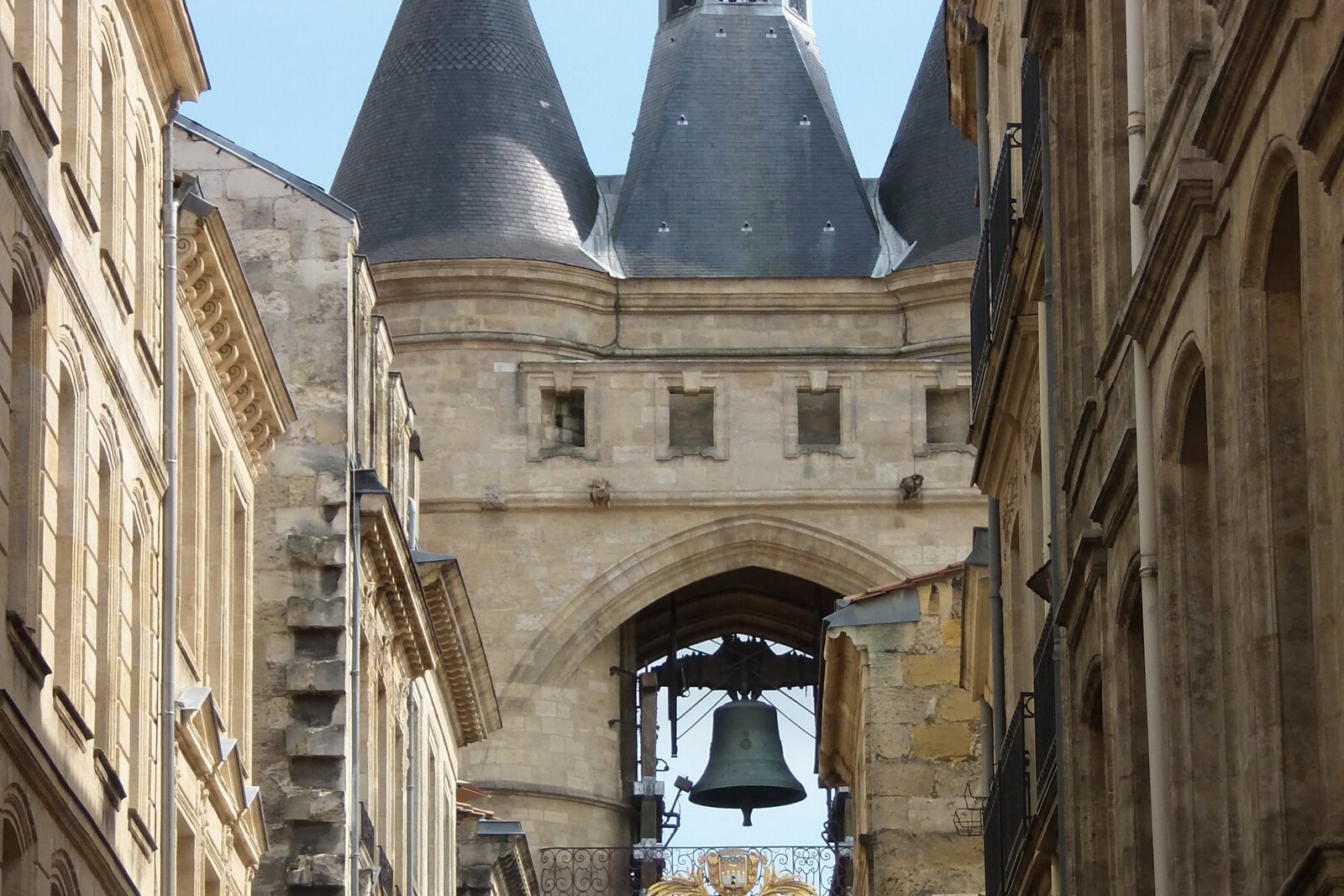
Look around first
What to notice
- Two round towers
- Pointed roofs
- The passageway of the former gate
- The bell above the passageway
The story of the place
Of Bordeaux’s old town hall, only two round towers and the arched passageway of Porte Saint-Éloi remain. The jurade, the city council of magistrates, met in the town hall, and people entered the city through these gates. Above the arch hangs the bronze bell Armande-Louise, cast in seventeen seventy-five and weighing about seven thousand seven hundred fifty kilograms. The entire remnant of the town hall came to be called Grosse Cloche after it.
On July second, fifteen forty-nine, the mathematics teacher Élie Vinet returned to Bordeaux from Portugal. Here, at the Collège de Guyenne, he earned his living by teaching and intended to take up his chair again. The familiar city confronted him with an unusual problem: there was almost nowhere to find out the time. Royal soldiers had removed the city clocks and destroyed the bells. The people of Bordeaux began making sundials, but few knew how to mark them correctly.
The main blow had fallen on the towers before Vinet. At that time, the old town hall adjoined them, where the jurade—the city magistrates—met. They controlled the bell above Porte Saint-Éloi. Its ringing summoned residents, warned of fire, and opened the grape harvest. For a winegrower, this signal could mean the value of a harvest: anyone who began picking before the appointed day faced a fine and confiscation of the bunches already picked. The city bell determined when people were to go out into the fields and in what order to take grapes to the presses.
In fifteen forty-eight, King Henry II tried to extend the gabelle—a salt tax—to Guyenne. Salt was needed every day to preserve meat and fish, so the levy affected both peasants and urban merchants. A revolt that began in the surrounding area reached Bordeaux. A crowd killed Tristan de Moneins, the royal lieutenant, who had gone out to negotiate with the rebels.
The king sent Anne de Montmorency, the constable—the commander in chief of the royal army—to Bordeaux. Montmorency was to punish the city and strip it of its former privileges. He dissolved the jurade, the city council of magistrates, took the gate keys from the magistrates, and ordered the town hall’s demolition to begin. Here, his men removed the pointed roofs from the towers, threw down the clocks, and lowered the bell. Other city bells were also removed, taken to Château Trompette, or broken up.
This is how Vinet saw the consequences of the repression several months later. The mathematics teacher answered them through his profession: he compiled a practical guide to sundials. He explained how to draw the hour lines and set up a dial so that townspeople could tell the time without tower mechanisms. The book was reprinted several more times.
The punishments were lifted gradually. In fifteen fifty-six, Henry II allowed the towers to be roofed again, and in fifteen sixty-one Charles IX permitted the bell to ring again. The original bronze has not survived to the present day. The bell above the passageway was cast in seventeen seventy-five and named Armande-Louise; it weighs about seven thousand seven hundred fifty kilograms. Its name passed to the entire structure—Grosse Cloche. Of the town hall that Montmorency began to demolish, two round towers and the passageway of the former Porte Saint-Éloi remain.
Useful on site
Outside — at any time. Official tour — from 6 euros, about 30 minutes, guided only; inside there are many steps and narrow passageways. Children under 6 are not admitted to the interior route.
Checked: June 28, 2026. Check the official source before visiting.Do not expect to hear Armande-Louise during an ordinary visit: the point of this stop does not depend on its ringing. The prison rooms and the bell itself are part of the interior visit, which must be planned separately.