 Guide On Map
La Candelaria: Gold and Power
From Santander Park through Plaza de Bolívar to Chorro de Quevedo
Guide On Map on your phone
Open the walk like a regular app
It takes about 10 seconds to install. No app store needed.
The whole path
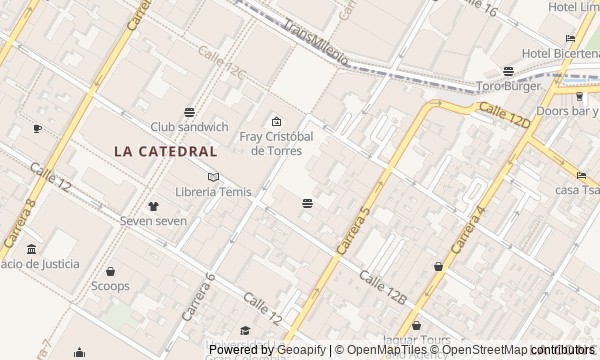
Route map
About the walk
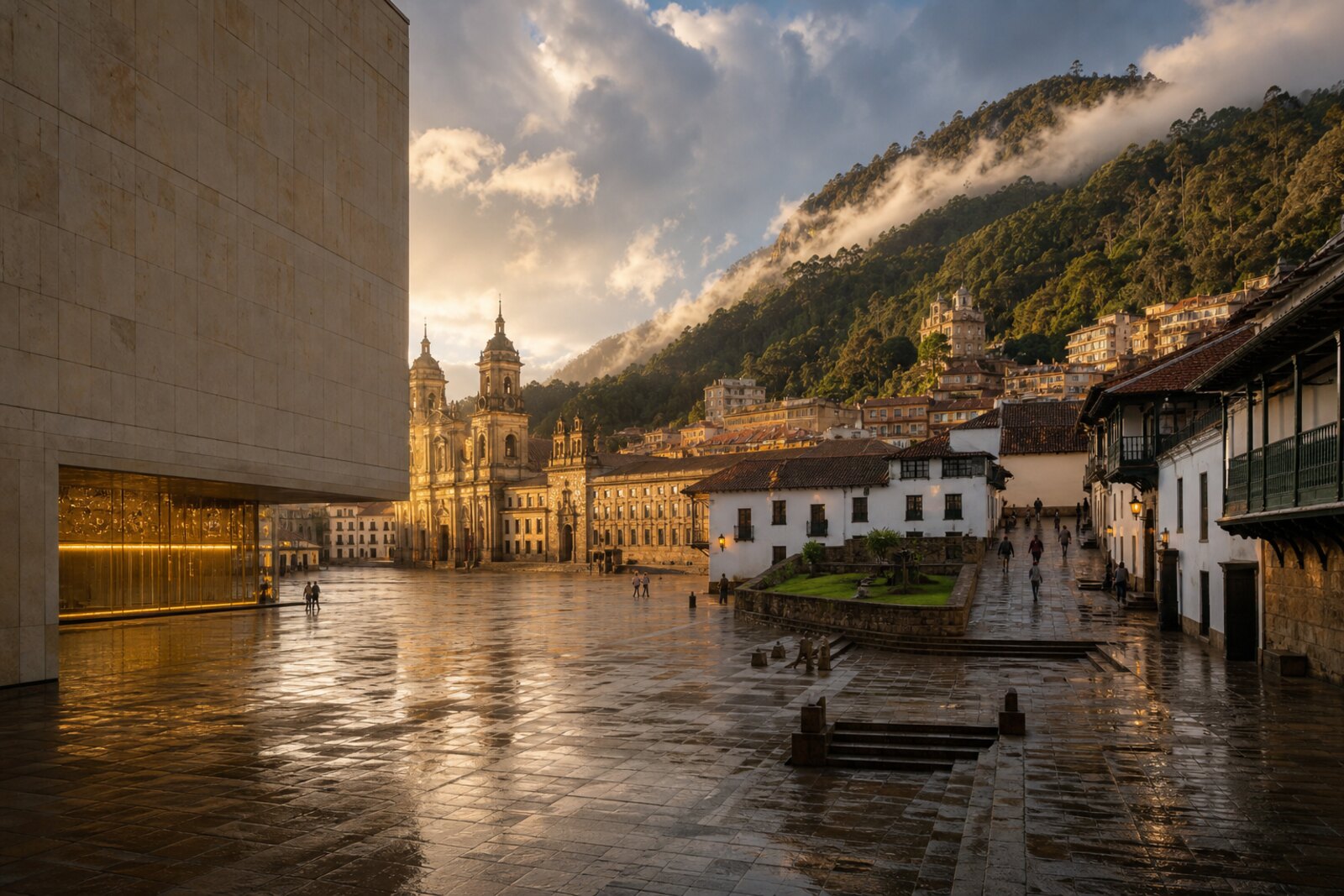
You will walk from Santander Park through Bogotá's old administrative center to the streets of La Candelaria and Chorro de Quevedo. The route passes the white cube of Museo del Oro, a colonial church, a university cloister, the main square, the cathedral, and the museum courtyards of the Bank of the Republic.
This is a walk about people who decided what to preserve, whom to obey, and whose name would remain on the city's map. You will encounter a museum for which one floor proved too little, a commission that outlived its makers, student elections with colonial roots, and a fountain that vanished together with the statue of its owner.
The story will be calm and precise. Documents will be separated from legends, and major political changes will emerge through a letter, a ballot box, a balcony, an agreement, and a stone basin.
By the end, you will be able to connect gold, cathedral chapels, a university facade, and a public stream into a story of how Bogotá fixed power into buildings and names.
Why this order
Santander Park sets the theme of urban memory, while Museo del Oro on its eastern side immediately shows another way of preserving the past: through a state collection. Returning through the same park to the Church of San Francisco shifts the conversation from a museum building to a colonial commission and the people who carried it out. Across the street, Claustro del Rosario continues the institutional theme, this time through a dispute over the right to govern it. A straight walk south leads to Plaza de Bolívar, where the struggle for autonomy moves from enclosed spaces into the public square. The Primatial Cathedral of Colombia on its eastern side adds the church's memory of the city's founder to civic power. From the cathedral's northern corner, the climb toward the former archbishop's house links old church property to Manzana Cultural. The final ascent to Chorro de Quevedo takes the route from major institutions to a public fountain whose name endured without a palace, museum, or state decision.
Those who want to understand the political and cultural geography of central Bogotá Those interested in the human decisions behind museum collections and urban monuments Those who enjoy connecting visible details with documents and precise stories
Those looking for a walk only about pre-Columbian gold Those who prefer a route without museums and church interiors Those who want a light overview of sights without historical conflicts
Before you go
The route is short in distance, but the altitude, climbs, and density of impressions call for an unhurried pace. Bring water, rain protection, and a layer for sudden changes in weather. Check access to Museo del Oro, Manzana Cultural, and the Primatial Cathedral of Colombia in advance: each place has its own schedule, and services or operational restrictions may change visiting conditions. Do not count on entering Claustro del Rosario without checking access first. Plaza de Bolívar may have barriers, security checks, and large public events; follow security instructions and do not try to bypass closed sections.
When to go
Start in the first half of the day if you want to go inside museums and churches. A later time also works for a walk that is mostly outdoors, and Chorro de Quevedo comes alive toward evening.
Backup plan
If a museum or church is closed, do not cross the stop off the route: at the Church of San Francisco and the Primatial Cathedral of Colombia, the facades and their place among neighboring institutions matter, while at Museo del Oro and Manzana Cultural, the contrast between the museum buildings and the street matters just as much. A closed Claustro del Rosario can be replaced by observing the square, entrances, and life around the university. If Plaza de Bolívar is blocked off, follow the accessible edge without approaching the cordon and continue only along open streets. In heavy rain, limit indoor visits to one museum complex and listen to the remaining stories under cover or after the walk.
Route conditions
Surface. Paved — 1.8 km (data covers 90% of the route)
Facilities. Toilets — 1
Elevation. Ascent — 32 m; descent — 12 m
OpenStreetMap extract of June 23, 2026: database data, not a check on the ground. Data © OpenStreetMap contributors, ODbL licence
Walk plan
Open in maps ↗- 1
Santander Park
Here, a family decision will collide with sanitary reform, and a private house will give its name to a city square. - 2
Museo del Oro
This stop will show how objects intended for melting down became a collection that required its own building. - 3
Church of San Francisco
The main retablo retains the trace of a long commission that passed from one master to another. - 4
Plazoleta del Rosario and Claustro del Rosario
Here it will become clear why the old college had to be defended from the order even after its founder's death. - 5
Plaza de Bolívar
The main square becomes the scene where market day ended with the creation of an autonomous governing council. - 6
Primatial Cathedral of Colombia
The cathedral will show how the remains of the city's founder were turned into a municipal monument and then returned to a church chapel. - 7
Manzana Cultural: Museo Botero and Casa de Moneda
Former industrial and church buildings will be joined into a district created for one private collection. - 8
Chorro de Quevedo
The final stop will explain how the landowner’s surname outlived the old fountain and its stone statue.
Route features
Everything you need stays in the browser
Progress, saves and your trip plan are stored on this device.
Add Guide On Map to your home screen so the walk opens outside the browser.
How we handle sources, maps and corrections: our editorial standards