 Guide On Map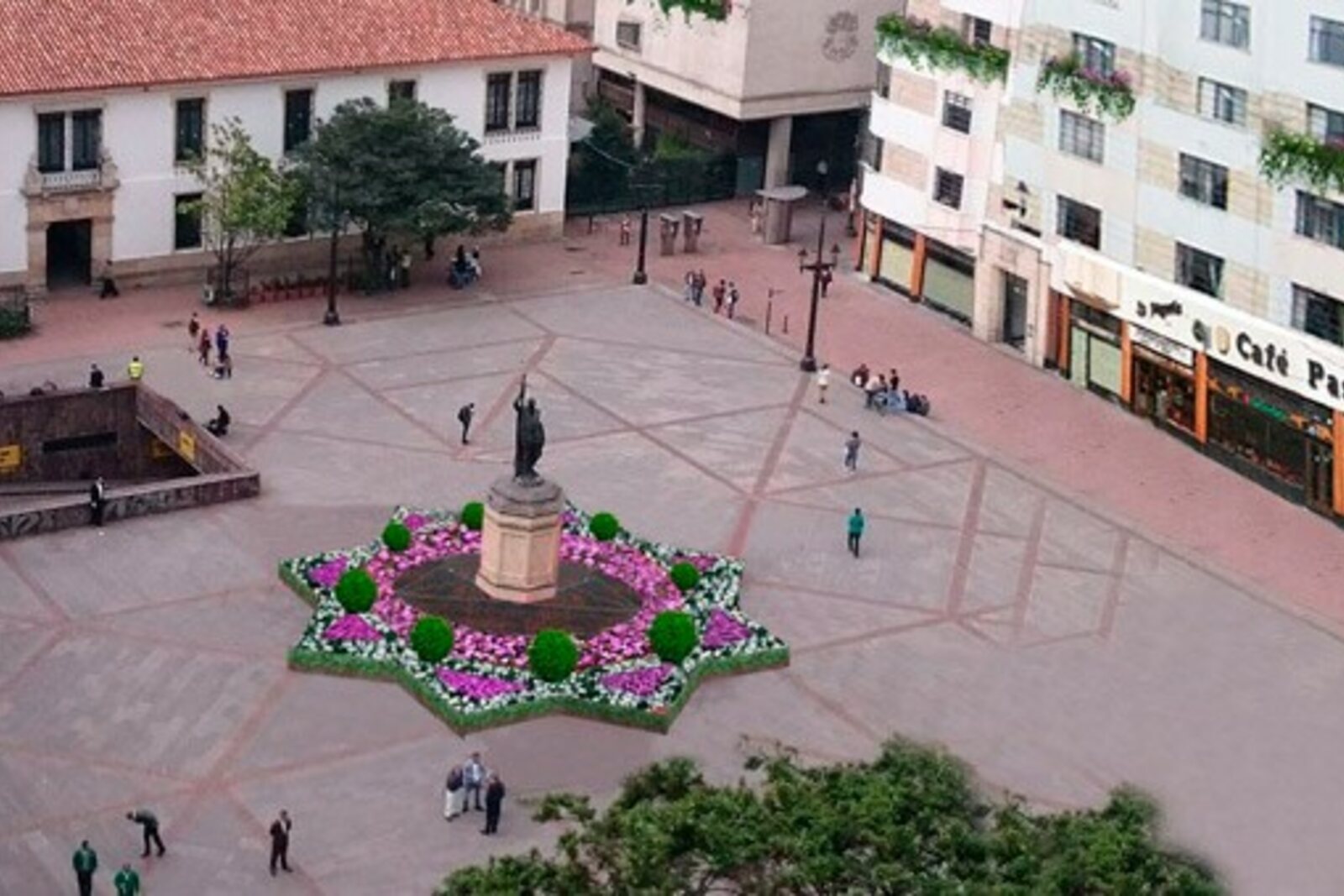
Look around first
What to notice
- Old university facade
- Pediment of La Bordadita Chapel
- Our Lady with Child
- Kneeling figure of the founder
The story of the place
Behind the old university facade, a small number of scholarship holders once lived with full support. The college trained theologians, lawyers, and doctors from the local lay nobility, and its life was paid for by income from estates transferred to it. Above the entrance to La Bordadita Chapel, Our Lady with Child occupies the center of the pediment; below her, the figure of the founder kneels before her.
Plazoleta del Rosario and the facade behind it belong to different eras. The square was opened only in nineteen seventy-four, after the demolition of a city block that had stood here. Students, teachers, traders, and employees of nearby institutions now pass through it. The square's name repeats that of its neighbor, three centuries older: Claustro del Rosario, the old building of what is now Universidad del Rosario.
The word “Rosario” here means the Rosary prayer. The Dominican friar Cristóbal de Torres, Archbishop of Santa Fe, had a particular devotion to the Virgin Mary under that name and dedicated the college he planned to her. In La Bordadita Chapel, Our Lady with Child is placed at the center of the pediment, while Torres himself is shown below, kneeling.
The archbishop wanted to educate future theologians, lawyers, and doctors from the local lay elite here. In Santa Fe, the Dominicans and Jesuits were already disputing the right to grant academic degrees; Torres intended to remove the new college from the rivalry between the two orders. He secured permission from the Spanish Crown, invested his own property in the institution, and transferred estates to it, whose revenues were to support the students.
In sixteen fifty-three, the first scholarship holders were housed in Claustro del Rosario. They were called colegiales: they received full support and could live here until they completed their studies, about seven years. The number of places depended on the college's income and usually did not exceed fifteen. This was a narrow circle of young men whose origins met the colonial requirements for the lay nobility.
Torres gave the first posts of rector and vice rector to two fellow Dominicans. The leaders of the order decided that, along with these appointments, the archbishop had handed them the entire college, and they tried to incorporate it into their educational institutions. Torres withdrew the appointments. He entrusted the running of the college to Cristóbal de Araque, his trusted ecclesiastical administrator, who was to preserve the institution for the scholarship holders.
The archbishop then drew up the college's constitutions. In them, he set out the order of study, the management of property, and the selection of leaders. The colegiales themselves received the right to take part in appointing the rector. For a colonial college, this was an unusual arrangement: students living on its funds also decided who would manage those funds.
On July seventh, sixteen fifty-four, the gravely ill Torres signed his will. He left the college the remainder of his archiepiscopal income, again named Araque as rector, and demanded that the lawsuit against the Dominicans continue. He also asked to be buried in the chapel here. The next day, the founder died without learning the outcome of the dispute.
Araque sought to carry out his wishes for another ten years. In sixteen sixty-two, he went to Madrid and presented the case to the royal court. Two years later, the Crown approved the constitutions, recognized Araque as rector, and rejected the Dominican Order's claim to the college. Araque carried out his commission, but he did not return to Santa Fe: he died in Madrid.
The university still operates behind the old facade. Fifteen colegiales, together with the university council, still elect the rector by secret ballot for four years. Another of Torres's wishes was fulfilled later: in seventeen ninety-three, his remains were moved from the city cathedral to La Bordadita Chapel. They lie beneath the same pediment where the founder is shown kneeling before Our Lady of the Rosary.
Useful on site
The open small square is freely accessible; the interior spaces of Universidad del Rosario depend on campus hours.
Checked: June 28, 2026. Check the official source before visiting.The claustro belongs to a working university, so visit it only where access is permitted; you can also take in the square from outside.