 Guide On Map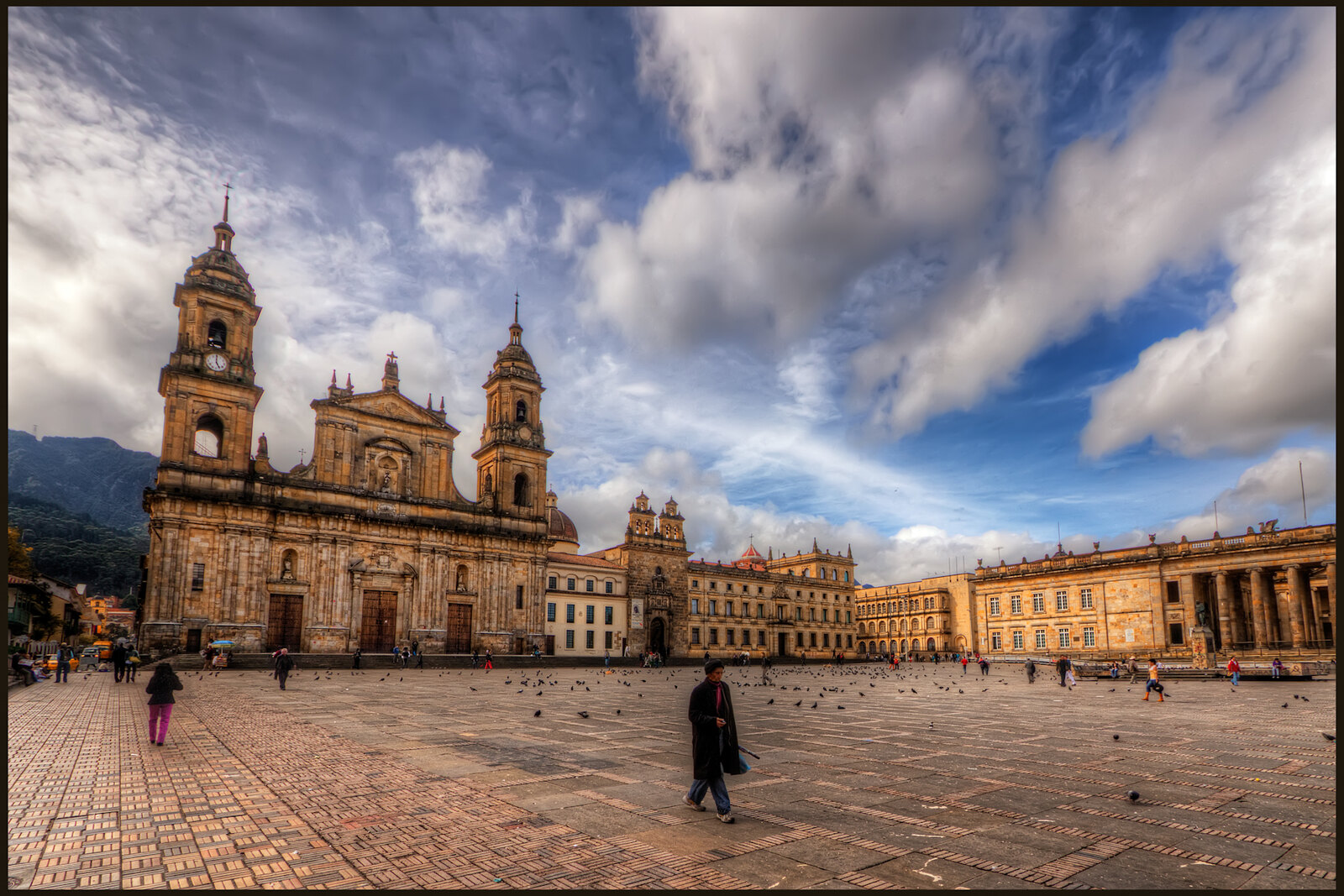
Look around first
What to notice
- Bronze statue of Bolívar
- Sword
- Constitution
- Facades of the National Capitol, City Hall, the Palace of Justice, and the Primatial Cathedral of Colombia
The story of the place
The National Capitol, City Hall in Liévano Palace, the Palace of Justice, and the Primatial Cathedral of Colombia stand on the four sides of Plaza de Bolívar. The western side was once occupied by the city council, the Cabildo; the old building is gone, and City Hall now operates in its place. A bronze Bolívar stands in the center; before it, there was the stone fountain Mono de la Pila, where residents came for water. Ceremonies and large gatherings are still held in this open space between the city's main institutions.
By the evening of July twentieth, eighteen ten, José Acevedo y Gómez had stepped onto the balcony of the city council above the western side of this square. Bogotá was then called Santa Fe, and the square Plaza Mayor, the Main Square. Below, the Friday market was still underway, but trade had already given way to a crowded gathering.
Acevedo y Gómez himself had built a fortune through large-scale trade. At the same time, he was a regidor—a member of the city council, or Cabildo. That day, he was pressing for an emergency meeting of the Cabildo and the creation of a local junta, a provisional governing council. The viceroy already considered this wealthy official a dangerous opponent.
Two years earlier, French troops had invaded Spain, and King Ferdinand VII had been forced to abdicate. Spanish cities were setting up their own juntas in the name of the captive monarch. Natives of New Granada, the Spanish possession that included present-day Colombia, demanded the same right for Santa Fe. Their plan was obstructed by Viceroy Antonio Amar y Borbón: he did not want to hand decisions over to the local council. The conspirators needed pressure from a large number of people, and they chose a market Friday. A quarrel over a vase in a nearby shop set off the chain of events after which townspeople filled the square.
Acevedo y Gómez needed to keep them here. From the balcony, he warned: if the people dispersed, in twelve hours they would be treated as rebels—cells, shackles, and chains awaited them. This was precisely tied to the place: beside the Cabildo stood the city jail, officials' offices, and the viceroy's residence.
The crowd proclaimed Acevedo y Gómez its representative. In the evening, the Cabildo convened, and he proposed the names of the members of the Supreme Junta. During the night leading into July twenty-first, those involved signed the act creating it. This document did not yet declare a complete break with Spain: it maintained loyalty to Ferdinand VII. But New Granada now had its first autonomous governing council.
For Acevedo y Gómez, the story did not end on the balcony. When Spanish troops retook Santa Fe in eighteen sixteen, participants in the first republican governments began to be hunted down and executed. The merchant left the city and hid in the southern forests. In May of eighteen seventeen, he died among the mountains of the Andakí people, still hiding from his pursuers.
The old Cabildo is gone. Liévano Palace stands in its place and houses Bogotá City Hall. The National Capitol, the Palace of Justice, and the Primatial Cathedral of Colombia also face this square. State ceremonies and public gatherings are held here because all these institutions open onto the same public space.
During Acevedo y Gómez's speech, the stone fountain Mono de la Pila stood in the center of the square, and residents drew water from it. Its place was taken by the man whose name the square now bears. Simón Bolívar commanded the army seeking to free New Granada from Spanish rule. After the victory at Boyacá in eighteen nineteen, his troops gained a route to the capital, and on August tenth Bolívar was welcomed here.
Twenty-three years later, the entrepreneur José Ignacio París, whose earnings included developing the Coscuez emerald mines, commissioned a bronze statue of Bolívar for his country estate. When the monument arrived in Bogotá, París abandoned his private plan and gave it to Congress. The legislators chose Plaza Mayor. The fountain was moved, and the statue was unveiled on July twentieth, eighteen forty-six—the anniversary of Acevedo y Gómez's speech. The square was then named after Bolívar.
The original Mono de la Pila is now in the courtyard of the Colonial Museum. In its former place, the bronze Bolívar holds a sword and the Constitution.
Useful on site
Open civic square; access routes may change because of security, rallies, and government events.
Checked: June 28, 2026. Check the official source before visiting.Look around from the open part of the square and take barriers, demonstrations, and heightened security into account; do not go around closed areas.