 Guide On Map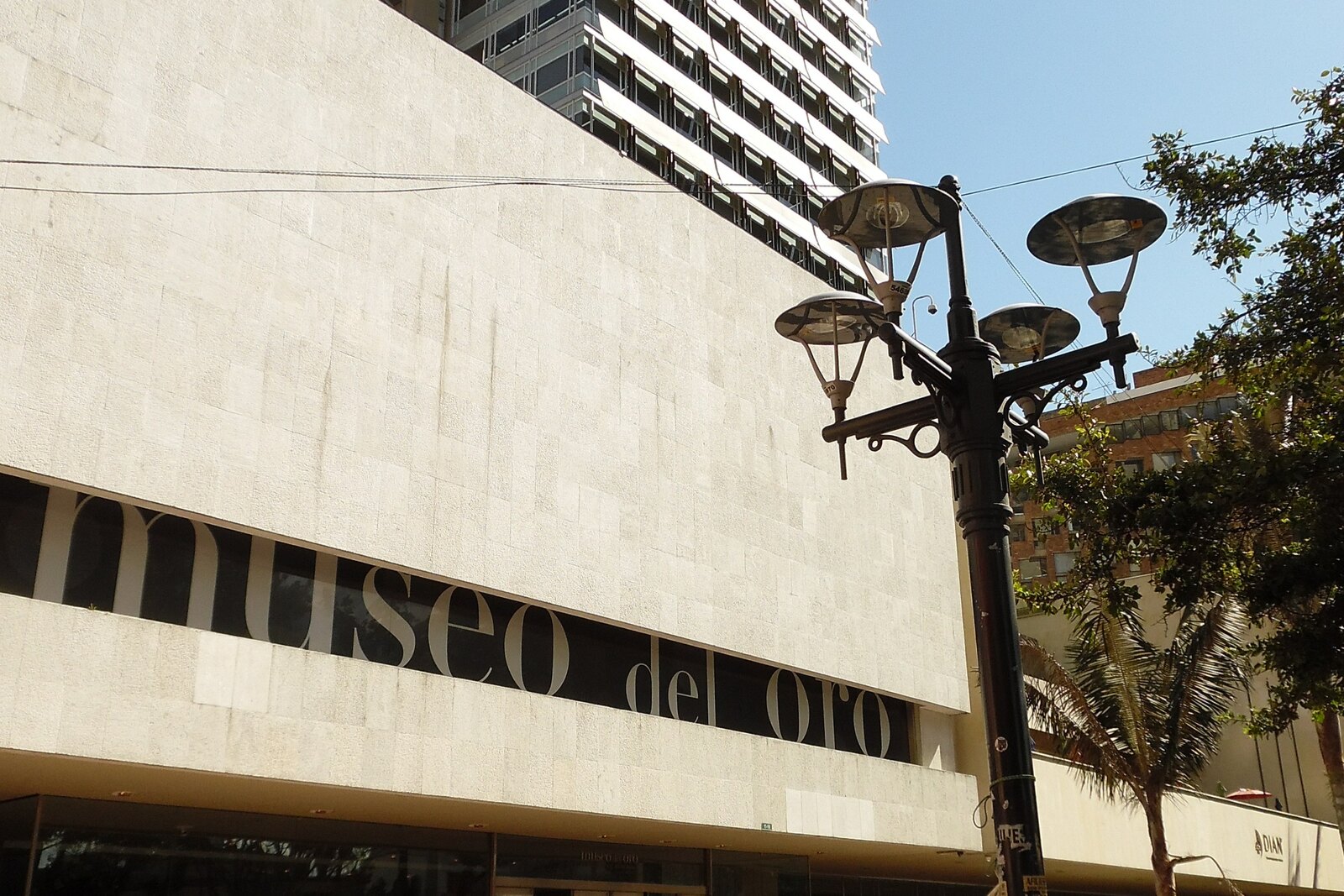
Look around first
What to notice
- Glass ground floor
- Solid marble volume
- Staircase to the galleries
- Quimbaya Poporo
The story of the place
The glass ground floor supports a white marble mass without windows. Inside are galleries where the light is directed toward small gold objects rather than the interior. Here the Bank of the Republic stores and displays objects made by peoples who lived in what is now Colombia before the Spanish conquest. The gold speaks not only of craftsmanship: in the exhibition, it is connected with labor, social standing, rituals, and gifts.
The white cube beside Santander Park grew out of a dispute over how much of the building to allocate to the museum: the top floor or all four.
That dispute began far from the present galleries. In the late nineteen thirties, the Bank of the Republic, Colombia's central bank, controlled the gold trade. Ancient gold objects sent from a regional purchasing station arrived at its Bogotá office. The usual fate of such metal was brief: melting down. The bank manager, Julio Caro, ordered that the finds be preserved.
In March nineteen thirty-nine, the minister of education, Alfonso Arango, suggested that Caro buy pre-Columbian objects before they went to dealers or into the melting furnace. Among the items offered was the Quimbaya Poporo, a gold vessel used to hold lime for chewing coca leaves. The bank paid twice the value of the gold it contained. For a financial institution, that was an important distinction: the object was valued above the raw material.
At first, the collection was kept in the bank's boardroom. As private collections were purchased, thousands of objects surrounded the tables and cabinets. Later, the objects were displayed in the bank building, at first almost exclusively for distinguished guests. Only in nineteen fifty-nine was the exhibition in the bank basement opened to the general public. That is how the name “Museo del Oro” arose—literally, “Museum of Gold.” Here, objects made by peoples who lived in what is now Colombia before the Spanish conquest were collected, and researchers studied who made them, who owned them, and what they were used for.
Two years later, the bank manager Eduardo Arias Robledo commissioned the architect Germán Samper to design a new building on this site. Samper was a partner in a private architectural firm already handling commissions for the bank, and he was seeking a new major project. The brief looked more modest than the present museum: the collections were to be given the top floor, with the remaining space assigned to other departments.
Samper frankly admitted that his firm did not know how to arrange a museum of ancient gold. He turned to Luis Duque Gómez, director of the Institute of Anthropology, who needed space to study, store, and display the growing collection. Duque replied that the collection needed the whole site. The architects prepared a design for a four-story museum.
A bank reviewer responded negatively to it. Samper had to explain why an institution that had begun with a few objects in the manager's office should be given an entire building. He proposed a thought experiment. If, after opening, a visitor remembered the stone finishes, the striking staircases, and the architects' skill, but could say almost nothing about the gold objects, the designers had failed. The precious objects required a good case, but the case must not compete with its contents.
The next day, Arias Robledo allowed the work to continue, appointing another architect to supervise it. Samper abandoned exterior images of idols and ornament. Above the glass ground floor, he raised a solid volume clad in pale matte marble; inside, a staircase led to windowless galleries, where the lighting could be directed toward the small objects.
The museum opened here in nineteen sixty-eight. Two years later, Samper received the National Architecture Prize for it. When the collection again no longer fit, the bank commissioned the same architect to expand it. The new wing doubled the area, and in nineteen oh eight the two wings were joined by a renewed exhibition.
Samper's original case remains by the park: a transparent lower floor and a white solid box above it. Inside, gold is displayed according to its ancient functions—as the result of craftspeople's work, a sign of status, part of a ritual, and an offering. The Quimbaya Poporo, for which the bank first paid more than the price of the metal, is kept in this building with the collection for which one top floor proved too little.
Useful on site
Museo del Oro: according to the Bank of the Republic, usually Tue-Sat 09:00-19:00, Sun 10:00-17:00, Monday closed; check rates/holidays.
Checked: June 28, 2026. Check the official source before visiting.A full visit requires separate time; if you enter during the route, focus on the poporo and the raft, checking access in advance.