 Guide On Map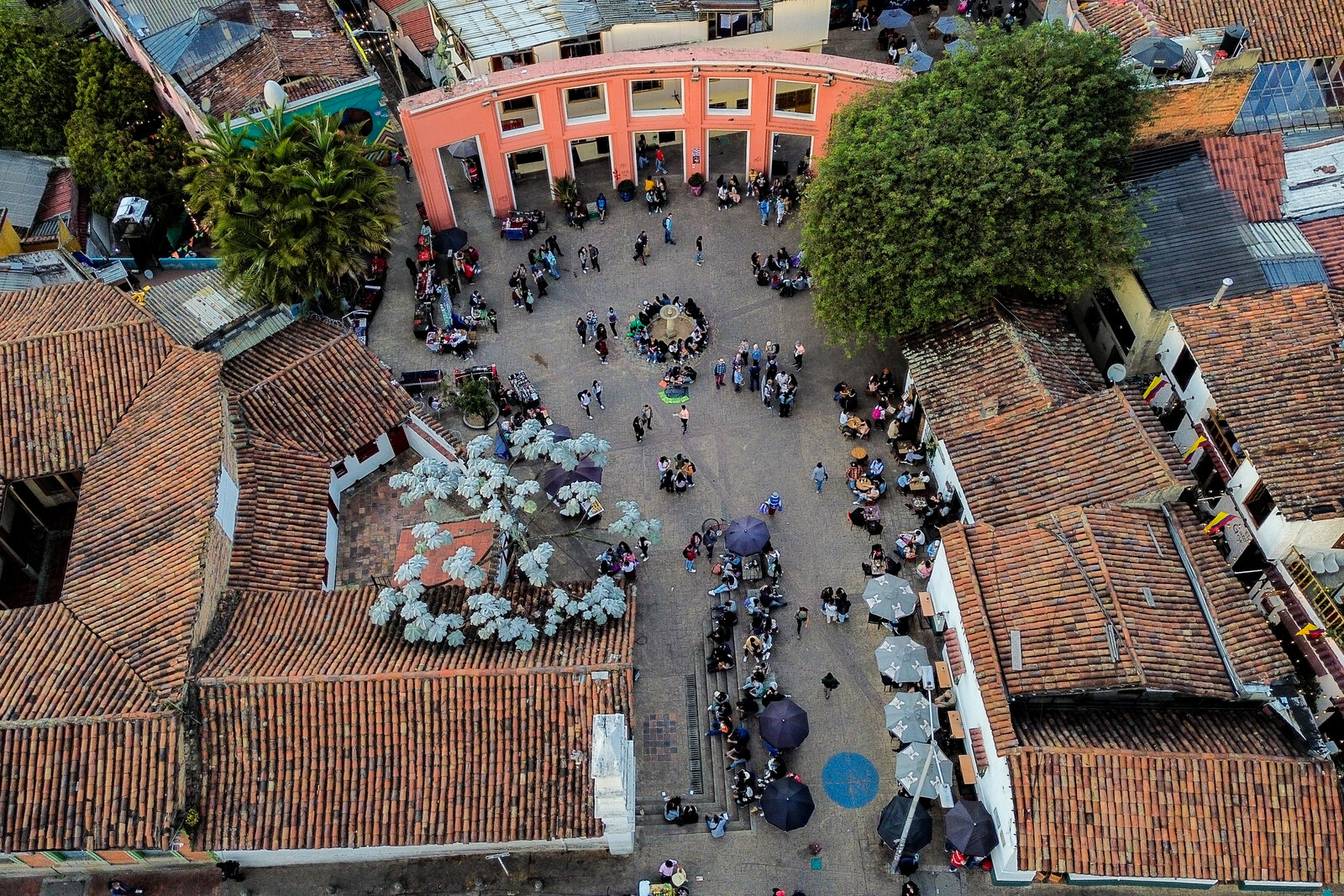
Look around first
What to notice
- Stone basin
- Wall with twelve openings
- White chapel
- The square’s steps
The story of the place
The steps of Chorro de Quevedo square and the edges by the cafés have long been occupied by students, musicians, and street storytellers. Their backdrop is a wall with twelve arched openings, erected in front of the northern façade that the city restorers considered unattractive. The openings recall the twelve huts of the Spanish camp, which, according to the traditional version, arose here on the site of a Muisca settlement; historians dispute the precise point where the city was founded. Nearby stands a white twentieth-century chapel that repeats the appearance of the lost Humilladero Chapel.
The stone basin at the center of the square explains its name. In Spanish, “chorro” means a jet of water, and Quevedo is the surname of the Catholic monk who sought convenient access to water for the local families.
Francisco Quevedo belonged to the Order of Discalced Augustinians and taught at their college. In eighteen thirty-two, he bought a plot on Pueblo Viejo Street—“Old Settlement”—for fifty pesos. It was an outlying area by the San Bruno stream. Residents walked to its springs carrying vessels, then carried the water uphill to their homes. On his plot, Quevedo set up a public water-drawing fountain. The journey for water became shorter, and the jet came to be called by his name—Chorro de Quevedo.
Later, a statue of Quevedo was commissioned for the fountain. Water flowed from the hands of the stone figure. This gratitude proved short-lived: in the nineteenth century, the statue was beheaded, and then it disappeared entirely. The fountain itself stood until eighteen ninety-six. A collapsed wall destroyed it together with the neighboring buildings. The stone basin now here was installed only in nineteen sixty-eight. After another repair in twenty seventeen, water was released from it for the first time in thirty-one years.
Street storytellers, musicians, and acrobats acquired their present square much later. In the early nineteen eighties, there were almost no establishments here, and the square itself remained sparsely populated. In nineteen eighty-five, the city corporation responsible for restoring La Candelaria decided to cover the northern façade, considered unattractive, with a wall of arches. Musicians and storytellers began using it as a backdrop, cafés occupied the edges of the square, and students from nearby universities filled the steps.
The wall has twelve openings. They recall the twelve huts that, according to the traditional version, the men of Gonzalo Jiménez de Quesada built here for the Spanish camp in fifteen thirty-eight. The site suited a garrison: it lay above the plain, was easier to defend, and was already occupied by a Muisca settlement. Historians dispute the exact site of the city’s founding, while Santa Fe was legally established later near today’s Plaza de Bolívar. The white chapel nearby also appeared in the twentieth century; it was built in the likeness of the lost Humilladero Chapel near today’s Santander Park.
Nothing remains of Francisco Quevedo’s fountain: neither the old masonry nor the monk’s statue. His surname has remained with the square, and at its center stands a later stone basin on the site of the public jet for which he bought this plot.
Useful on site
An open city square; after sunset, stick to well-lit routes and the current conditions in the city.
Checked: June 28, 2026. Check the official source before visiting.The approach includes slopes and uneven paving; the square can be busy in the evening, and storytellers’ performances do not follow a guaranteed schedule.