 Guide On Map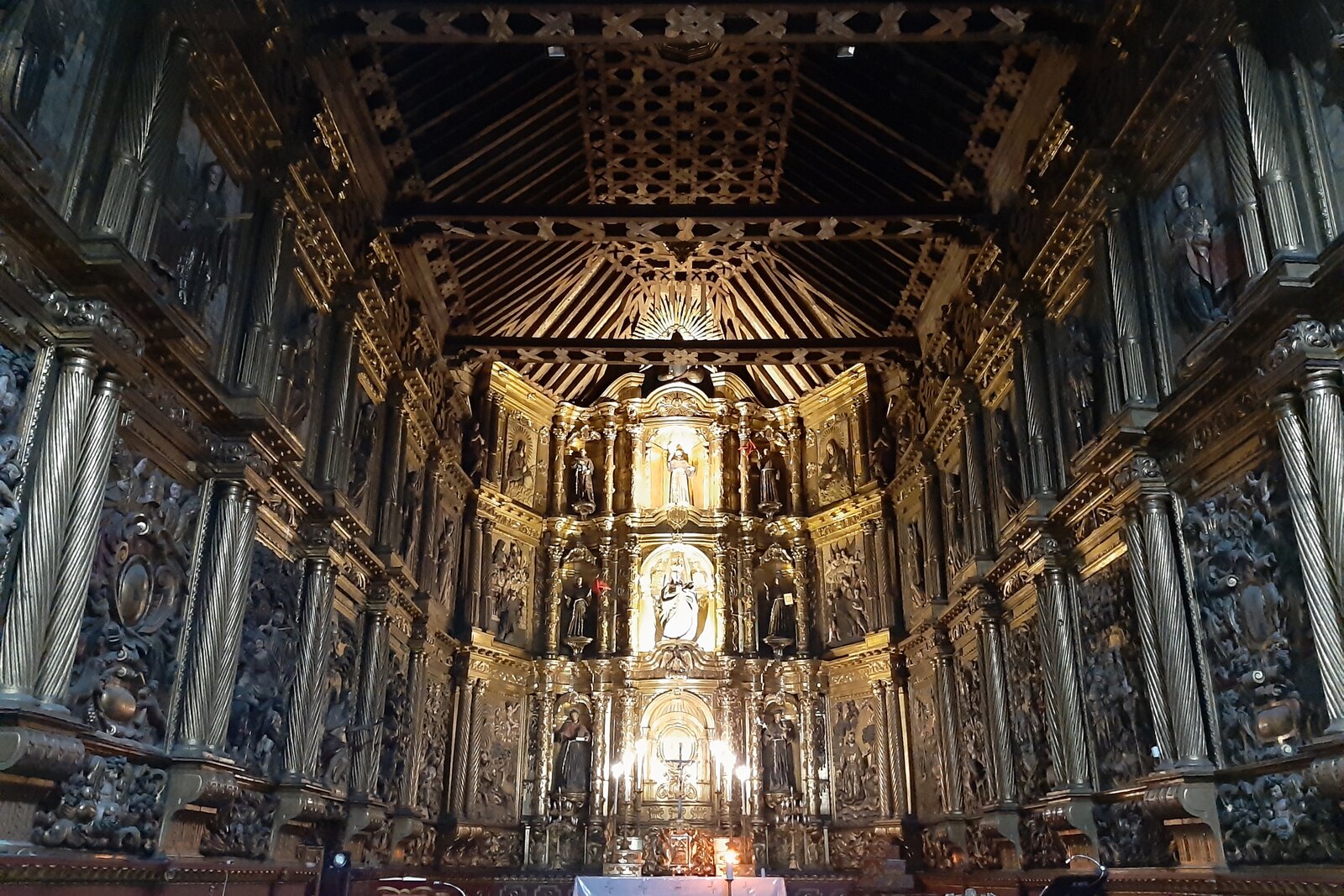
Look around first
What to notice
- Main retablo
- Side reliefs
- Gilded carving
- Central composition
The story of the place
The Franciscan church grew from houses given to the brothers for a church and convent in fifteen fifty-seven. Behind the altar stretches a tall wooden wall with niches, sculptures, and reliefs, almost blocking the space in front during Mass. It was enlarged along the altar walls, and its middle was later replaced by a new composition about the Eucharist and the Immaculate Conception. That is why the gilded carving at the edges preserves one era, while the most prominent center already speaks the language of the eighteenth century.
In July sixteen twenty-three, the Franciscan Francisco de Indo, who oversaw the order's financial affairs in Santa Fe—the name Bogotá had at the time—commissioned an enormous carved retablo for this church. This is the name for a wooden wall with niches, sculptures, and reliefs behind the main altar. It occupies almost all the space in front during Mass.
The Franciscans settled on this site in fifteen fifty-seven. Archbishop Juan de los Barrios gave them the houses that stood here so that the brothers would have a permanent church and convent. The order was founded by Francis of Assisi, so the church was dedicated to him; episodes from his life were later carved for the main retablo as well.
The commission went to Ignacio García de Ascucha, one of the city's most experienced woodcarvers and assemblers of wooden structures. He undertook to finish the work in two years. The Franciscans advanced the money in installments; within a few weeks, the master had already received more than a thousand pesos. He was liable with all his property. As security for the contract, Ascucha mortgaged houses and three enslaved people from his workshop. One of them, Juan Criollo, was himself a trained assembler. The documents do not make it possible to determine which details each worker carved, so it would be wrong to call all the carving the work of Ascucha alone.
Two years were not enough. Ascucha passed the commission to his colleague Luis Márquez, but Márquez died, and Ascucha had to take the unfinished retablo back. In the autumn of sixteen twenty-eight, five years after the contract was signed, Ascucha was making his will and understood that he himself might not have time to finish. He instructed the Franciscans that, if he did not, they should entrust the work to Antonio Rodríguez—his apprentice—who was to bring the structure to completion.
Half a year later, Ascucha died. He was buried in this church, and Rodríguez carried out the instruction he had been given: he finished the wooden part, but without paint or gold. Lorenzo Hernández de la Cámara, a master gilder, then took up the work. By sixteen thirty-three, he was covering the final reliefs, intended for the side sections, with gold. The work promised in two years took almost ten and outlived the two masters who had led it.
The Franciscans continued to enlarge the retablo along the walls of the altar area. In seventeen eighty-nine, they replaced its middle with a new composition to emphasize the Eucharist and the Immaculate Conception of the Virgin Mary. That is why the most prominent central section already dates from the eighteenth century. The work of Ascucha's workshop remained at the edges: the reliefs from the life of Francis, commissioned for the church of his order, have survived there.
Useful on site
Access to the church depends on services; viewing the exterior along Carrera 7 remains available as an urban layer of the route.
Checked: June 28, 2026. Check the official source before visiting.Enter only when access is open, speak quietly, and do not disturb the service; ask locally whether photography is permitted.