 Guide On Map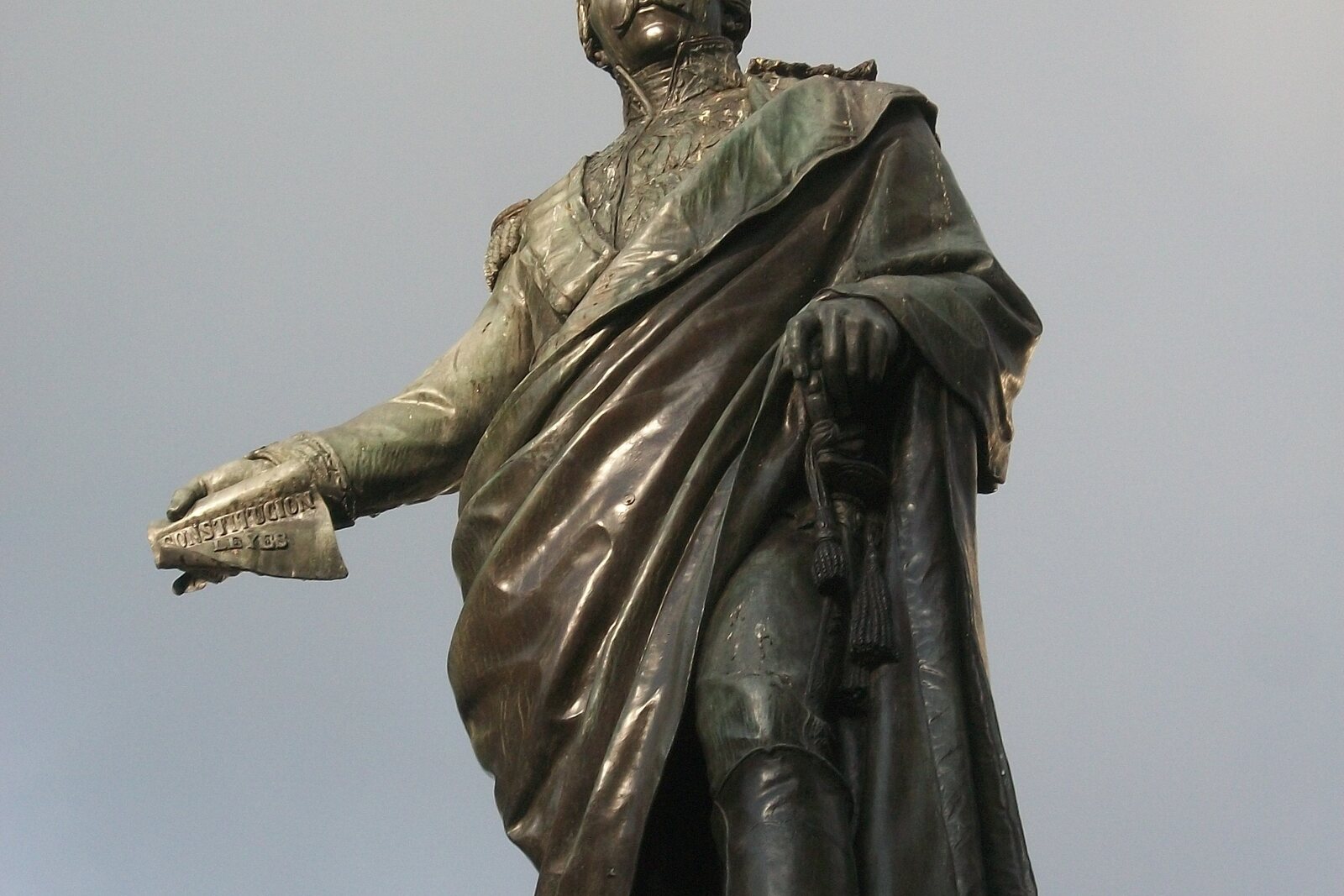
Look around first
What to notice
- Santander’s statue
- A half-unfolded constitution
- The hilt of a sword
- The Avianca Building
The story of the place
At first, trade took place here in the square beside the Convent of San Francisco, from which it took its first name. Later, a garden was laid out around the bronze figure of the military man, a fence and gas lamps were installed, and the former market square became a park. In its right hand, the figure holds a half-unfolded constitution, while its left hand touches the hilt of a sword; on the northeastern corner, a high-rise building now stands in place of his house.
In eighteen fifty, Sixta Pontón, the widow of General and former president Francisco de Paula Santander, ordered his grave opened. She decided to bring her husband’s remains home—to the house on the northeastern corner of this square. By then, Santander had already been dead for ten years.
He had received the house in eighteen twenty-one as a reward for his service in the liberation army. Commander-in-chief Simón Bolívar gave it to the general who had prepared troops for the decisive campaign against the Spanish and then governed the young republic from Bogotá while Bolívar continued fighting.
A few years later, the former comrades went their separate ways. Santander pressed for adherence to the constitution; Bolívar demanded emergency powers. In eighteen twenty-eight, conspirators tried to kill Bolívar. Santander was accused of involvement; the question of how deeply he participated in the conspiracy remains disputed. A military court sentenced him to execution by firing squad. Bolívar commuted the execution to imprisonment and exile.
Santander left this house as a convicted general and returned in eighteen thirty-two as the elected president of New Granada—a republic occupying most of present-day Colombia. He spent his final years here and died here on May sixth, eighteen forty.
Even earlier, Santander had pressed for Bogotá’s residents to be buried in a public cemetery rather than inside churches and convents: for a crowded city, it was a matter of hygiene. When his newborn son Juan died, the family buried the child in the new Central Cemetery. Santander himself was buried there at first as well.
But ten years later, Sixta Pontón ordered her husband’s remains moved back to the house by the square. They remained there until eighteen sixty-six—five more years after Sixta herself died. The man who had advocated moving the dead from city homes and churches to the cemetery returned, after death, beneath his own roof.
While Santander’s remains lay in the house, the city authorities renamed Plaza de San Francisco—the present-day park had borne that name because of the neighboring Convent of San Francisco. The reason was stated plainly in an eighteen fifty-one decree: this was the site of the house where the general had lived and died. That is how the name “Santander Square” appeared.
In the same decade, Congress ordered a statue of him installed here. The commission was carried out by the Florentine sculptor Pietro Costa, but the bronze figure did not reach Bogotá until twenty-eight years later. It was unveiled on the anniversary of Santander’s death—May sixth, eighteen seventy-eight. Workers then enclosed the former market square, laid out a garden around the monument, and installed gas lighting. The square became a park for the statue already standing at its center.
Santander’s house has not survived: its site on the northeastern corner is occupied by the Avianca Building. The bronze figure in the center is the very one unveiled in eighteen seventy-eight; its former marble pedestal was replaced in nineteen fifty-eight. In his right hand, the general holds a half-unfolded constitution; his left hand rests on the hilt of a sword.
Useful on site
An open city park; access and comfort may change because of events, police activity, and heavy traffic downtown.
Checked: June 28, 2026. Check the official source before visiting.Walk around the edge of the park: the center is lively, and different viewpoints offer the best sense of the square.