 Guide On Map
Historic Center of Arequipa: the plaza, monastery, and San Lázaro
From Plaza de Armas through Monastery of Santa Catalina de Siena to Campo Redondo Square
Guide On Map on your phone
Open the walk like a regular app
It takes about 10 seconds to install. No app store needed.
The whole path
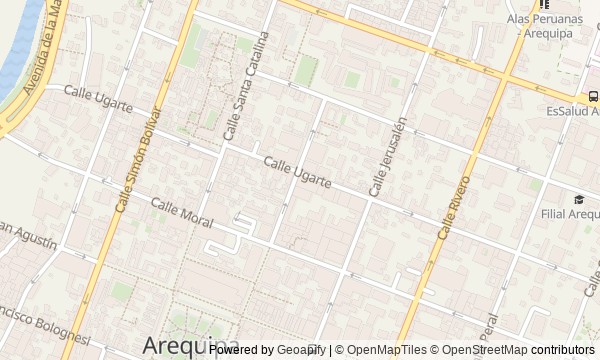
Route map
About the walk
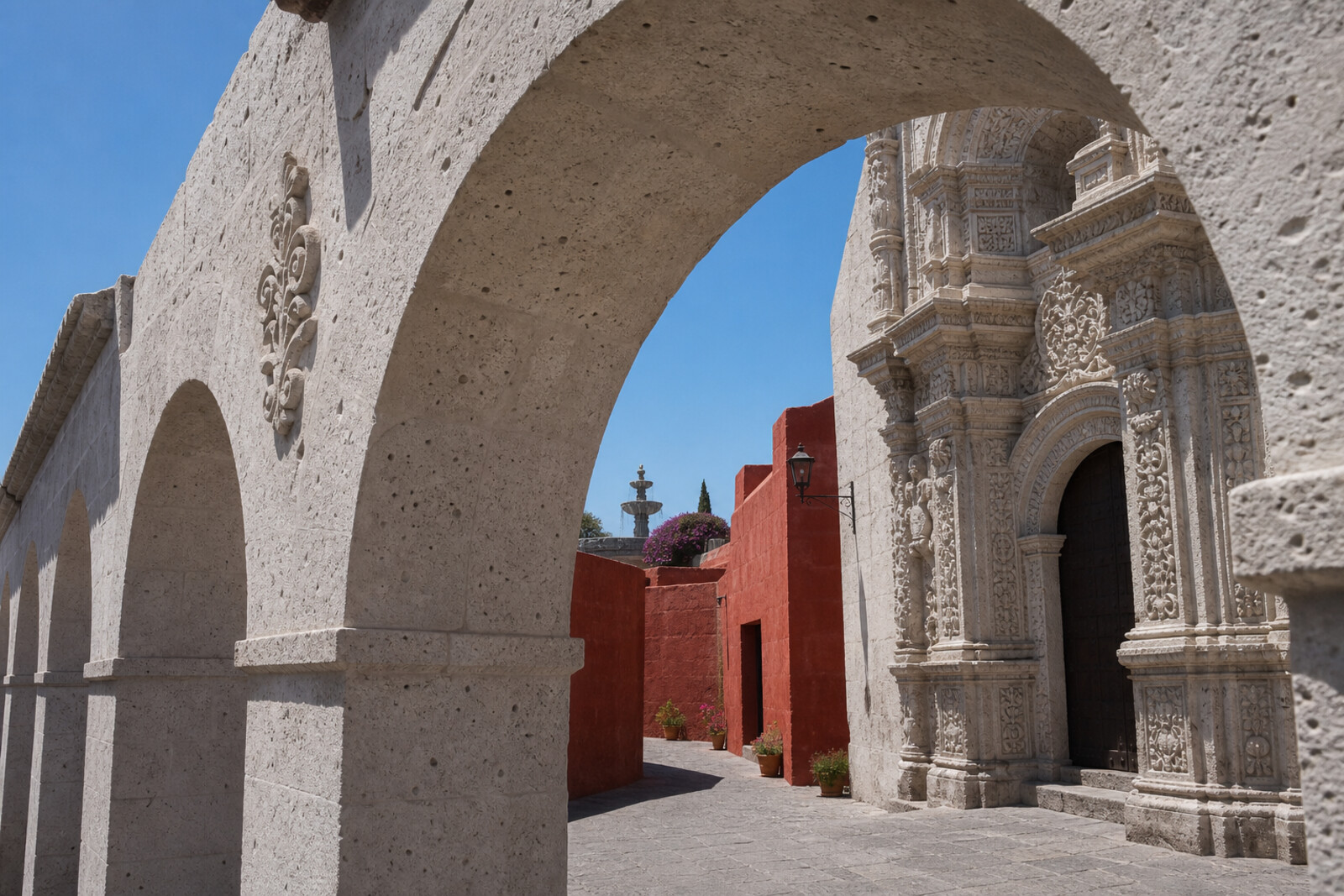
You will begin at the fountain in Plaza de Armas, walk along Arequipa Cathedral, and enter the Society of Jesus quarter through the plaza's southeast corner. Then come the commercial cloisters, a residence with a carved family tree, a monastery the size of a small town, a courtyard with alpacas, and the crooked alleys of San Lázaro.
The ceremonial facades will look seamless. Behind them, though, lie wills, dowries, a royal decree, family money, and an agreement that split a monastery in two. Why did the little figure above the fountain lose its wings? How did a five-year-old girl end up in a marriage record? Why is a free exhibition arranged to lead you toward the store racks?
The story follows documents and human decisions, calmly separating the city's legends from what can be proved. By the end, you will know why a square in San Lázaro still bears the surname of a man whom the archive stripped of his role as founder of Arequipa.
Why this order
At the fountain, you will first see how the main plaza gathered public announcements, a market, and sentences. Then you will approach Arequipa Cathedral on the north side: its rebuilding explains why the church occupies an entire edge of the plaza. Diagonally across from it, you will move to the Church of the Society of Jesus—from cooperation between the authorities and the bishop to the royal decree that expelled another order. The neighboring Cloisters of the Society of Jesus bring the story back to the beginnings of Colegio de Santiago and a disputed will. From there, the route leads to a private residence, where property is already being divided within a family. Next comes Monastery of Santa Catalina de Siena: the workings of a large women's household set up the story of the compromise that preserved the monastic quarter. After the closed cells, you will emerge into the open production exhibition at Mundo Alpaca. One final short walk through Bayoneta Alley ends in San Lázaro, where crooked passages and a mistaken square name test the rectangular version of the city's founding.
People who enjoy history through documents and human decisions People interested in courtyards, old residences, and facade details People who want to connect Arequipa's ceremonial center with the alleys of San Lázaro
People looking for a light overview without difficult stories People who need a route limited to open plazas People who prefer a short list of architectural styles and dates
Before you go
Monastery of Santa Catalina de Siena is a separate visit with its own entrance: do not leave it until the end of your available time, and check access conditions in advance. The Arequipa Cathedral museum, the gallery at Casa Tristán del Pozo, and the interior spaces at other stops may keep their own hours. The churches remain active, so a service or parish event takes priority over sightseeing. Wear sturdy shoes for cobblestones and thresholds; sun protection helps even where the buildings are close together. Inside churches, the monastery, and working demonstration areas, follow photography rules and do not photograph people without permission.
When to go
Start in the first half of the day, so you do not have to rush through Arequipa Cathedral and can reach Monastery of Santa Catalina de Siena with enough time to spare. Reserve your main pause for the monastery itself: the other stops are more compact, and many still make sense when seen only from the street. Afterward, save some energy for Mundo Alpaca and an unhurried finish in San Lázaro—the winding layout is better taken in on foot than rushed along the shortest line.
Backup plan
If Arequipa Cathedral or the Church of the Society of Jesus is closed, continue the route: the towers, masonry, and carved portals let you follow the main story from outside. If the cloisters or the gallery at Casa Tristán del Pozo are inaccessible, focus on the boundary between the street and the closed courtyard—it matters to the story in its own right. Skipping Mundo Alpaca does not require changing the rest of the route. A closed Monastery of Santa Catalina de Siena is a more serious loss: it is better to reschedule the full route, because the monastery connects the themes of earthquakes, women's choices, and a city within a city. If rescheduling is impossible, end the shortened walk in San Lázaro, honestly treating it as a different version of the route.
Route conditions
Surface. Sett — 866 m; paving_stones — 612 m; gravel — 169 m; paved — 27 m; asphalt — 22 m (data covers 81% of the route)
Access. Wheelchair — limited; stroller — limited
Facilities. Toilets — 6; drinking water — 1; rest points — 6
Elevation. Ascent — 23 m; descent — 8 m
OpenStreetMap extract of August 25, 2026: database data, not a check on the ground. Data © OpenStreetMap contributors, ODbL licence
Walk plan
Open in maps ↗- 1
Plaza de Armas and Tuturutu
Here you will see how the main square served the city at once as a place for announcements, trade, and authority. - 2
Arequipa Cathedral
The cathedral will show who rebuilt the main church after the fire and why the building became longer. - 3
Church of the Society of Jesus
This stop introduces the history of the order through the morning when officials simultaneously inventoried the church, school, and property. - 4
Cloisters of the Society of Jesus
The cloisters make it possible to trace how a private will turned into a dispute over the right to open a college. - 5
Casa Tristán del Pozo
The house shifts the conversation from church property to family capital and the lives recorded in a dowry. - 6
Monastery of Santa Catalina de Siena
Here the route will show how earthquakes forced a closed community to find a way to preserve an entire monastic quarter. - 7
Mundo Alpaca
The complex breaks down a familiar product into a chain of handwork, machines, museum displays, and trade. - 8
San Lázaro and Campo Redondo Square
The finale will test a city legend against an archival document and leave you among streets that appeared before the Spanish grid.
Route features
Everything you need stays in the browser
Progress, saves and your trip plan are stored on this device.
Add Guide On Map to your home screen so the walk opens outside the browser.
How we handle sources, maps and corrections: our editorial standards