 Guide On Map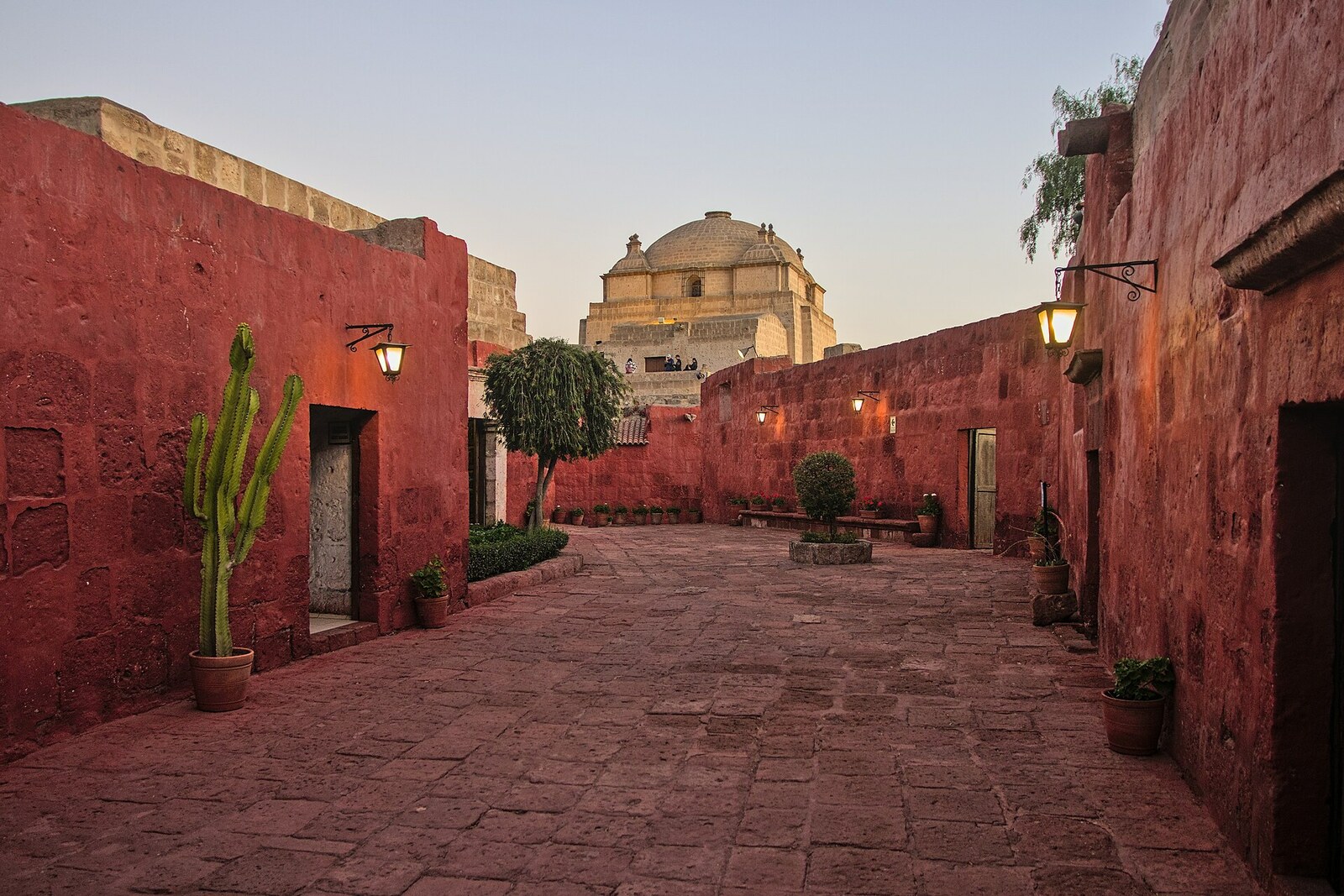
Look around first
What to notice
- The tall outer wall
- Streets and alleys inside the monastery
- Private cells
- Old kitchens
The story of the place
A tall unbroken outer wall conceals an entire small quarter: behind it, houses are linked by narrow streets and alleys. The city council set aside four adjoining plots for it, and later the relatives of novice nuns added separate dwellings—sometimes with a kitchen, a courtyard, and rooms for servants. Over many years, this became a place where women in enclosure lived very differently: a family's means could be guessed from the size of its own house and the number of servants. Part of this inner city is now open to visitors, while the northern section remains closed.
In January nineteen sixty, an earthquake again damaged the enclosed convent of Dominican nuns in central Arequipa. The first blow had come two years earlier, and the nuns had already paid for repairs to the church and cloisters. After the second, it became clear that the community could not afford to save the entire complex.
Behind the outer wall stood far more than a church with a few residential buildings. In fifteen seventy-nine, the city council granted four plots to the future monastery. The wealthy childless widow María de Guzmán gave it her property, settled among the unfinished buildings, and became its first prioress. The house was dedicated to Saint Catherine of Siena, a member of the lay branch of the Dominican Order. Hence the full name, Monastery of Santa Catalina de Siena.
As early as fifteen eighty-two, an earthquake destroyed the first buildings. The communal dormitory was damaged and too small for the growing community. The nuns' families then began to build separate cells for their daughters at their own expense. Some received a kitchen, a courtyard, and rooms for servants. The new dwellings were added for almost two centuries; passages were left between them, becoming streets and alleys.
Behind the wall, class-bound Arequipa was reproduced. Some women brought large dowries and took lifelong vows; others entered without money or remained laywomen attached to the monastery. An archival inventory from the late eighteenth century counted sixty-five servants here; the prioress had three. Separate houses and kitchens preserved this difference better than any account of monastic poverty.
After the earthquakes of the twentieth century, the very size of this inner “city” section became a threat to its survival. The commission restoring Arequipa refused to include Santa Catalina in its program: the work was too expensive, and strict enclosure made even expert inspection of the damage difficult. Demolition, the addition of two reinforced-concrete floors, and the construction of a street straight through the monastery were discussed. Banks agreed to provide money only if the repaired premises were turned over for commercial use. The archbishopric rejected these conditions.
The Arequipa engineer Eduardo Bedoya Forga proposed a different calculation. He led a group of local entrepreneurs prepared to pay for the restoration and recoup their investment through ticket sales. The nuns commissioned a new wing for themselves on part of the garden and the damaged area, and between nineteen sixty-eight and nineteen seventy they moved there. The vacated streets, cells, and courtyards could be repaired without violating enclosure.
The entrepreneurs created a separate company and signed an agreement with the community: the company would restore the old section and receive the right to conduct paid visits for twenty years. Workers rebuilt the damaged walls and vaults, removed later floors, returned preserved details to their former places, and installed water, sewerage, and electricity. On August fifteenth, nineteen seventy, Santa Catalina opened to the public for the first time.
The boundary drawn for this agreement remains in force today. The museum route runs along the old streets with private cells and kitchens, while Dominican nuns continue to live in the enclosed northern section.
Useful on site
Daily 09:00–18:00, last entry 17:00; Tuesday and Wednesday 09:00–19:00, last entry 18:00. Closed on Good Friday, 25 December, and 1 January.
Checked: date not specified. Check the official source before visiting.This is the most extensive stop and a separate visit. Do not try to see the entire complex in a rush; follow the marked route, access restrictions, and rules of silence.