 Guide On Map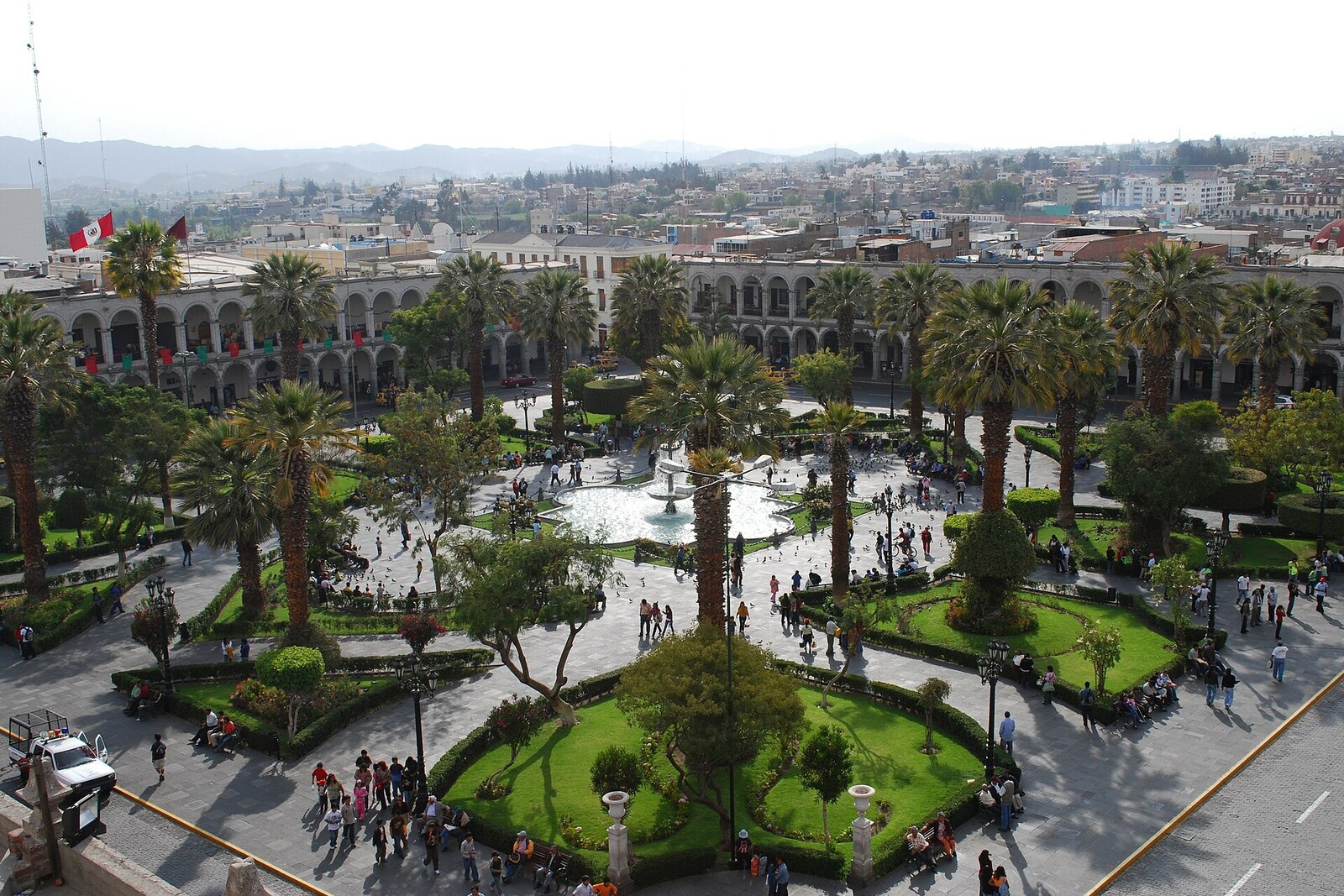
Look around first
What to notice
- Bronze fountain
- Figure of the trumpeter
- Portals along the sides of the square
- Long façade of the cathedral
The story of the place
Portals run along the edges of the square, and a bronze fountain stands in the middle. The Spanish founders left this space for the city’s principal affairs: troops assembled here, council decisions were announced, officials were received, processions took place, and a market operated. A stone marker of the royal court once rose in the center, while the town hall and prison stood nearby. Water reached the fountain from an irrigation ditch, and the basin was once even enclosed with chains so that pack animals could not climb into it.
The name of the little figure at the top of the fountain is popular in origin. “Tuturutu” conveys three short trumpet notes. Exactly whom the trumpeter depicted has not been established. In the eighteenth century, the Arequipa chronicler Ventura Travada called him an angel and an allegory of Glory carrying news; at that time, the statue still had wings. They were later lost, and the little figure came to be taken for a soldier or a town crier. There is also a legend about a messenger of the Inca Maita Cápac, who blew a trumpet to summon people for news and provisions. It is only a legend: there are no documents about such a person.
The place chosen for the trumpeter, however, is easy to understand. The Spanish founders set this square aside for the city’s principal public affairs. It was originally called Plaza Mayor—the Main Square. The name Plaza de Armas is connected with the military assemblies and formations held in squares of this kind. Here, decrees of the city council were read out, officials were received, processions were held, and a market operated until nineteen thirty. The town hall and prison stood nearby. Before the fountain was built, a picota stood in the center—a stone pillar marking the royal court and the place of public punishment.
Bishop Juan Cavero de Toledo gave the bronze fountain to the city. It was inaugurated in seventeen thirty-five. Water was brought to it by a channel from an irrigation ditch; chains were stretched around the basin so that pack animals could not climb into it. Tuturutu stood above the city’s water supply with a trumpet in his hand—where news, orders, and sentences were meant to be heard by everyone.
On February eighteenth, eighteen thirty-six, the sentence was announced in the square to a man who had led Peru only a year earlier. Felipe Santiago Salaverry was a professional officer: the army gave him an income, standing, and rapid advancement. At twenty-eight, he rebelled against President Luis José de Orbegoso and declared himself head of the republic. Salaverry sought recognition for his government; Orbegoso wanted to regain his post and called on the president of Bolivia, Andrés de Santa Cruz, for help. Santa Cruz intended to unite the two countries in a confederation.
Salaverry led his troops south, but near Arequipa he was defeated in the Battle of Socabaya. He tried to escape to the coast. General Guillermo Miller, who commanded part of Santa Cruz’s forces, promised the prisoners that their lives would be spared. Learning of this guarantee, Salaverry offered almost no resistance when he was detained. Miller, however, had no right to make such a promise.
A military council sentenced Salaverry and eight of his officers to death. Santa Cruz was asked to overturn the execution, but he ordered the sentence to be carried out in Plaza de Armas before a large crowd. Before going out to the firing squad, Salaverry wrote a protest against the court, made a will, and asked for a pen for a final letter to his wife. He asked her to care for the children, who would now be left without his support. At twenty-nine, Salaverry and eight of his associates were shot here.
After their deaths, Santa Cruz was able to create the Peruvian-Bolivian Confederation, but the execution alienated even some of his former supporters. The confederation lasted about three years.
The fountain with Tuturutu was already in the center of the square on the day of the shooting. It was later dismantled, altered, and returned, but the trumpeter again stands in the same place, above the space where townspeople were once informed of both celebrations and death sentences.
Useful on site
Open around the clock; individual passageways and the fountain area may be closed during city events.
Checked: date not specified. Check the official source before visiting.The entire stop is accessible in the square without entering a building. View the fountain from the edge and keep in mind the constant movement of people around it.