 Guide On Map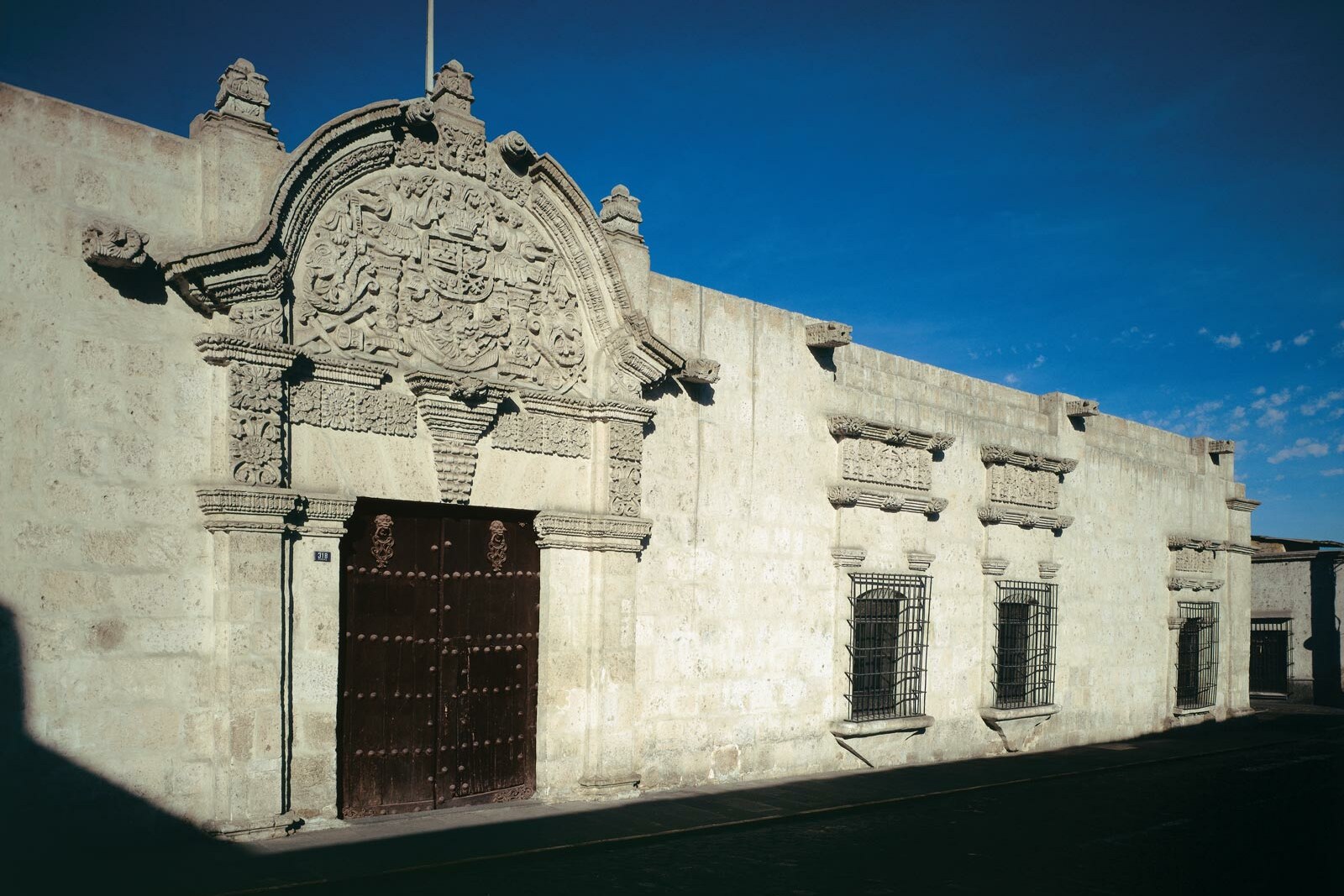
Look around first
What to notice
- Eighteenth-century façade
- Old doors
- Genealogical tree above the entrance
- Five cantuta flowers
The story of the place
On June twenty-fourth, seventeen thirty-six, the merchant Domingo Carlos Tristán del Pozo and his wife Ana María Carasa acquired this plot. Two years later, their urban residence stood here—the present Casa Tristán del Pozo. The house still bears the name of its first owner.
Domingo came from Cádiz to seek his fortune in South America. He traded between Pacific ports and Upper Peru; part of his business was brokering on the local slave market. In seventeen thirty-seven, he sold five enslaved people in Arequipa on behalf of another merchant. Domingo and Ana María also kept enslaved people in their own household: the wife received three with her dowry, and the husband listed two among his property when they married.
In this house, Domingo raised Andrea, to whom he gave the surname Tristán. Archival records do not name her origin. A researcher of the family documents considers her Domingo’s probable illegitimate daughter: he acknowledged another such daughter in his will, but not Andrea. Therefore, her place in the family was secured through a dowry and an arranged marriage.
Domingo chose a groom for her—Urbano Adriasola, the illegitimate son of his business partner. The record of their marriage agreement survives in a notarial register from seventeen fifty-seven, although the page with the exact date of the transaction has been lost. Andrea received two thousand six hundred sixty-one pesos. The sum included Cayetana, an enslaved girl aged five, valued at two hundred fifty pesos.
Thus, one document determined both their fates. Andrea entered marriage with capital of her own and the surname of the house’s owner. Cayetana became part of the property of the new household; the record does not say what happened to her afterward.
The Tristán family owned the mansion for about forty years. In seventeen seventy-eight, an heir sold it to the bishop, but the builder’s name remained. Since nineteen seventy-four, the house has belonged to a bank, and a gallery of Arequipa painting now operates in its first rooms. The façade and old doors have survived from the eighteenth century.
Above the entrance is carved Christ’s genealogical tree: five cantuta flowers hold medallions of Joachim, Anne, Mary, Joseph, and Jesus. Beneath this stone image of a family, the household archive left another record: Andrea already bears the surname Tristán, and beside the name of five-year-old Cayetana stands a price.
Useful on site
The façade is accessible at all times. Gallery hours previously published by the foundation: Monday–Friday 09:00–12:00 and 16:00–18:00, Saturday 09:00–13:00; confirmation is required before visiting.
Checked: date not specified. Check the official source before visiting.You can view the façade regardless of whether the gallery is open. The inner courtyards belong to a separate cultural space, so do not go beyond closed doors and barriers.