 Guide On Map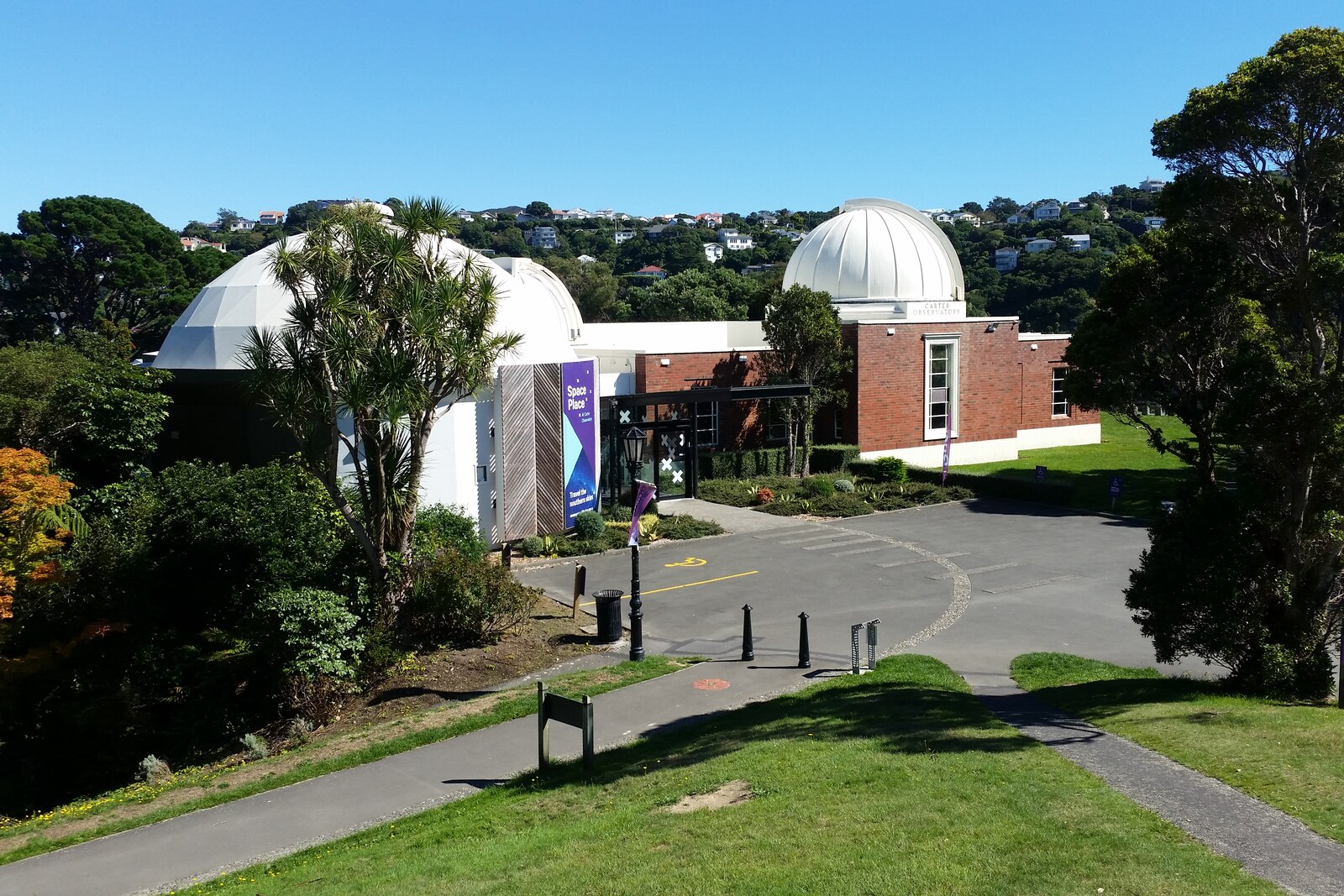
Look around first
What to notice
- The old dome
- Thomas Cooke Telescope
- Digital planetarium
- “Space Place” sign
The story of the place
The old dome shelters the Thomas Cooke Telescope, moved from Wellington City Observatory; Wellington City Observatory once occupied the site of today's parking lot and was housed in a green iron shed. Here, on the Botanic Garden ridge, an observatory for observing the sky was opened. Its staff collected data on the southern lights, gave lectures, and on clear evenings let city residents look through the telescope. Over time, Wellington's night lighting deprived this spot of the darkness it needed, and scientific work was moved off the hill; the dome and the instrument now sit alongside a digital planetarium and interactive galleries.
The Carter name on the sign does not belong to an astronomer. Charles Rooking Carter made his living in construction: after arriving in Wellington in eighteen fifty, he became a contractor, built the first public buildings, and reclaimed sites from the harbor with fill and retaining walls. In England, he had sometimes been without work; in New Zealand, carpentry brought him land and a fortune.
Carter died in eighteen ninety-six. He bequeathed the remainder of his estate—two thousand two hundred forty pounds—to the New Zealand Institute as the beginning of a fund for an observatory near Wellington. The will stipulated telescopes, a staff of astronomers, and public benefit. The money was not enough to build a finished institution, so the trustees invested the capital and accumulated interest. Three existing observatories tried to obtain the fund, but none of the attempts fulfilled the will in full.
The resolution came forty-two years later. Parliament passed a separate Act on Carter Observatory, Wellington City Council allocated land on the Botanic Garden ridge and handed the Thomas Cooke Telescope over to the new institution. This slope was not chosen for a pretty address: the sky had already been observed here. On the site of today's parking lot stood Wellington City Observatory—a green-painted iron shed. After the telescope was moved, Wellington City Observatory was demolished.
Murray Geddes became the first director of the new institution. Before his appointment, he earned his living as a schoolteacher and pursued astronomy as an amateur: he discovered a faint comet named after him and led the collection of observations of the southern lights. The post at Carter Observatory allowed him, for the first time, to make this work his profession.
Construction was delayed by the Second World War, and the doors opened only in December nineteen forty-one. Geddes moved his southern-lights observing program here, gave public lectures, and held telescope viewings. He then left to serve in the New Zealand Naval Reserve. In nineteen forty-four, thirty-five-year-old Geddes died of illness while serving. He was succeeded by the astronomer Ivan Thomsen. The staff continued collecting data until nineteen fifty-eight and compiled the first and, for its time, longest catalog of visual observations of the southern lights.
Later, city light pollution began to interfere with research, and professional observations were moved where the sky was darker. By nineteen seventy-seven, the institution had received national-observatory status, but then lost it; in two thousand ten, Wellington City Council opened a renewed visitor center here. This is how the digital planetarium, interactive galleries, and the present name, “Space Place,” appeared.
The Thomas Cooke Telescope from the green shed remained beneath the old dome. On clear evenings, the instrument transferred here in fulfillment of Carter's will still shows the sky to the public.
Useful on site
Mon closed; other hours depend on the day, last entry 30 minutes before.
Checked: June 26, 2026. Check the official source before visiting.Viewing it from outside does not require a long stop, but plan a visit to the exhibition or a program beneath the dome separately, and check availability in advance.