 Guide On Map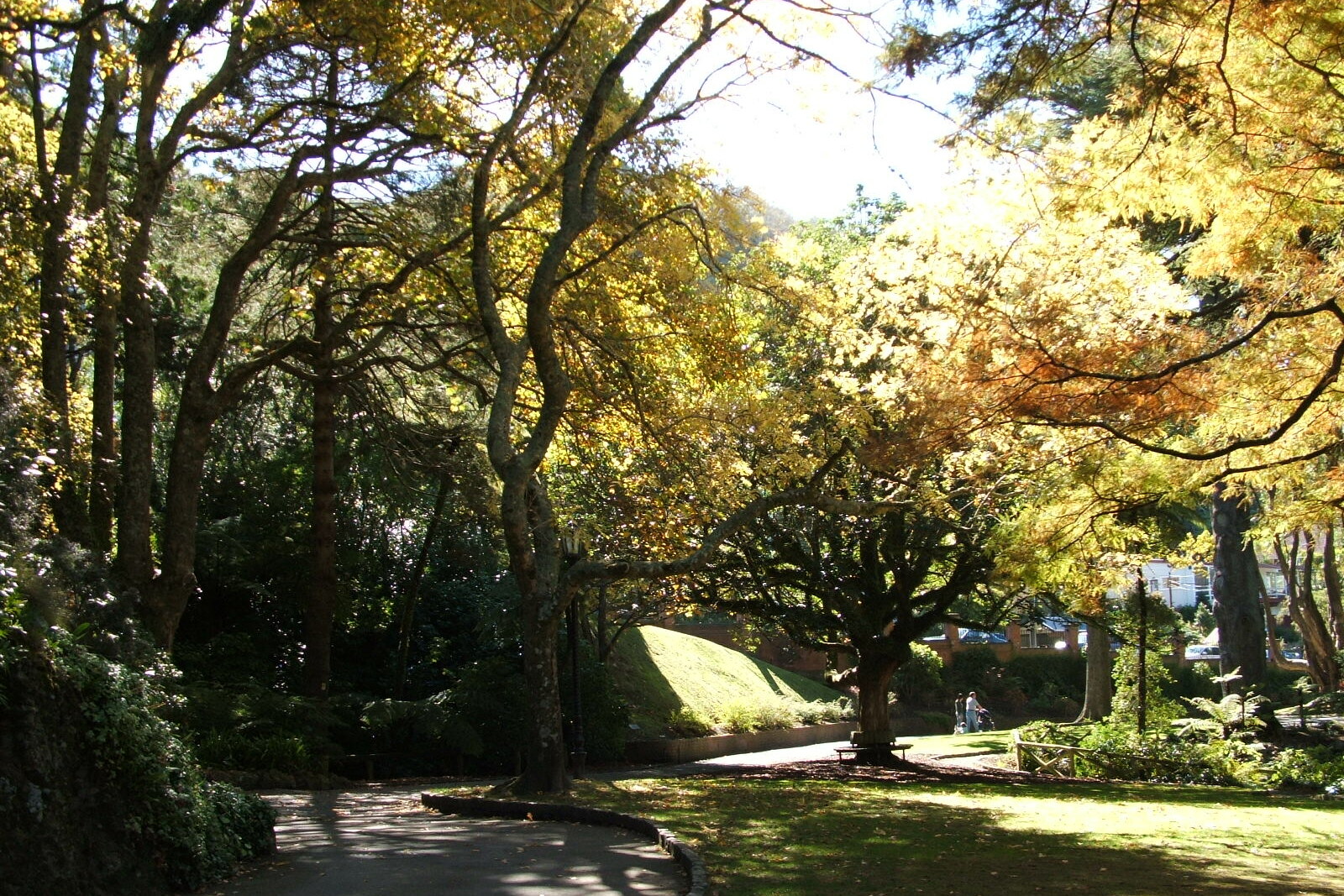
Look around first
What to notice
- Old pines
- Dense conifer crowns
- Forest understory
- A trail on the slope
The story of the place
The upper layer of forest on the slope was planted as a windbreak: its crowns were meant to take the wind that had previously reached the sparse remnants of native forest. The botanic garden was laid out where logging had left an almost open slope, and camps were set up on the cleared land. Pines, oaks, Australian acacia, and New Zealand beeches withstood the local soil and wind in different ways; the dense crowns of the old pines still stretch above the trail.
In February eighteen sixty-nine, James Hector was already receiving seeds here from the Royal Botanic Gardens, Kew. A few months earlier, he had been appointed manager of the neglected reserve. Hector served as the chief government scientist: he headed the New Zealand Geological Survey and the Colonial Museum, while ministers asked him to determine which natural resources and plants could be turned into timber, food, or raw material for a new industry. A walking trail was not yet part of his assignment.
By then, only part of the former native forest had survived. Settlers had felled the usable trunks, camps were set up on the uncovered land, and the remaining trees suffered from the wind. Hector proposed testing fast-growing species from other countries here. In eighteen sixty-nine, Parliament formally established the botanic garden, and dozens of conifer species began to be planted on the slopes. Seeds came from the Himalayas, Mexico, Calcutta, and Kew. Members of the garden board added oaks, Australian acacia, and New Zealand beeches: the tall plantings were meant to shelter the remnants of native forest.
The experiment needed someone to raise the saplings every day and keep them from being trampled. In September eighteen seventy, the board hired William Bramley, the first full-time gardener-caretaker. He earned eighty pounds a year and settled here with his wife Ann and their children. His pay included the right to cut grass for one cow, provided that the cow did not wander through the garden. The condition was entirely practical: other people's horses and livestock regularly came through the weak fences, while visitors broke plants and cut wood.
Bramley planted and guarded the experimental trees for nineteen years. It proved impossible for one person to watch over the entire grounds. In eighteen eighty, he was injured while trying to restore order, and after that a police constable was assigned to the garden. The caretaker's family kept their home, while the constable was given a separate house. So the scientific plantings had to be protected by the same means used to guard city streets.
Meanwhile, the experiment spread far beyond this slope. In eighteen seventy-one, the government promised settlers two acres of unused land for every acre of forest planted. Many tested seeds and saplings were now needed, and Hector's New Zealand Geological Survey became their distribution point. Plants from Wellington were sent to farms, schools, hospitals, churches, and other gardens. In the eighteen nineties, government specialists collected seeds from the grown trees for the first forest reserves. By nineteen twenty-one, radiata pine, once one of the candidates here, had become one of the country's main commercial species.
Some of the trees under trial died. Those suited to Wellington's soil and wind still rise above the paths; the old pines here are among the oldest in New Zealand. Their crowns still do the work for which Hector and the garden board planted the first saplings: they shield the slope and the forest understory from the wind.
Useful on site
The garden grounds are open from dawn to dusk.
Checked: June 26, 2026. Check the official source before visiting.Stay on the marked paths and take care on wet sections. Signs help distinguish native vegetation from the old experimental plantings.