 Guide On Map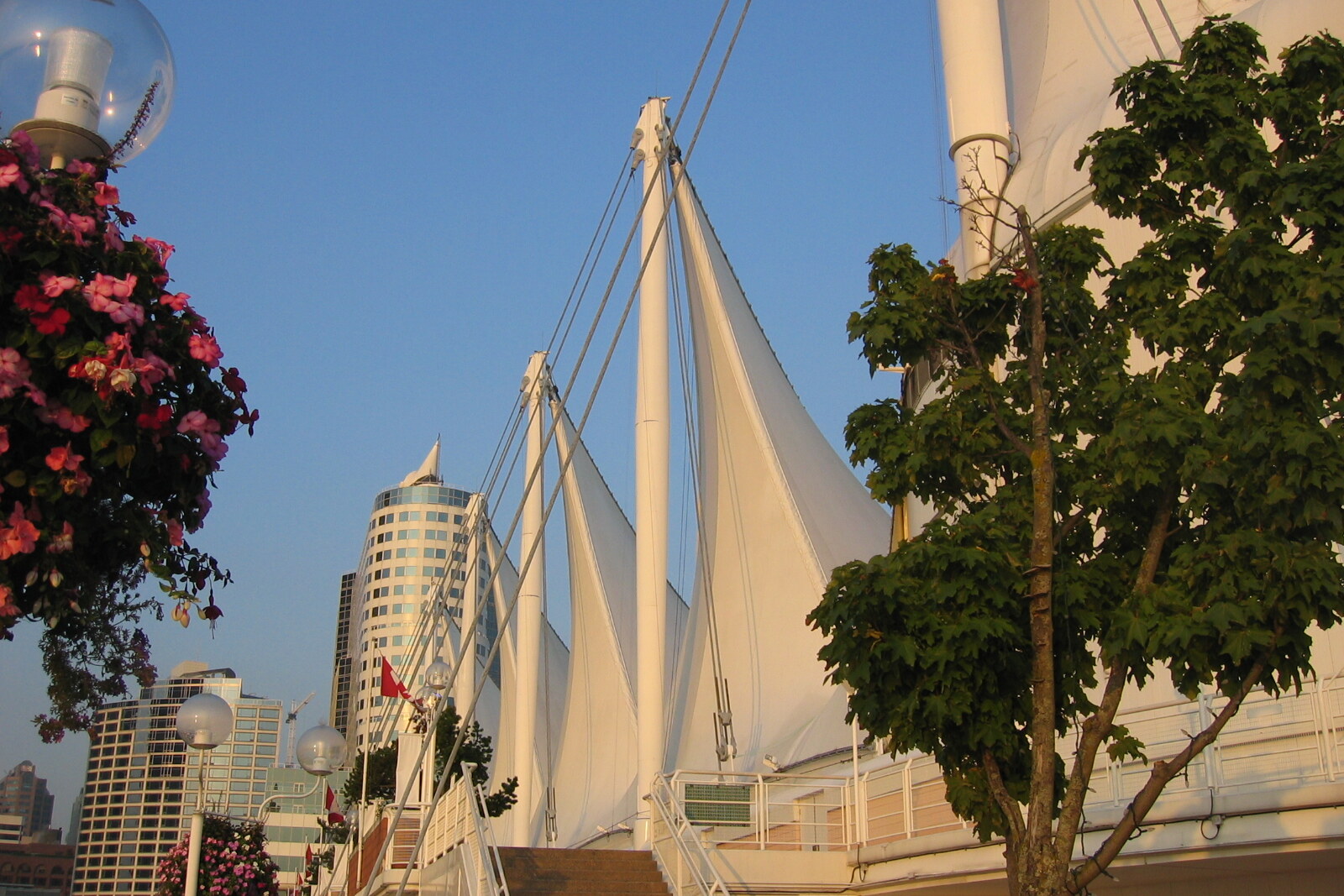
Look around first
What to notice
- Five white roof panels
- Western side of the pier
- Cruise terminal berths
The story of the place
The five white panels above the water appeared as the roof of the Canadian pavilion at the World's Fair of nineteen eighty-six. The complex was built on the supports beside Pier B-C, which had received transpacific liners since nineteen twenty-seven. Beneath the exhibition hall, a marine terminal was immediately set up with baggage services, customs, and passport control, and later a convention center opened above. Cruise ships now moor along the white structure.
On May twenty-third, nineteen fourteen, the Sikh entrepreneur Gurdit Singh brought the Japanese steamship Komagata Maru, which he had chartered, to Vancouver. Singh made money from railway contracts and rubber plantations in Malaya. Now he wanted to test whether Canadian officials could close the port to people who, like Canadians themselves, were considered subjects of the British Empire.
There were three hundred seventy-six passengers aboard, mostly people from Punjab. Many hoped to find work at sawmills and construction sites in British Columbia: earlier settlers had written home that pay here was much higher than in India. The people bought tickets from Singh and traveled through Hong Kong and Japanese ports toward the Canadian coast.
Canada had already imposed a condition on such settlers that was nearly impossible to meet. Under the nineteen-oh-eight rule, an immigrant had to arrive from their country of birth without transfers, with a through ticket bought in advance, and have two hundred dollars with them. There were no direct sailings from India to Canada, and steamship companies did not sell through tickets. Singh therefore chartered an entire ship: the voyage was meant to bring the passengers to Vancouver and, at the same time, put this rule to a judicial test.
Komagata Maru was anchored off a pier of the Canadian Pacific Railway, beside what is now the western side of Canada Place. Immigration inspectors barred the steamship from docking. Only a few former residents of Canada, the ship's doctor, and his family went ashore. The others spent two months aboard. Supplies of water and food were running low, and communication with supporters on shore was restricted.
Vancouver's South Asian community raised money, paid part of the charter fee, and hired a lawyer. The case of one of the passengers was chosen for judicial review. The judges upheld the immigration officials' decision, and the passengers were issued deportation orders.
They refused to leave until the ship was supplied with everything needed for the return passage. On July nineteenth, about one hundred fifty police officers tried to board from the harbor tug Sea Lion. The passengers repelled the attack with pieces of coal and bricks. A day later, the Canadian military cruiser HMCS Rainbow approached the steamship. After negotiations, water and food were delivered aboard, and on July twenty-third the ship was taken out of the harbor.
The return ended at Budge Budge, near Calcutta. British police decided to arrest Singh and the other organizers, while trying to send the rest under guard by train to Punjab. In the clash, the police opened fire: nineteen passengers were killed, and many were arrested or placed under surveillance. Gurdit Singh escaped, spent seven years in hiding, then surrendered and spent five years in prison.
Canada Place itself appeared much later. It was built on the supports of the adjacent Pier B-C, which opened in nineteen twenty-seven for transpacific liners. Five white panels covered the Canadian pavilion at the World's Fair of nineteen eighty-six; beneath the exhibition hall, a marine terminal was immediately set up with baggage services, customs, and passport control. After the fair, a convention center opened above, while the cruise terminal remained below. Today's liners moor along the white complex. Komagata Maru was anchored in the water off its western side for two months and never came alongside the pier.
Useful on site
The outdoor promenades are accessible as part of the complex; the lower promenade is officially connected to the route along Coal Harbour, and an elevator leads to the upper level. Because of cruises, conferences, holidays, and private events, individual sections may be closed.
Checked: June 30, 2026. Check the official source before visiting.Stay on the accessible outdoor promenade; during cruises and events, individual passageways may be blocked.