 Guide On Map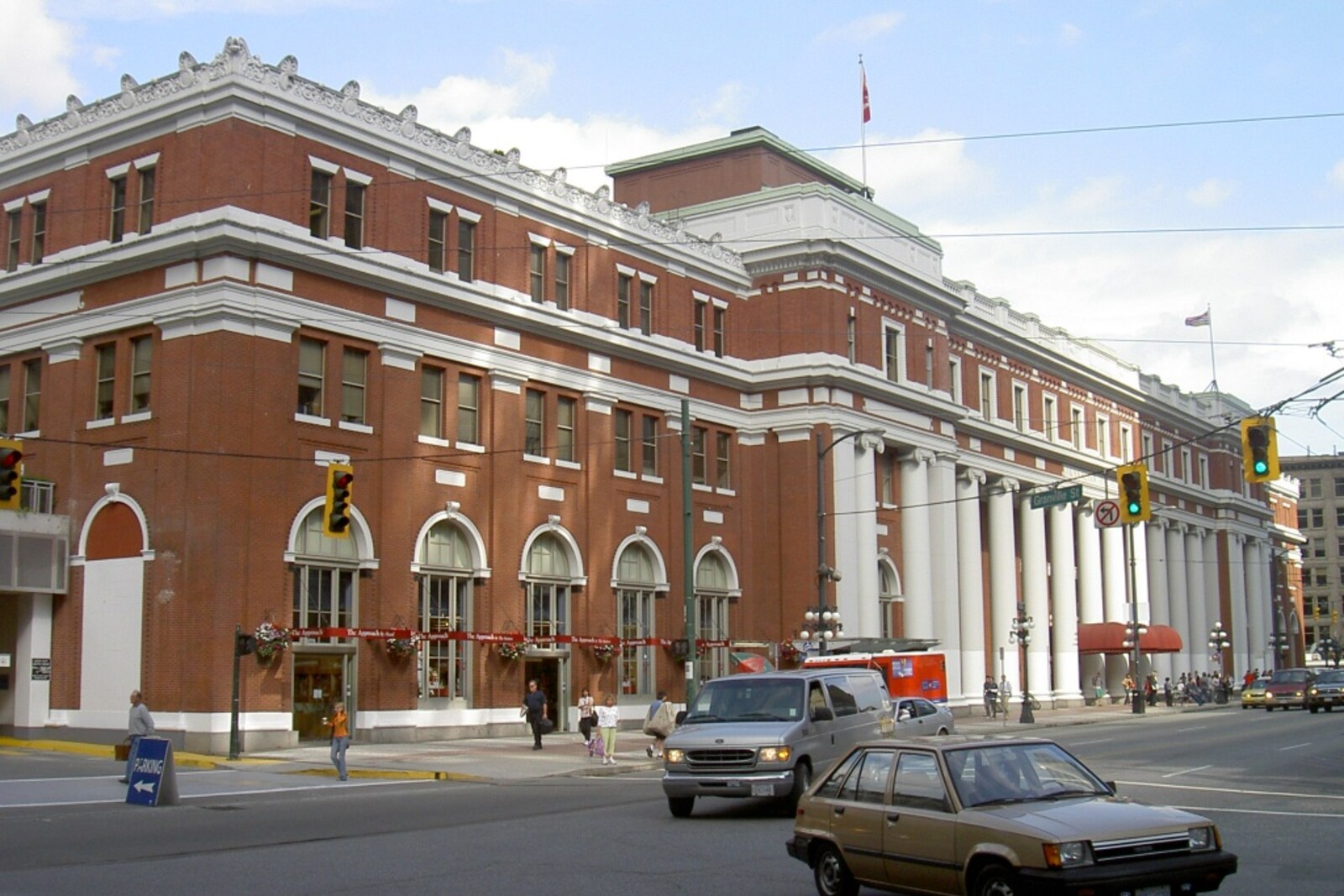
Look around first
What to notice
- Brick station façade
- Main station hall
- West entrance on the Howe Street side
The story of the place
Today's brick façade and main hall belong to the third station building: it began receiving passengers in nineteen fourteen. The site by the deep harbor made it possible to unload ocean-going vessels almost beside the tracks, while a small ravine rose from the shore to Cordova Street. After long-distance trains left in nineteen seventy-nine, SkyTrain, Canada Line, the SeaBus ferry, and the West Coast Express commuter service still end and begin their routes here. People from Port Moody now come here too—by train to Waterfront Station.
The west entrance of today's Waterfront Station faces Howe Street. It was at the foot of this street that, on May twenty-third, eighteen eighty-seven, engineer Peter Reiter brought locomotive number three hundred seventy-four to the first Vancouver platform of the Canadian Pacific Railway. There was no brick station yet: passengers were received in a wooden building with a coal stove in the middle of the hall.
The terminus was originally in Port Moody, farther east along the same inlet. Local landowners bought up lots in expectation of a future port city. William Van Horne, president of the railway company, pressed to move the terminus to the settlement of Granville, which was soon renamed Vancouver. Here the company received land for its own urban district, and trains could be brought almost right up to the deep-water harbor. A small ravine rose from the shore to what is now Cordova Street; nearby, ocean-going vessels could unload directly beside the railway tracks. That is why the station was located at this very spot.
Port Moody landowners tried to stop the extension of the line across their lots and obtained court injunctions against the work. On January fifth, eighteen eighty-seven, the Supreme Court of Canada lifted those injunctions. Railway workers continued laying track, and on May twenty-first the company loaded its employees onto a train and, in a single night, moved the terminus's administration from Port Moody to Vancouver.
Two days later, Reiter brought in the first passenger train from Montreal—one hundred fifty people. According to a local historical account, Jonathan Rogers, a twenty-two-year-old apprentice to a building contractor, was the first to step onto the platform. He intended to earn a living by his trade in the new city. Soon Rogers bought four lots at a railway-company auction, became one of Vancouver's leading developers, and put up a building on Granville Street that still bears his surname.
For the landowners of Port Moody, the outcome was the opposite. The railway company moved freight operations to Vancouver, cancelled the steamship service between Victoria and the former terminus, and the Port Moody pier became unnecessary. The expectation of a major terminus city did not come true.
The first wooden station disappeared. Locomotive number three hundred seventy-four was preserved in the Roundhouse pavilion at the other end of the former railway lands. The present Waterfront Station hall is already the company's third building, opened in nineteen fourteen. Long-distance trains left here in nineteen seventy-nine, but the terminus remained a terminus: SkyTrain, Canada Line, the SeaBus ferry, and the West Coast Express commuter service now converge here. Passengers from Port Moody board at Moody Centre Station and travel to Waterfront Station—the place to which railway employees moved the terminus in a single night.
Useful on site
The lobby is open during the transport hub's operating hours. Until early morning, the entrance from Cordova Street may be closed, and the transit authority directs passengers to other entrances.
Checked: June 30, 2026. Check the official source before visiting.This is an active transport hub: look around near the entrances and do not block passenger flows.