 Guide On Map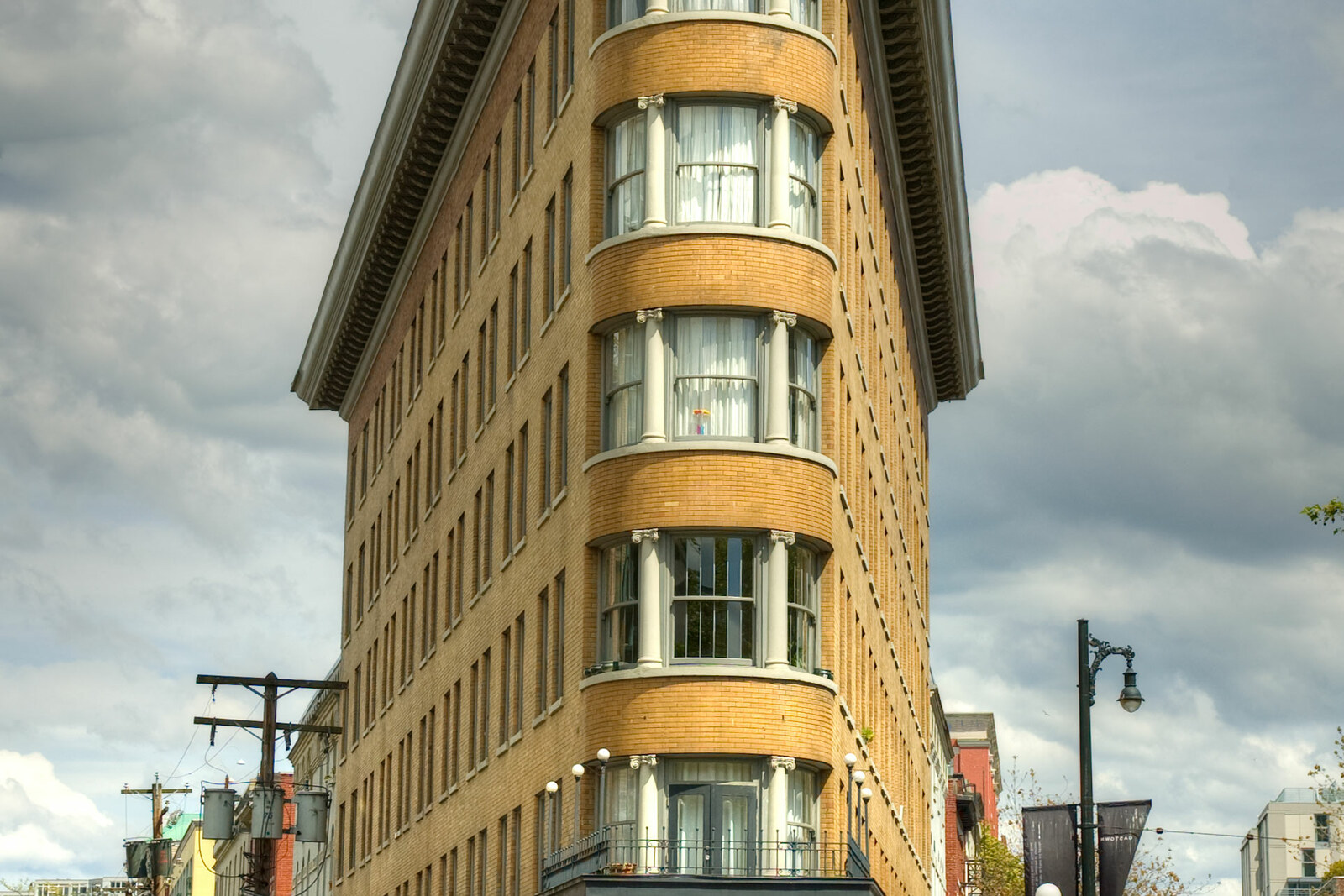
Look around first
What to notice
- Byrnes Block
- The paving of Maple Tree Square
- Trees along Carrall Street
- The green-route lanes
The story of the place
On September thirtieth, eighteen sixty-seven, John “Gassy Jack” Deighton came ashore near the future Maple Tree Square. He was a river steamboat pilot, but after a long illness and a decline in shipping, he was looking for another source of income. A sawmill operated nearby: its workers and sailors were paid wages, but there was nowhere for them to have a drink.
Deighton chose a site just beyond the boundary of the sawmill’s property, where its ban on alcohol no longer applied. According to local tradition, he brought a barrel of whiskey and offered the workers everything they could drink if they would help put up a bar. In a day, they supposedly assembled the board-built Globe Saloon, measuring about three and a half by seven meters. The construction date belongs specifically to the tradition; the establishment’s lasting success is better documented.
This place had been used long before Deighton. Representatives of the Squamish, Tsleil-Waututh, and Musqueam peoples set up a summer camp here, gathered food, and preserved it. The area was called Luk-Luk-I—“beautiful grove.” The shallows extended south toward False Creek, and people took small boats between the two bodies of water. Deighton needed the same shore and the same convenient passage, but now for the saloon’s patrons.
For his habit of telling long stories, Deighton became known as John “Gassy Jack” Deighton. Housing and other establishments appeared near his bar; the settlement came to be called Gassy’s Town, and then Gastown. Three years later, colonial officials decided to divide the improvised settlement into streets and lots for sale. It officially received the name Granville—the name the future Vancouver bore until eighteen eighty-six.
Carrall Street, laid out on the plan, ran directly through the first saloon. Deighton occupied the land without a registered lot and could not save the building. He paid one hundred thirty-five dollars for the nearest corner lot and built the two-story Deighton House, with a bar, billiard room, and rooms for lodgers, on the southwest corner of Carrall Street and Water Street. Later, he handed management of the hotel over to his brother and sister-in-law. Its prosperity was brief: in eighteen seventy-five, when Deighton began expanding the house, he fell ill and died at the age of forty-four. His young son, the sole heir, died before the estate was settled; little more than three hundred dollars remained from the business.
A huge maple grew beside the porch. Residents met beneath it and left notices there, so the intersection came to be known as Maple Tree Square. In the Great Fire of eighteen eighty-six, both the tree and Deighton’s hotel burned down. After the fire, Byrnes Block was built on its site; it still stands on the corner today.
The street’s name is connected with the same plan that made Deighton move the saloon. Robert Carrall was a doctor and politician who worked to bring British Columbia into Canada. In eighteen seventy, he was sent as one of three delegates to Ottawa to negotiate the terms of union; the eastern boundary of the new Granville was named for him.
At the beginning of the twenty-first century, city engineers narrowed the roadway of Carrall Street, created paths for pedestrians and cyclists, and planted trees. This created a green route between False Creek and Burrard Inlet. Its northern end reaches Water Street where the survey of eighteen seventy forced Deighton to remove his bar from the future road. Neither the saloon itself nor the original maple remains here; Byrnes Block marks their place.
Useful on site
Open at all times as a street space; access depends on roadworks and events in Gastown.
Checked: June 28, 2026. Check the official source before visiting.Do not look for the vanished maple or the removed statue as surviving sights; observe how the present design depicts the “old” district.