 Guide On Map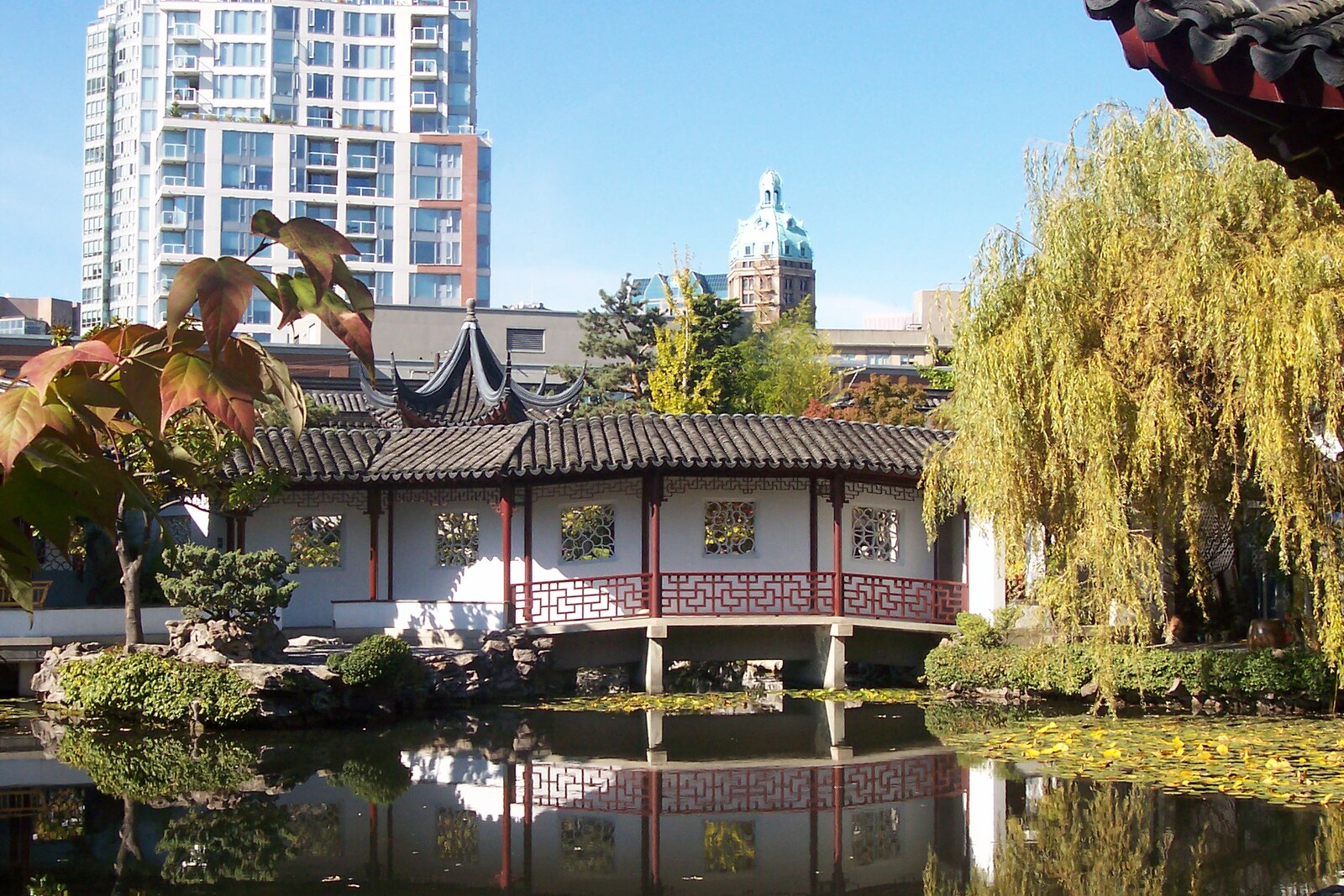
Look around first
What to notice
- The white dividing wall
- The shared pond
- Pavilions with tiled roofs
- Stones from Lake Taihu
The story of the place
A white wall runs through this block, but water from the shared pond passes beneath it from the city park into a quiet garden with pavilions and tiled roofs. The city manages the open part of the green site, while a nonprofit society created to support it is responsible for the smaller, ticketed part. Both belong to the Chinese Cultural Centre of Greater Vancouver, which contains a museum, an archive, educational spaces, a performance hall, and a restaurant. The centre occupied a former industrial block given to the local Chinese community after the freeway through Chinatown was abandoned.
In the spring of nineteen eighty-five, seventy containers were delivered to this block. Inside were beams made in China, carved latticework, roof tiles, river pebbles, and stones from Lake Taihu. More than fifty carpenters, stonemasons, roofers, painters, and makers of artificial rocks arrived from Suzhou after the cargo. They lived in Vancouver for thirteen months and began assembling the garden with hand tools, joining wooden parts without screws or glue.
Vancouver architect Joe Wai and landscape architect Don Vaughan sought a full-scale scholar's garden from the Ming dynasty, rather than a collection of Chinese ornaments among local flower beds. Wang Zu-Xin, the chief designer on the Suzhou side, was responsible for the traditional arrangement of pavilions, courtyards, water, and stones. At the same time, Canadian architects had to get this structure through local building codes. The Chinese carpenters preserved mortise-and-tenon joints, while Wai and Vaughan looked for ways to meet strength and safety requirements without replacing the old technique with an ordinary modern frame.
The garden appeared on this site specifically as an extension of the Chinese Cultural Centre of Greater Vancouver. The centre was founded in nineteen seventy-three with the support of dozens of local societies: one of Vancouver's largest Chinese communities had nowhere to hold classes, exhibitions, and celebrations together or to keep its own archive. After the project for a freeway through Chinatown was cancelled, the city allocated a former industrial block for the centre. The architectural competition program immediately provided for classrooms, a museum, a performance hall, a restaurant, and a garden. Revenue-generating spaces were needed to support the rest of the centre.
With the classical garden, the expenses proved even more serious. It had to be built not only from imported materials, but then constantly repaired, painted, and protected from Vancouver's dampness. The organizers divided the green part of the block in two. They transferred the larger park to the city parks department and made it free. The smaller garden, where the Suzhou craftspeople worked, became a ticketed museum; it is still managed by a nonprofit society created to raise money for construction. A single pond connected the two halves.
The name Sun Yat-sen was chosen during the work itself. Sun was a doctor who became an organizer of the movement to overthrow the last Chinese dynasty, the Qing dynasty. In nineteen eleven, he came to Vancouver, spoke before Chinese associations here, and raised money for an uprising. After the fall of the dynasty, he was elected the first provisional president of the Republic of China. For the centre's founders, he was a person known to different parts of the Chinese diaspora and whose history had directly passed through Vancouver's Chinatown.
By the opening of the nineteen eighty-six World's Fair, the Suzhou craftspeople had completed the first full-scale classical Chinese garden outside China. The centre now contains a museum, an archive, and educational spaces, while the garden hosts tours, exhibitions, concerts, and celebrations. The white wall still separates the free city park from the ticketed garden; water from the shared pond passes beneath it.
Useful on site
Classical Garden: Tuesday–Sunday 09:30–16:00, last entry 15:30. Sun Yat-sen Park next door is free.
Checked: June 28, 2026. Check the official source before visiting.Plan a visit to the classical garden separately; if you do not go inside, do not try to substitute entry with a look through service passages.