 Guide On Map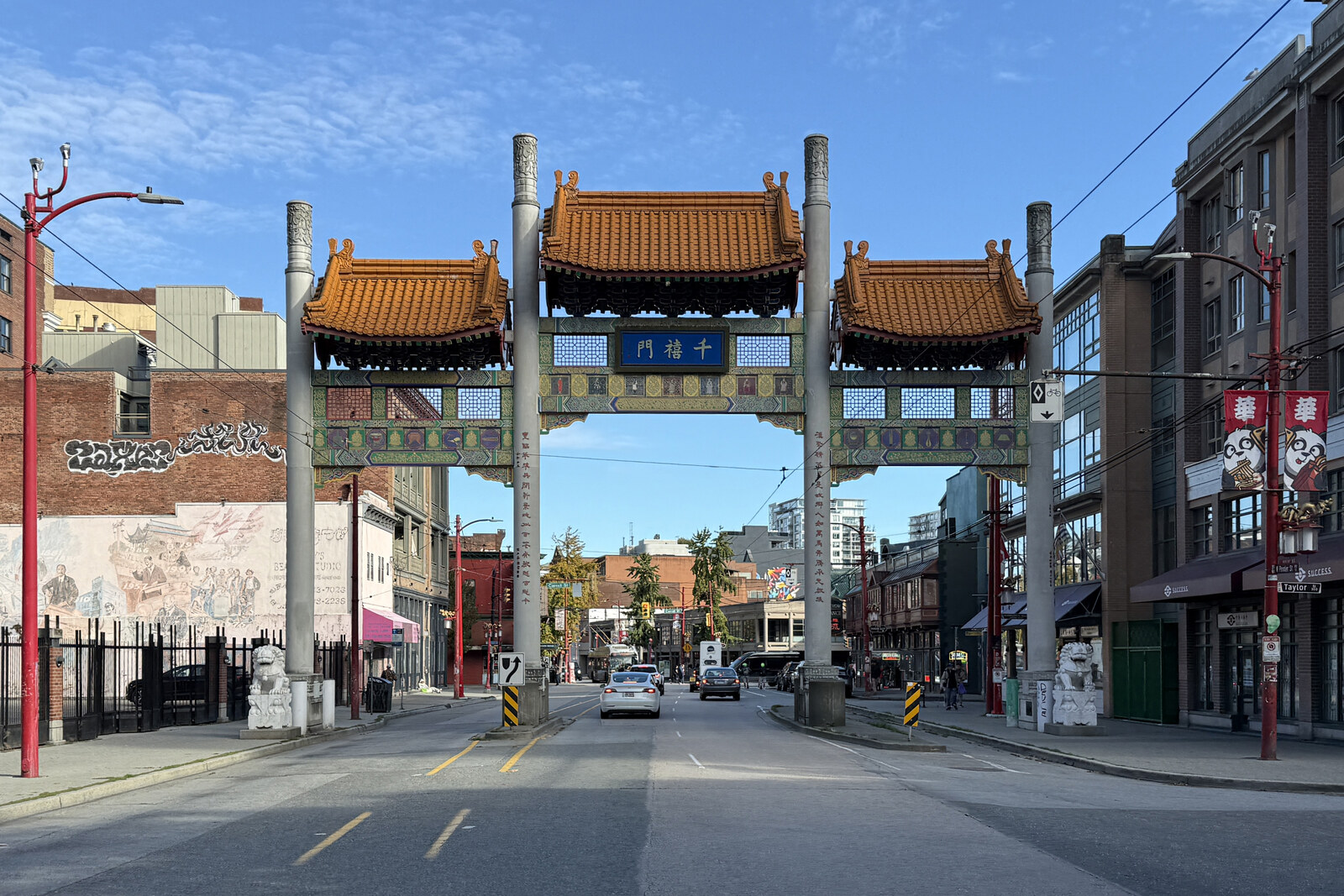
Look around first
What to notice
- Four red supports
- Three passageways over Pender Street
- Roofs with ceramic tiles
- The inscription on the eastern side
The story of the place
A gate with four red supports and three passageways stands over Pender Street; buses and bicycles move through it below. Its traditional Chinese silhouette is assembled from concrete, steel, fiberglass, and vinyl, and the only genuine imported ceramic here is the roof tile. The inscription on the eastern side invites people to remember the past and look ahead, and after the work was completed, the gate passed to the city.
In the late nineteen nineties, Vancouver’s Chinese business and community organizations saw a new neighbor at Chinatown’s western boundary: International Village, a retail and entertainment complex. People could leave it, turn toward downtown, and never realize that the old Chinese quarter began across the street. The Chinatown Historic Area Planning Committee decided to install a permanent gate here: it was meant to lead visitors from the intersection of Taylor Street and Pender Street farther east, toward the neighborhood’s shops and institutions.
This was not the first attempt. About ten years earlier, the local Lions Club had already proposed a permanent arch, but failed to raise the money. In nineteen ninety-nine, the approaching new millennium opened access to special government grants. Representatives of merchants, the Chinese Cultural Centre of Greater Vancouver, the Chinese Benevolent Association of Vancouver, the Dr. Sun Yat-Sen Classical Chinese Garden, and other organizations created the Vancouver Chinatown Millennium Gate Society. The society owned no property: its sole task was to raise money and see the construction through to completion.
About three hundred people attended a charity dinner. In one evening, they gave about twenty-five thousand dollars; together with donations from residents, companies, and associations, the community raised one hundred ninety-three thousand five hundred. The city, the province, and the federal government promised the rest. That is how the name arose: Millennium Gate, the “Gate of the Millennium.” It opened after the round date, in two thousand two.
The local architect Joe Wai was commissioned to create four supports and three passageways in the proportions of a classical Chinese gate. With that design, the central supports would stand directly in the roadway of Pender Street. Jack Chow, the owner of a nearby insurance office, depended on clients who came to Chinatown and demanded that the project be discussed. He was concerned about the gate’s location and the loss of one traffic lane.
The society invited a feng shui specialist, and after the review Wai made minor changes. They handled the lane differently. Engineers preserved bus and bicycle traffic and added six parking spaces, but they did remove one westbound traffic lane. The four supports before your eyes show the decision made then: to achieve the gate’s classical proportions, people had to reshape the street itself.
Construction then nearly stopped because of a city requirement. Officials wanted a bank guarantee of five hundred thousand dollars—in case the society abandoned the work and the unfinished structure had to be dismantled. The bank would not provide that amount: the society had no assets, and the gate itself, as the city report cautiously stated, had no resale value. Community representatives secured a reduction of the guarantee to fifty thousand. The council agreed, construction was authorized, and after the opening the city took the structure onto its books.
The Chinese antiquity here lies in the form. The load-bearing parts are made of modern concrete and steel, the decorations of fiberglass and vinyl; only the ceramic roof tiles were brought from China. The gate’s name is written on the western side, and on the eastern side: “Remember the past and look to the future.” Buses and bicycles still pass beneath this inscription, while motor traffic narrows to the lane Jack Chow tried to preserve.
Useful on site
Accessible at all times as part of the street.
Checked: June 28, 2026. Check the official source before visiting.View the gate from the street; choose a spot away from the main flow and do not linger in the passageway.