 Guide On Map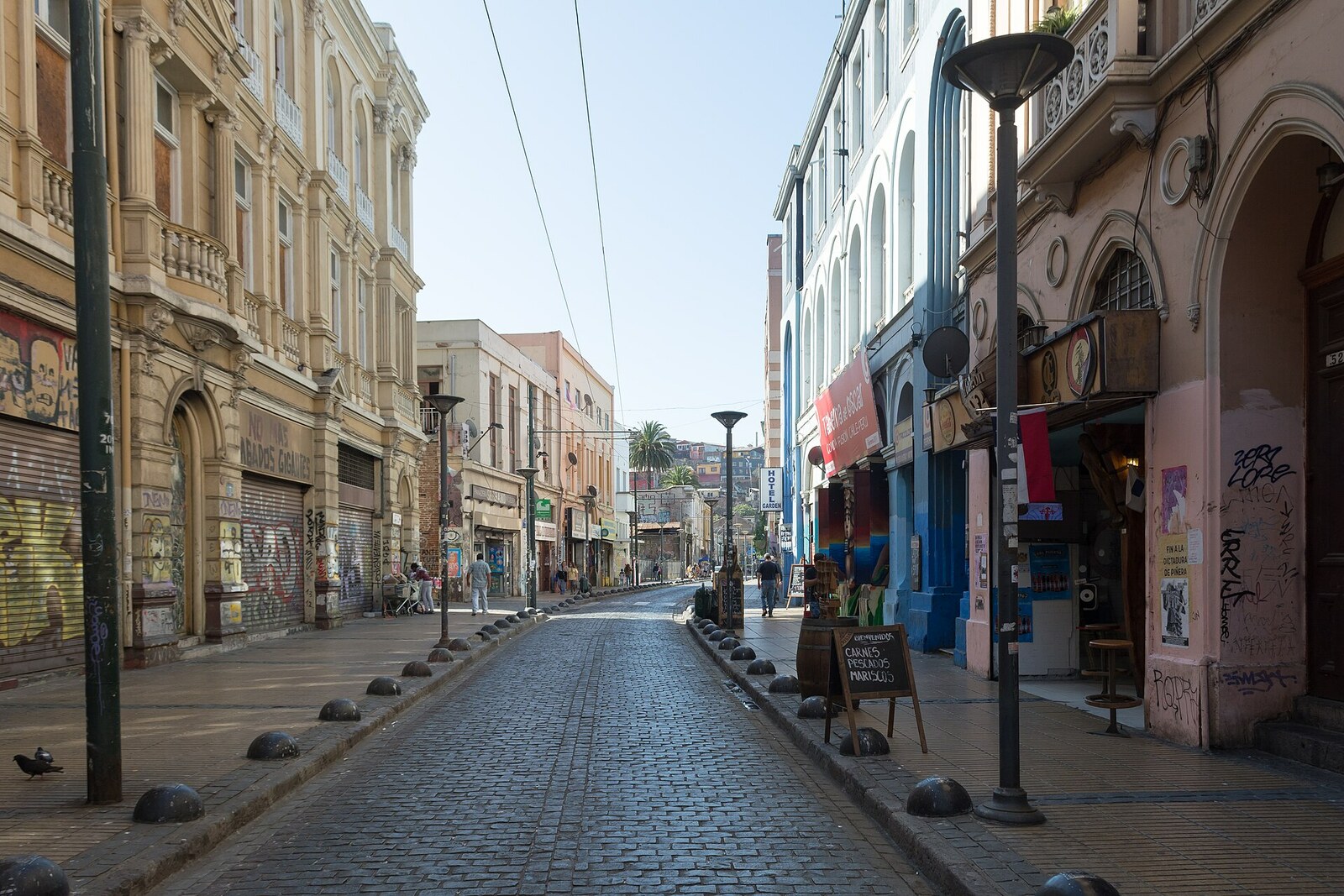
Look around first
What to notice
- Shops on the ground floors
- Residential stories above the shops
- White marble plaque
- Four names on the memorial
The story of the place
Serrano Street (formerly La Planchada) remains a commercial street today. Its old houses were designed for this: shops below, homes above. In the nineteenth century, what is now Serrano Street (formerly La Planchada) was called La Planchada. It ran parallel to the shore, linking the customs house with the arsenal. Merchants settled where goods and customers passed through; wealthy families built two- and three-story houses, and later builders pushed the sea back with landfill.
After the War of the Pacific, the street was named after the Chilean naval officer Ignacio Serrano. In May eighteen seventy-nine, during the Battle of Iquique, he commanded the guns of the corvette Esmeralda. After the death of its commander, Arturo Prat, Serrano gathered twelve sailors and, at the next ramming strike, led them onto the deck of the Peruvian ironclad Huáscar. He tried to jam the turning mechanism of the gun turret. Serrano was seriously wounded; Peruvian sailors carried him to a cabin, a doctor treated him, but the lieutenant died of blood loss. His detachment was defeated, and the attempt to capture the ironclad failed. It was for this deed that the surname Serrano appeared on the street signs.
The street's most serious story began early in the morning of the third of February two thousand seven. Firefighters reported a leak to the gas company Gasvalpo and a power outage to the energy company Chilquinta. A resident of one of the houses, Avelina Pozo Muñoz, also called the energy company and reported that the lights had gone out.
Gasvalpo workers found the leak and discovered an energised cable beside the gas pipe. It was dangerous to continue digging, so they called Chilquinta employees to de-energise the line. However, the gas and electricity supplies were not cut off in time.
The damaged cable formed an electric arc. Red-hot metal burned through the polyethylene gas pipe. Gas traveled through the old cast-iron network along the street, entered through cracks into the basements of houses number three hundred ninety-two and three hundred ninety-eight, and accumulated there. The investigation did not establish exactly which spark was the final one. At about half past eight, an explosion occurred, followed by a fire. Four buildings were destroyed, and several more were damaged.
Avelina Pozo Muñoz and her son Aldo Ayala, Yvonne Castro, and fifty-nine-year-old Eliseo Páez, who earned a living polishing shoes, were killed. More than forty people were injured. Those affected sought compensation for eight years. In two thousand fifteen, a civil court found Gasvalpo and Chilquinta responsible for the faulty condition of the underground networks and for failing to eliminate the danger in time.
A memorial with a white marble plaque stands at number eight hundred twelve. Four names are engraved on it; Avelina, who called the energy company herself that morning, is listed beside her son Aldo.
Useful on site
Open as a city street; it is better to walk here during the day and not linger for long near closed façades.
Checked: June 24, 2026. Check the official source before visiting.Look at the buildings from the opposite side of the street, and do not go behind the barriers around hazardous or vacant sections.