 Guide On Map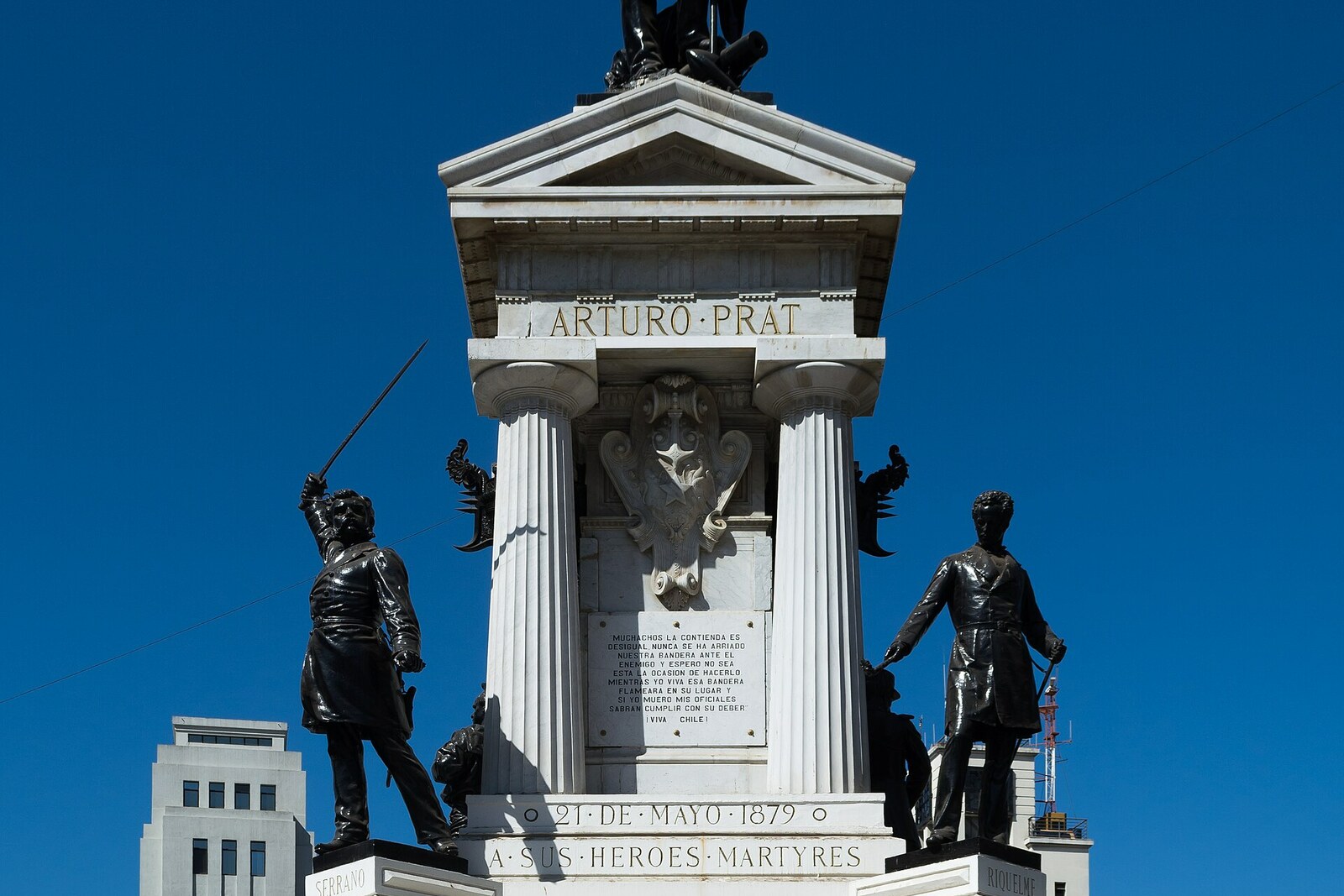
Look around first
What to notice
- Bronze figure with a saber
- The monument’s pedestal
- The Navy High Command building
- The square in front of the monument
The story of the place
A dark bronze figure holding a saber crowns the monument, and beneath its pedestal is a crypt containing the remains of twenty-two participants in naval battles. The monument and open square occupy the site of the city’s stock exchange; residents and businesspeople of Valparaíso raised the money for its construction. Chilean Navy High Command is now housed in the former provincial administration building, so the square remains the city’s main site for naval ceremonies.
On May twenty-first, eighteen eighty-eight, three coffins were brought here. They contained Captain Arturo Prat of the Chilean Navy, Lieutenant Ignacio Serrano, and Sergeant Juan de Dios Aldea of the naval artillery. That morning, the coffins arrived from Iquique aboard the armored ship Huáscar—the very ship on whose deck these men had received fatal wounds nine years earlier.
Prat commanded the wooden corvette Esmeralda, which was blockading the Peruvian port of Iquique during Chile’s War of the Pacific with Peru and Bolivia. On May twenty-first, eighteen seventy-nine, Esmeralda was attacked by the far more powerful Peruvian Huáscar. When the armored ship first rammed the corvette, Prat tried to board it. Aldea and another sailor managed to jump after the captain. Prat was shot on Huáscar’s deck, and Aldea was fatally wounded. At the next collision, Serrano boarded the armored ship with a group of sailors; he too was wounded and died. After the third strike, Esmeralda sank.
The Spanish merchant and volunteer firefighter Eduardo Llanos, together with other residents of Iquique, secured the burial of the dead at the local cemetery. This made it possible to preserve and later identify them. Huáscar itself was captured by the Chilean Navy a few months later. In eighteen eighty-eight, the former Peruvian armored ship carried the remains of the people killed while attempting to capture it.
President Aníbal Pinto signed the decision to erect a monument to them as early as September eighteen seventy-nine. The document specified neither a location nor a source of funding. Residents and businesspeople of Valparaíso wanted the monument for their port and raised one hundred sixty thousand gold pesos. The construction site was occupied by the city’s stock exchange. The monument was unveiled in eighteen eighty-six, and two years later a funeral procession passed through Valparaíso and ended here, at its crypt.
The square is named for Rafael Sotomayor Baeza, a civilian minister whom the government sent to oversee preparations for the military campaign. In March eighteen seventy-nine, he sailed north from Valparaíso and took naval officer Arturo Prat with him as his secretary. Sotomayor was responsible for troop transport and supplies in the desert; it was he who chose the port of Pisagua for a landing between enemy forces in Iquique and Tacna. In May eighteen eighty, the minister died of a brain hemorrhage in a field camp, six days before the Battle of Tacna. After his death, the square was named after him; a mausoleum for sailors from the same war was later built there.
Today, a bronze Prat holding a saber stands atop the monument, and the crypt contains the remains of twenty-two participants in the battles of Iquique and Punta Gruesa. Chilean Navy High Command occupies the former provincial administration building, and the square serves as the city’s main site for naval ceremonies. Every May twenty-first, the parade ends at the crypt: wreaths are laid above the three coffins that the procession brought here in eighteen eighty-eight.
Useful on site
Open as a square; separate interior spaces, the crypt, and underground sites can be visited only with special access or during events.
Checked: June 24, 2026. Check the official source before visiting.The underground archaeological remains are not permanently visible from the square, so do not plan the stop around a mandatory visit to the exhibition.