 Guide On Map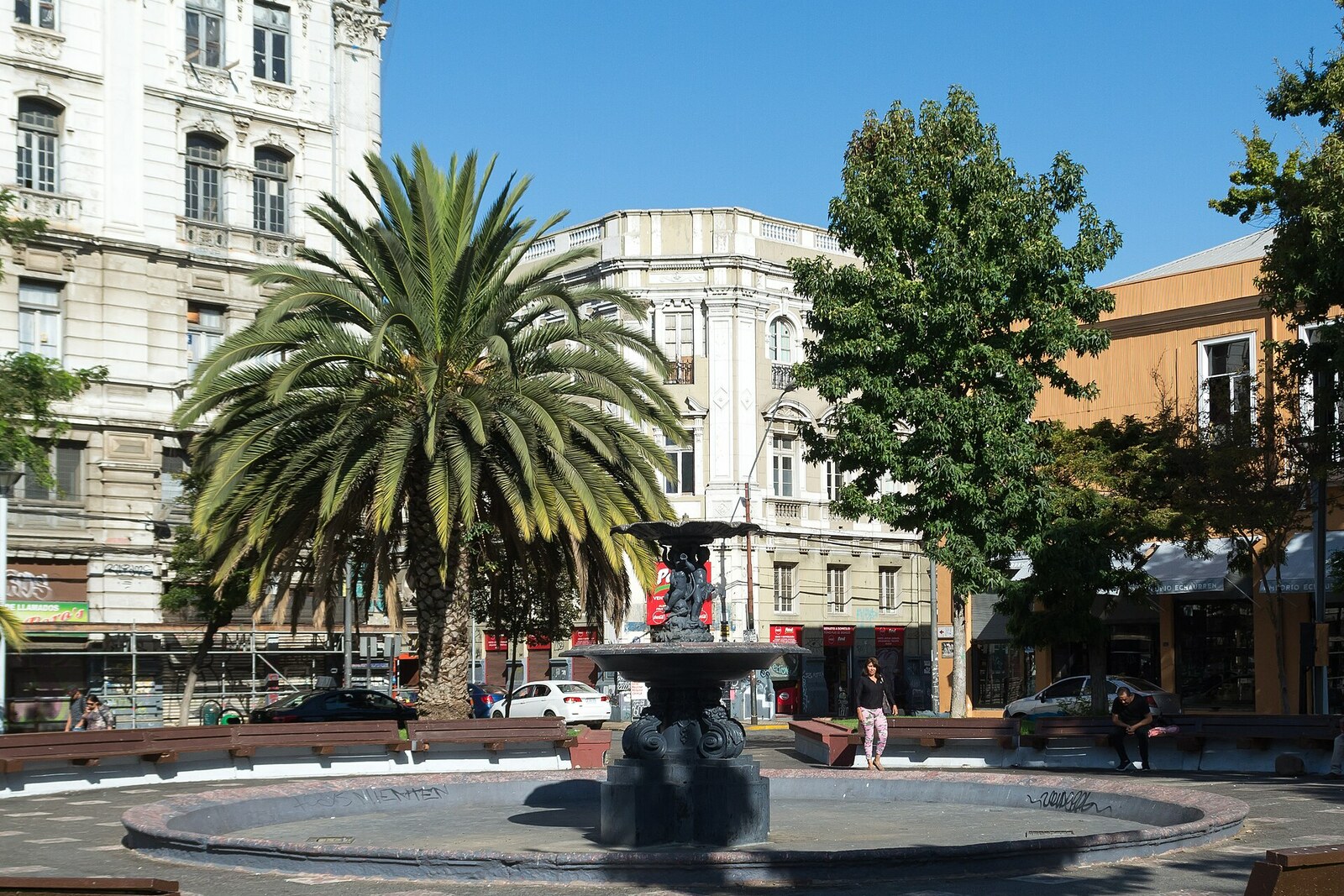
Look around first
What to notice
- Fountain
- Palm trees
- Concrete barriers
- Stone facades
The story of the place
Among the stone facades, there is a small garden here with palm trees, a fountain, and low concrete barriers. The square acquired this appearance after a reconstruction completed by nineteen forty-one. The former layout disappeared after a severe earthquake, while the name preserves the memory of a man involved in shaping Valparaíso.
The present fountain stands approximately where the shoreline once ran. The sea reached this part of Valparaíso, and people came ashore here from boats, unloaded goods, and transferred them onto carts. That is why the city’s first square was at once a landing place, a market, and the place where the municipal government met. By the middle of the nineteenth century, it was called Municipal Square.
Between the water and the slopes lay a narrow strip of level ground. Trade was growing, stone houses were being built around it, while the streets retained their old bends and cramped width. The provincial intendant Francisco Echaurren, responsible for administering Valparaíso, pressed the municipality to widen streets with every reconstruction. If a new permanent building were allowed along the old line, its walls would preserve that crampedness for decades.
In February eighteen seventy-three, the owner Raimundo Clausen planned to replace his house on Municipal Square. Echaurren demanded that a strip of Clausen’s plot be set aside to widen the square itself and the two neighboring streets. For Clausen, it was land on which he intended to build. For the intendant, it was a rare opportunity to make space without demolishing a newly erected building. He warned that otherwise the streets would remain narrow and winding forever, and residents and city services would suffer as a result.
The minister of the interior refused Echaurren’s request: the municipality could not take private land without a special expropriation law. On that occasion, it was not permitted to take the strip from Clausen. Echaurren had proposed taking such a law through Congress even earlier, but plot owners objected to the numerous expropriations, deputies debated for a long time, and municipal councilors disagreed over who should set the width of each street.
Echaurren continued to halt individual building projects and demand a new line for the facades. The law for the transformation of Valparaíso was passed only in December eighteen seventy-six. It set street widths, the procedure for expropriations, and rules for new buildings. By then, Echaurren had already left office. At the end of his six-year administration, the municipal councilors resolved to rename the former Municipal Square Francisco Echaurren Square, in memory of his work for the city.
The fountain, palm trees, and concrete barriers appeared later. The earthquake of nineteen six severely damaged the old square, and its present garden-like appearance took shape after the next reconstruction, completed in nineteen forty-one. No recognizable layout remains from the square of Echaurren’s time. What remains is the surname of the man who, right here, tried to cut a strip of land from a private plot so that a future stone wall would not leave the square as cramped as before.
Useful on site
Open as a city square; the route is intended for daylight hours.
Checked: June 24, 2026. Check the official source before visiting.Take in the space from the edge of the square, without obstructing trade or traffic. It is best not to take out valuables unless necessary.