 Guide On Map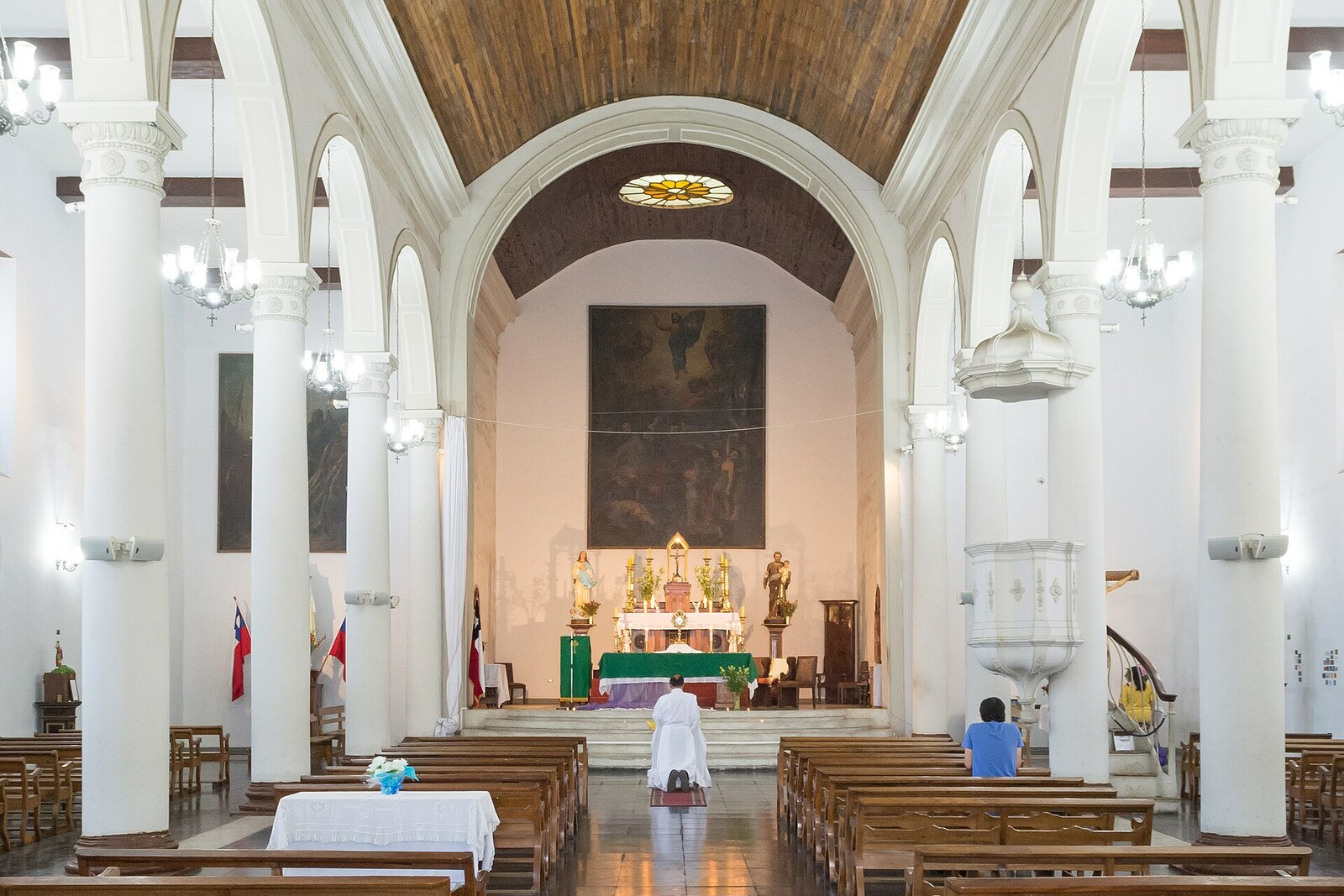
Look around first
What to notice
- Church facade
- Square in front of the church
- Neighboring streets
The story of the place
Behind the facade of La Matriz Church stands the fourth church to have risen on this patch of harbor. A chapel of clay and straw once gathered the port's first residents around it, before the streets here had time to be planned. The word Matriz refers to the original, mother parish. The nearby square preserves the name of the Dominican monastery that once stood behind the church; the monastery itself has long been gone, while the streets of the old harbor still spread out around it.
In September eighteen sixty-eight, the new parish priest Mariano Casanova held an election in Valparaíso for a heavenly patron. Casanova had been sent here as parish priest and district vicar—a church judge representing the archbishop. He wanted to bring parishioners back to the churches and was already considering leaving his post: the city had received him with hostility, and a sore throat did not exempt him from delivering five Sunday sermons in a row.
The dispute concerned the full name of the church facing the square. When the city parish was divided, the church was assigned the Savior of the World as its patron. Yet since the eighteenth century, residents had venerated Our Lady of Mercy of Puerto Claro here. Her image stood at one of the altars, and old city council decisions named her, specifically, as the patron. Casanova decided that the faithful themselves would provide the answer.
The city council objected: in its view, the matter had already been settled in favor of Our Lady. Protestants and other residents who did not belong to the Catholic Church suspected that, under the guise of a vote, the parish priest wanted to count the Catholics. Casanova nevertheless ordered tables to be set up at the entrances to several city churches. Votes were accepted on the third, fourth, fifth, and sixth of September.
On the tenth of September, the counting commission announced the result. Nineteen thousand nine hundred forty-six people chose the Savior of the World. Our Lady of Mercy received four thousand one hundred thirty-two votes, and other saints received three hundred eighty-four. In all, twenty-four thousand four hundred sixty-two ballots were cast.
Five days later, the results were announced here. According to an account in a newspaper of the time, people filled the church, the square, and the neighboring streets. More than thirty priests gathered in the altar area, and more than twenty choir singers performed a hymn of thanksgiving. The Savior of the World became the patron of the parish and of Valparaíso, and August sixth was designated as his city holiday.
The word “Matriz” in the name is older than this vote. It refers to the original, mother parish: the first chapel here, made of clay and straw, was built in fifteen fifty-nine, and the harbor's first residents settled around it before the streets here had been laid out in advance. The present building is the fourth church on this site; it was completed in eighteen forty-two, so the people taking part in the election entered the very church that stands here now.
Santo Domingo Square took its name from the Dominican monastery that stood behind La Matriz Church. After the expulsion of the Jesuits, their property was transferred to the Dominicans—the Dominican Order founded by the Spanish preacher Saint Dominic de Guzmán. The monastery by the square is no longer there. The voting tables have disappeared too, but the words “Savior of the World” in the church's full name remain the result of that count, which once filled the church, the square, and all the neighboring streets with people.
Useful on site
Accessible from outside as an urban space; the interior opens irregularly, usually during services, parish events, and heritage days.
Checked: June 24, 2026. Check the official source before visiting.Plan primarily to view the exterior: entry may depend on a service or event. During worship, do not disturb parishioners.