 Guide On Map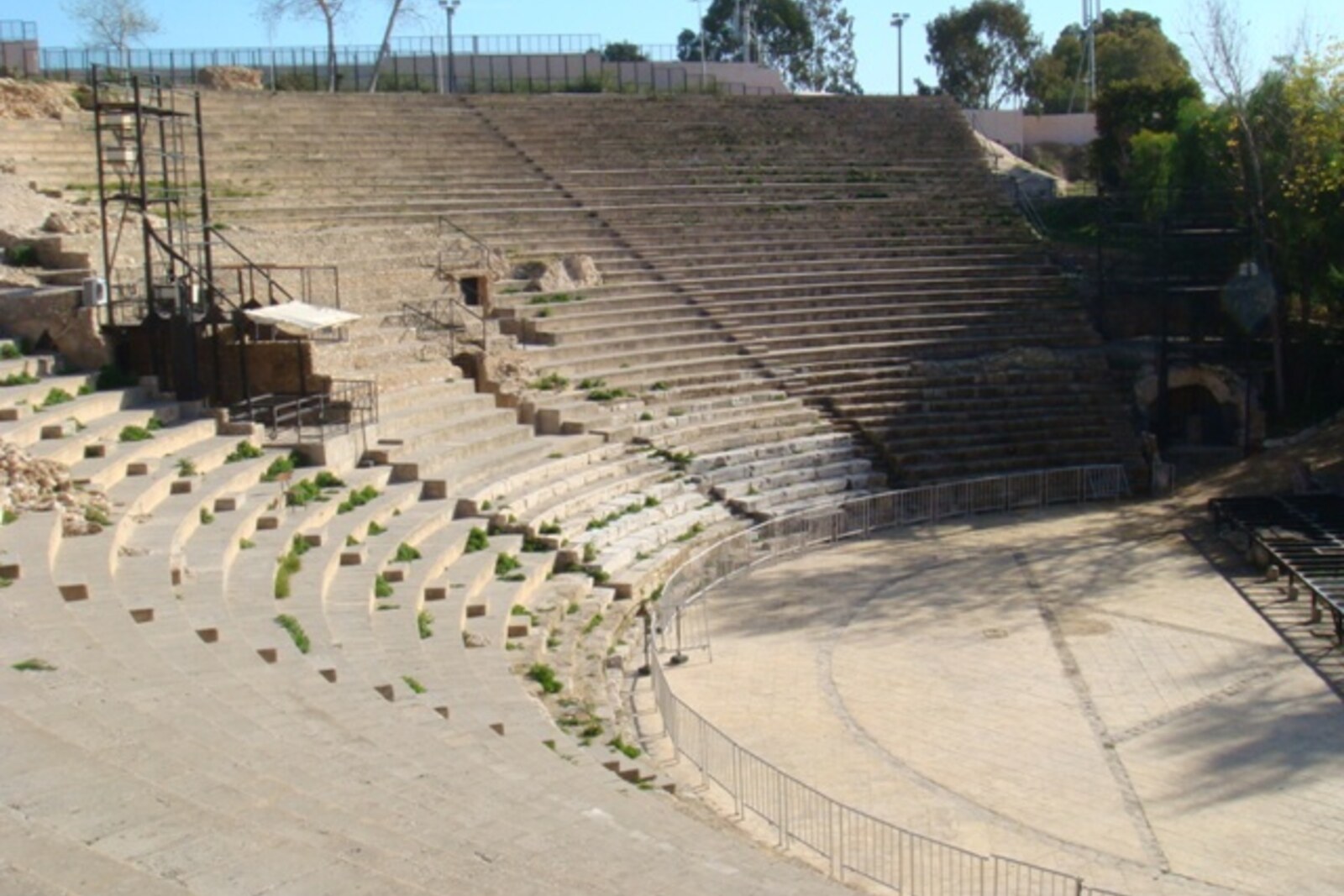
Look around first
What to notice
- Remains of the stage
- The semicircle of the orchestra
- The lower rows of ancient seats
- Reconstructed stands
The story of the place
The semicircle by the stage once held about ten thousand people, and these seats drew more than just lovers of spectacle: people came here to hear lectures and to watch mimes, tragedies and comedies, dancers, jugglers, and tightrope walkers. Columns and covered galleries framed the stage, and before it lay the orchestra with a marble floor and a wooden platform. Archaeologists found the ancient lower rows and the remains of the stage beneath a deep layer of earth; the broad stands around them appeared much later. Now, in summer, they are again filled by the International Festival of Carthage.
In the second half of the second century, Apuleius stepped onto the stage of this theatre, barely able to support himself on an injured leg. A Platonist philosopher and professional orator, he returned to the Carthaginian audience to explain his absence and thank the townspeople for the highest honor of his career: a decree for a public statue.
Apuleius grew up in Madaurus, a city in what is now Algeria. His father left him and his brother a large fortune; Apuleius substantially reduced his share through long years of study and travel. In Carthage, he studied rhetoric, then continued his education in Athens and Rome. His inheritance paid for that life, while he earned his standing in society through books and speeches. In that era, a celebrated orator could fill a theatre just as an actor or tightrope walker could.
Apuleius's previous appearance was interrupted by rain. He promised to finish the speech the next day, but afterward injured his leg in the gymnasium. The joint had to be set; pain and exertion brought him out in a sweat, followed by chills and abdominal cramps. By Apuleius's own account, he nearly died. For several days, he received treatment in the Persian Baths and did not appear before his listeners.
During his absence, the former consul Aemilianus Strabo, Apuleius's former fellow student, submitted a proposal to the city council to erect a statue of the philosopher in a prominent place. Strabo sought official recognition for a man whose speeches were already known in Carthage. The council unanimously approved the proposal and allotted a site, while Strabo himself promised to pay for the bronze and the craftsman's work.
Apuleius still could not walk properly when his treatment enabled him to reach the theatre. To miss the appearance would have meant leaving his broken promise unexplained at the very moment when the townspeople were deciding whether he deserved a public honor. From the stage, he spoke of his illness, thanked Strabo, the council, and the listeners, and stressed that he had not asked for the statue himself. He then promised to set his thanks down in writing so that they would spread through the provinces.
Such a speech required a theatre. In Roman Carthage, this place held about ten thousand people. Apuleius listed the familiar activities of this stage: mimes, comedies, tragedies, dancing, jugglers, tightrope walkers, and philosophical lectures. He described a marble floor, a wooden platform, the columns of the stage facade, covered galleries, and rows of seats. Public reputation was made before this entire semicircular audience.
Only a small part of that setting has survived. Archaeologists found the remains of the stage, the orchestra, and the lower rows beneath a layer of earth several meters deep; by the spring of nineteen oh six, people had begun staging performances here again. Most of the present stands were built during later reconstructions, and since nineteen sixty-four they have been filled by spectators at the International Festival of Carthage. The fate of the statue promised to Apuleius is unknown. His speech survives in the collection Florida, along with a list of boards, columns, and roofs that are no longer there before the present stage.
Useful on site
Included in the Carthage combined ticket; access may be restricted during festivals and installation work.
Checked: June 28, 2026. Check the official source before visiting.Remember that the visible appearance has been substantially reconstructed; during festival preparations, access to the stage or seating rows may be restricted.