 Guide On Map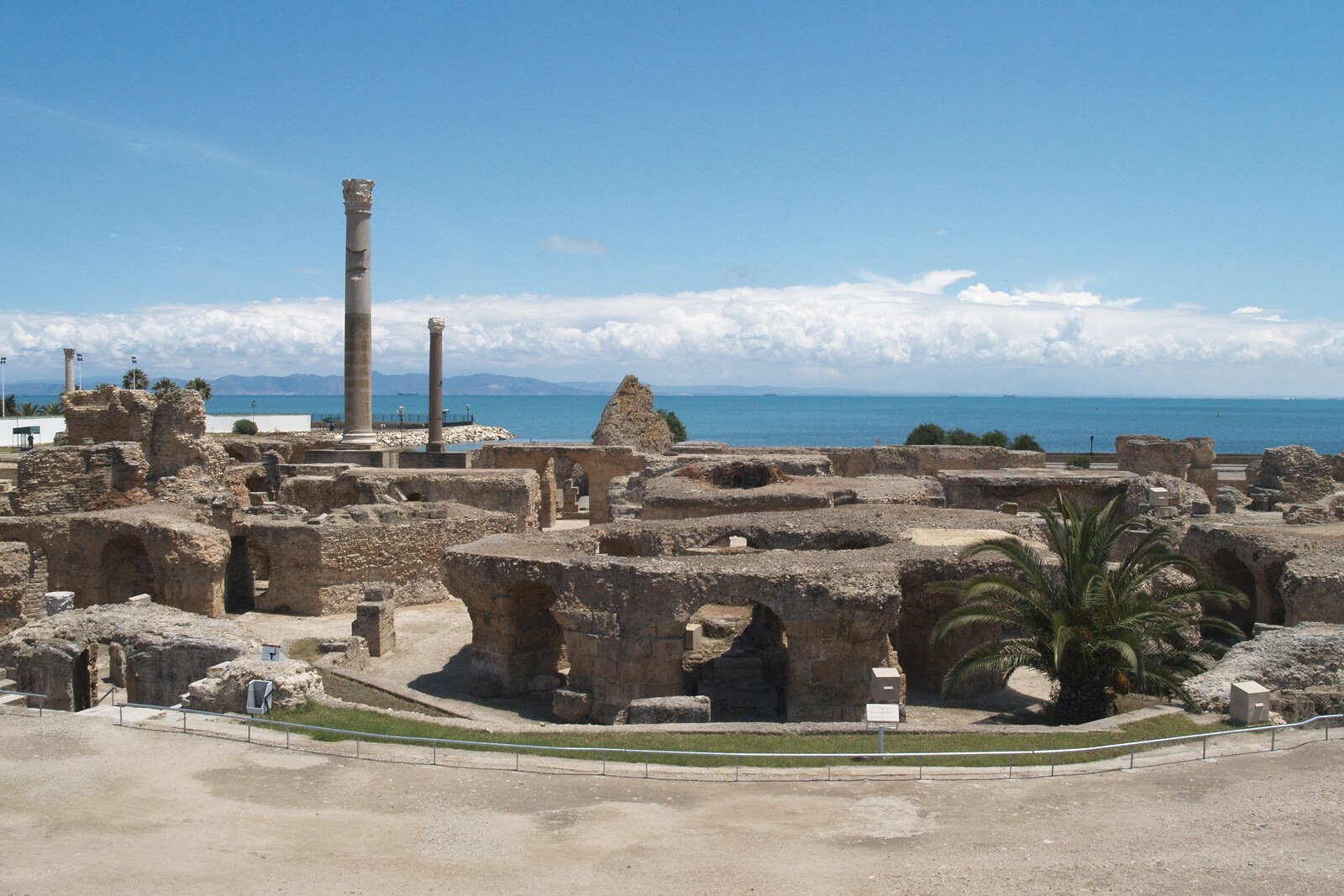
Look around first
What to notice
- Lower vaults
- Service passageways
- Reconstructed column of the cold hall
The story of the place
At Carthage's seaward edge stand the ruins of baths that occupied four city blocks left empty after a fire. Here residents rested and met, moving from changing rooms through warm and hot rooms, a cold hall, and an open-air pool; exercise areas and latrines stood nearby. A reconstructed column rises above the low walls, recalling the main halls that are no longer here. Water was brought here from the springs at Zaghouan via the long Zaghouan Aqueduct and collected in cisterns above the baths.
The low vaults and passageways have survived because ancient visitors to the baths almost never came down here. On this level, attendants stored fuel, tended the furnaces, and brought in water. The halls with pools were one level above and have disappeared. The fifteen-meter column raised above the ruins stood in the cold hall among seven similar supports; the cold hall's area was comparable to that of a large cathedral.
Before the baths, a residential quarter stood by the shore. After a fire, four empty city blocks were taken over for a public complex. The leaders of Carthage wanted to provide the capital of the Roman province of Africa with baths on the same scale as those built in Rome itself. Such a construction project required the emperor's consent.
That emperor was Antoninus Pius, the Roman emperor from whom Carthaginian magistrates sought permission and assistance. A dedicatory inscription states that the city built and decorated the baths with Antoninus's permission and thanks to his grants. The work itself was directed by two duumvirs, the city's two chief magistrates. Their names survive only in part on a broken slab.
The seaside site was also chosen to serve the needs of this enormous operation. Engineers supplied fresh water through the Zaghouan Aqueduct from the springs at Zaghouan, about one hundred thirty-two kilometers from Carthage. Large cisterns above the baths received the water and then directed it to the pools. Fuel for the furnaces was delivered from the seaward side. Attendants received it on the lower level and serviced the boilers without crossing the bathers' paths.
Upstairs, a visitor passed through one of two symmetrical sequences of rooms: changing rooms, warm and hot rooms, a cold hall, and an open-air pool. Exercise areas and latrines stood nearby. For residents, these were public baths, a place for rest and meetings; for the people who maintained them, they were a water supply system, furnaces, and constant movement beneath marble floors.
Antoninus Pius died in the year one hundred sixty-one and did not live to see the opening. His adoptive sons and successors, Marcus Aurelius and Lucius Verus, completed the porticoes and outer buildings. The final opening of the baths and the Zaghouan Aqueduct took place in the year one hundred sixty-two. The complex served the city reliably for more than two centuries.
Of the upper halls, a reconstructed column remains; of the service level, the vaults through which visitors now walk. Of the magistrates who directed construction here, fragments of names have survived; of the emperor who gave permission and died before the opening, the name Antonine Baths.
Useful on site
Included in the combined Carthage ticket; AMVPPC publishes the archaeological park's seasonal hours.
Checked: June 28, 2026. Check the official source before visiting.The stone levels and changes in elevation require sturdy footwear; stay on the marked paths and allow time for the view from the seaward side.