 Guide On Map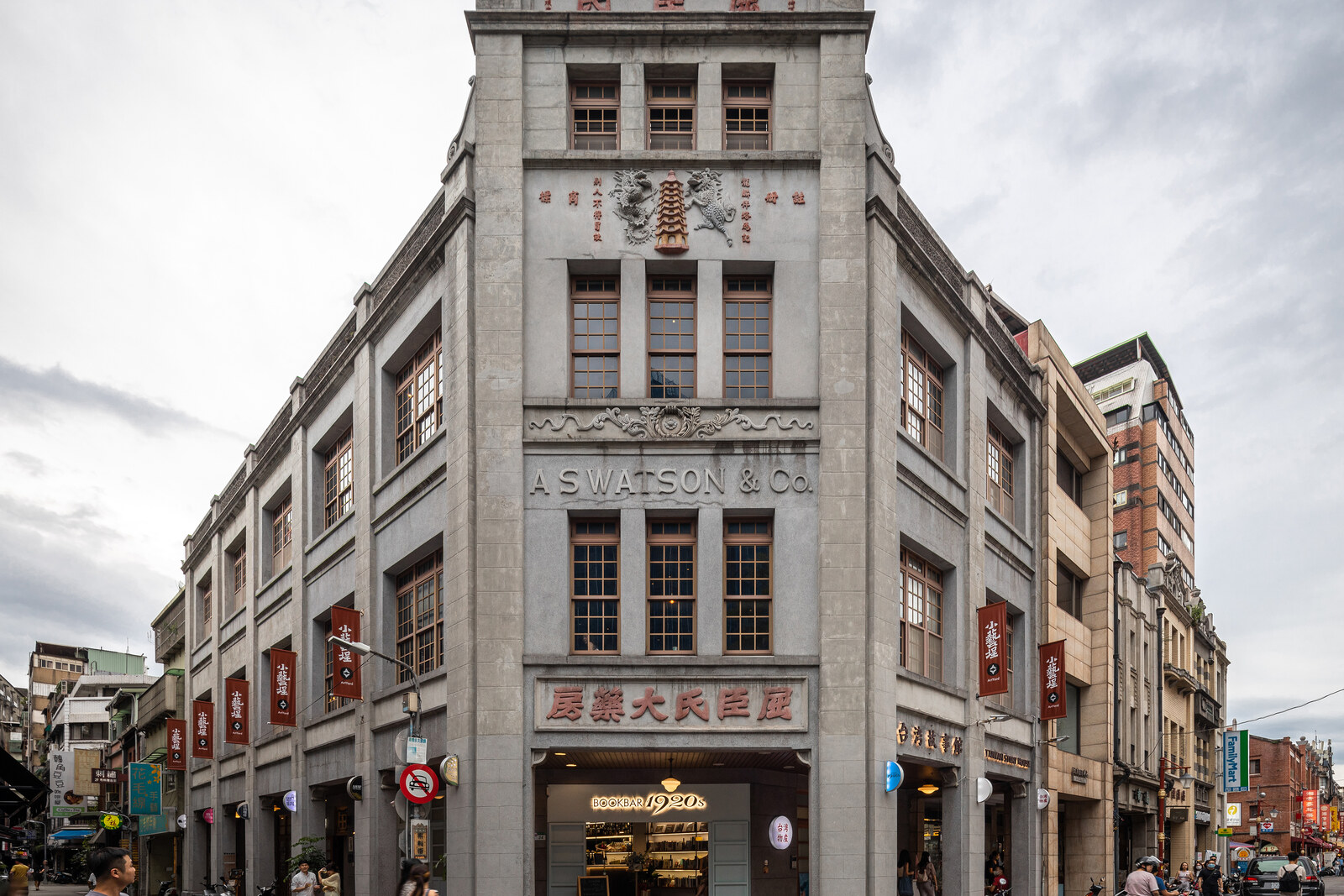
Look around first
What to notice
- The inscription “A.S. Watson & Co.”
- Dragon and qilin
- Seven-tiered pagoda
- The warning “do not imitate others”
The story of the place
In Dadaocheng, river-borne goods did not remain at the wharf: imported Western medicines were taken to Dihua Street, and local wholesalers distributed them among pharmacies across the island. This three-story building housed such a pharmacy; the foreign name on its façade was meant to inspire trust in the medicines in the crates inside. A fire in the late nineteen nineties destroyed the building’s wooden interior, but the exterior walls survived. They were later restored, and small shops, cafés, and venues for cultural events replaced the pharmacy in the building.
On the façade, Li Junqi had his company’s name written twice: in Chinese, “Watson’s Great Pharmacy,” and above it, “A.S. Watson & Co.” On the third floor, he placed a dragon and a qilin on either side of a seven-tiered pagoda. An inscription nearby warns: “The dragon and qilin accompany the pagoda—not to be imitated by others.” In nineteen thirty-four, Li lost a case over the unlawful use of this very emblem.
The Watson on the façade was Alexander Skirving Watson, a British pharmacist. In eighteen fifty-eight, he became manager of the Hong Kong Dispensary, and from eighteen seventy-one the business traded under his name. Watson himself did not run the Taipei pharmacy. Li obtained the right to sell the Hong Kong company’s goods in Taiwan and put the supplier’s name on his own building.
By then, Li made his living from the medicine trade. In Yuanlin, he ran Deshoutang Pharmacy, then moved the business to Taipei and began wholesaling imported Western medicines, including cod-liver oil. He chose a location among the trading houses of Dihua Street: goods arrived here from the river wharves, and from here wholesalers distributed them to shops across the island. The three-story building with its foreign name told customers whose medicines stood in the crates inside.
In nineteen eighteen, Li brought his apprentice Wu Shichuan here. Wu had begun as a teenager in his employer’s pharmacy in Yuanlin, and here he learned to compound proprietary medicines. Wu then opened his own wholesale Shennong Pharmacy nearby and secured the Hong Kong company’s general representation. Li lost the supplier whose name had already been carved into his façade, but he continued to use the emblem with the dragon, qilin, and pagoda.
The Hong Kong company sued. After Li’s defeat, it declared Wu Shichuan’s pharmacy the sole official representative in Taiwan. Wu opened a factory, produced his own stomach powders, cough remedies, and other proprietary medicines, and sold them through pharmacies across the island. Li’s son trained as a pharmacist in Nagasaki, returned here, and continued the family business; over time, however, trade declined, and the premises began to be rented out to tailors, fabric sellers, and restaurant owners.
In the late nineteen nineties, a fire destroyed the building’s wooden interior. The exterior walls with the name and disputed emblem survived. After the building was recognized as a city monument, Li’s descendant, the architect Li Yongchun, restored it; small shops, cafés, and spaces for cultural events now operate inside.
The façade still bears the name of the pharmacist who did not trade here and the warning “not to be imitated by others”—above the door of the pharmacy whose right to that emblem the court did not recognize.
Useful on site
A historic building with modern tenants; access inside depends on the current establishments.
Checked: date not specified. Check the official source before visiting.The main details are outside and above eye level; view them from a safe spot without obstructing movement near the shop.